Monthly Archives: December 2013
Since when is New Year’s Day on January 1st?

The answer: January 1st, 1753. If you live in America or in any other country then part of the British Empire, 1753 was the first year where January 1st was celebrated as the first day of a new calendar year. The Calendar Act of 1751 was the British law which set 1752 as the year of transition from the Julian to the Gregorian calendar for England and its colonies. By that time, the rest of the Western world had already made the transition (although the French would have another go at a different calendar after the French revolution of 1789). Japan’s transition to the Gregorian calendar came much later in 1873, and China made the switch relatively recently in 1929.
Happy Lady Day! March 25th was until 1753 the first day of the new calendar year, and it was then referred to as “Lady Day”, not New Year’s Day. For instance, the day after March 24, 1751 was March 25, 1752. The day after December 31, 1751 was January 1, 1751! So everyone, from the Pilgrims to the early colonists to a young George Washington, were celebrating New Year’s Day as “Lady Day” on March 25th of every year.
Eleven days when absolutely nothing happened in America. What happened on say September 4th 1752? Absolutely nothing. The reason is that, in order to make the transition to the Gregorian calendar at that time, the day after September 2nd 1752 became September 14th 1752. All the eleven days in between, from September 3rd to September 13th, never existed. The next time you are asked to come up with a question at a trivia game, just ask “What day of the week was September 7th 1752?”
Tonight, raise your champagne glass to Alysius Lilius! Alysius Lilius, also known as Guido Lilio, is the man who came up with the calendar that we all use today around the world. Alysius Lilius was an Italian astronomer and philosopher from Ciro, in Calabria. The calendar he invented was proposed to and accepted by Pope Gregory XIII (hence the name Gregorian calendar), who first implemented the new calendar within the Catholic universe in 1582.
March 24th 1751 or April 5th 1752? Do you realize that people in England and its colonies were living on a different day, and for almost three months every year, a different year than people in say France or Spain? When the newspaper in England read March 24, 1751, for example, the Paris newspaper was dated April 5, 1752! No wonder the French and the English were regularly at war with each other — they could not even agree on what day it was!
Winterthur Museum ~ An easy day trip from Washington, New York City, Baltimore, Philadelphia …
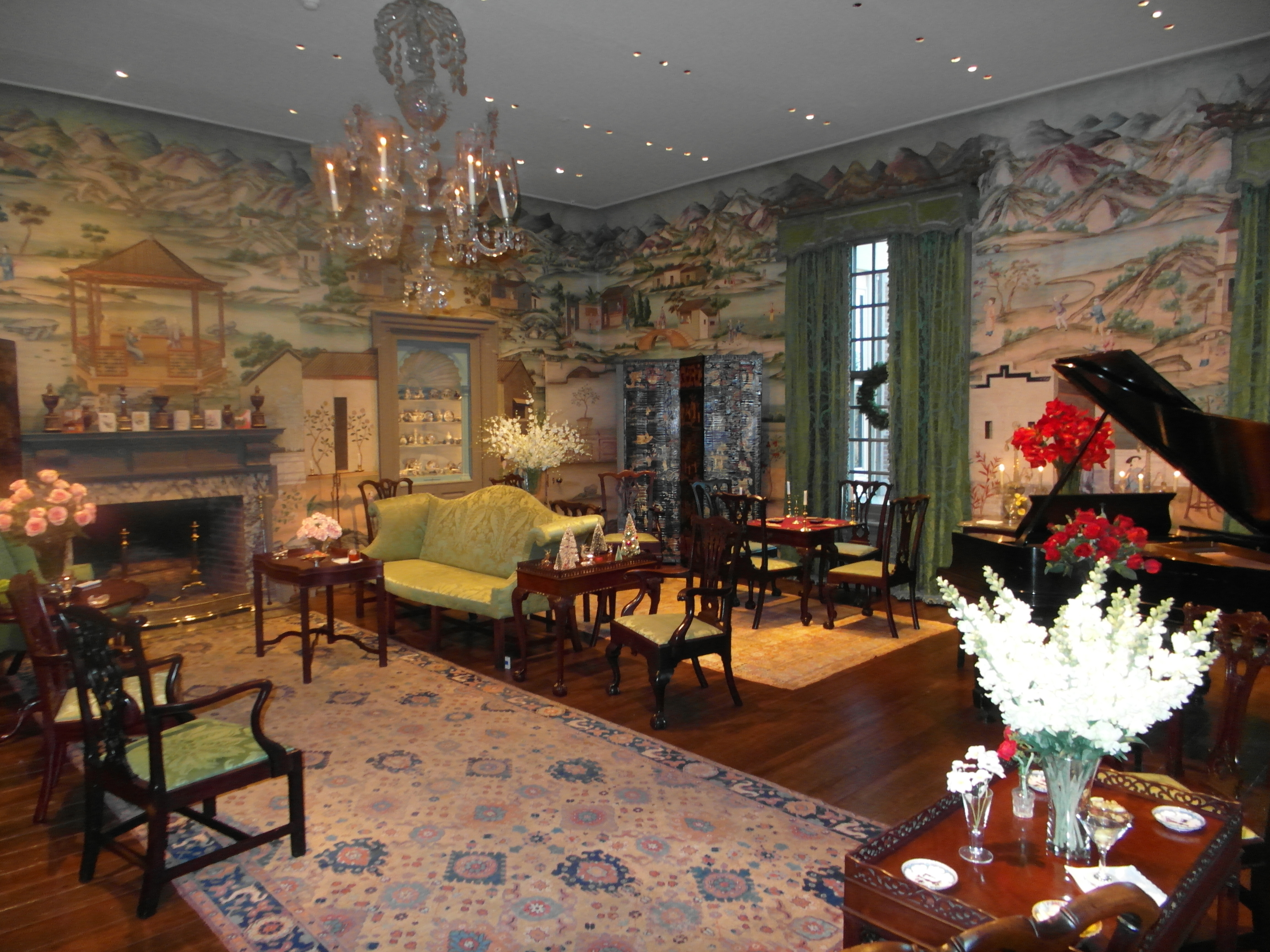
One of the 175 rooms in the Winterthur mansion
Winterthur Museum is the premier museum of American decorative arts and is an easy and worthwhile day trip year-round for people living in the Mid-Atlantic region.
Originally a 60-acre mansion and estate of the Dupont family located within a 1,000 acre preserve of rolling meadows and woodlands, Winterthur (named after the Swiss town of the same name) was transformed into a museum of more than 90,000 objects (furniture, ceramics, etc…) made or used in America between 1640 and 1860 by Henry Francis du Pont, who was born at Winterthur and lived there until his death in 1969. The main house contains more than 175 rooms, and there were at one time more than 90 buildings on the estate, including a farm which provided the food for the residing family, a golf course, tennis courts, multiple gardens, swimming pools, and even a pool with koi fish.
Access: The Winterthur Museum is less than an hour’s drive from Philadelphia, one hour from Baltimore, an easy two-hour drive from Washington DC, and only slightly more from New York City. It is located a few miles off the Route 52 exit (exit 7) of I-95 in Wilmington DE. There is a very large parking lot on the property, as well as a separate handicapped parking area next to the Visitors’ Center. Free trams make a continuous loop to carry visitors between the Visitors’ Center and the main mansion (museum) on the other side of a hill, although it is barely a five minute walk to make the trek by foot via a very well marked and paved walkway. Also departing from the Visitors’ Center, a separate free open-air tram provides a twenty-minute guided tour around the many gardens of the property at regular intervals.

Winterthur Mansion
Tours: It is important to understand that you cannot visit the Winterthur mansion unless you are part of an organized tour. I was quite unaware of that when I showed up at the Visitors’ Center. I had, of course, visited the Winterthur Museum website prior to our trip, and read about the option of reserving one of various listed tours. However, my reaction was that I would prefer to get a feel for the place first and walk around those 175 rooms before committing to any specific tour. I was quite surprised, therefore, to learn that you can only enter the mansion as part of an organized tour group. Fortunately, we were still able to sign up for a “Yuletide” tour when we purchased our entrance tickets at the Visitors’ Center. To the basic $20 Winterthur entrance fee, one must add another $2 to cover the price of the one-hour tour.

Visitors scheduled for the tour at our appointed time were divided up in groups of ten, and guided through a very precise route of approximately thirty rooms in the basement as well as on the fifth and sixth floors of the mansion.
Most of the rooms we toured on the upper floors were relatively small with low ceilings, particularly in comparison to the rooms at Biltmore and the Hearst Castle, two other famous American castles open for touring. However, every room was completely and very tastefully furnished, and exquisitely decorated for Christmas. Of particular note were the many different types of Christmas trees, from a giant twenty feet high majestic Christmas tree in the large solarium to the stunningly beautiful dried flower Christmas tree, the candy Christmas tree, and the very unique peony Christmas tree. Because this was a Yuletide tour, our guide spent most of her time talking about the Christmas decorations and what the Dupont family did at Christmas time. I would have loved to hear more about the incredible collection of furniture on display in all of those rooms (there are separate tours available which focus on the decorative arts in the mansion).
One comment our guide made about furniture related to the first major piece we saw as we began our tour, a Vermont cupboard displaying Staffordshire ceramics. Apparently it is when Henry Francis du Pont saw this pine cupboard in 1923 at the house of Electra Havemeyer Webb in Shelburne, Vermont (now the Shelburne Museum) that he was inspired to start collecting American decorative arts.
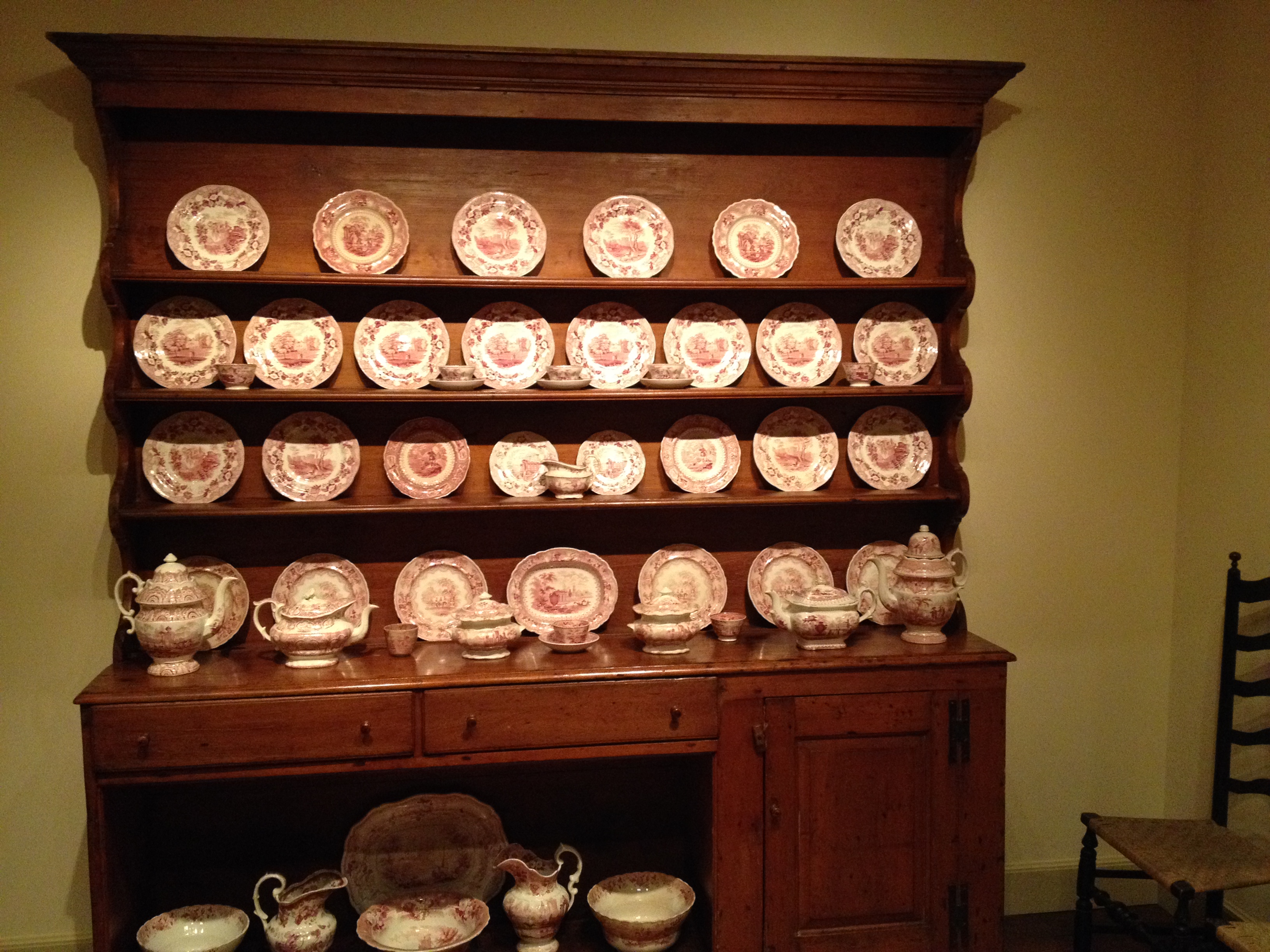
The pine cupboard and Staffordshire ceramics from Vermont
Another comment that our guide made related to the various ashtrays in the main living room. She mentioned that she had asked visiting schoolchildren what those objects were, and none of them knew that they were ashtrays, none of them even knew what an ashtray was! Times certainly have changed since I was a child.
It should be mentioned that, attached to the main mansion, is a relatively small T-shaped two-story gallery building displaying some of the objects of the collection as well as hosting current exhibitions. Access to this building is included in the basic price of the entrance ticket. The rotating exhibits in the galleries are presented attractively and in depth, and serve as an excellent prelude to touring the main building.
Clearly, there is a lot more to see at Winterthur than what we were exposed to during our one-hour tour of the mansion and our twenty minute guided ride around the gardens. Next time, we will return for a tour dedicated to the decorative arts of the main building and to see the gardens in bloom!
Which came first? The Delhi Belly, Montezuma’s Revenge or the Cairo Two-Step?
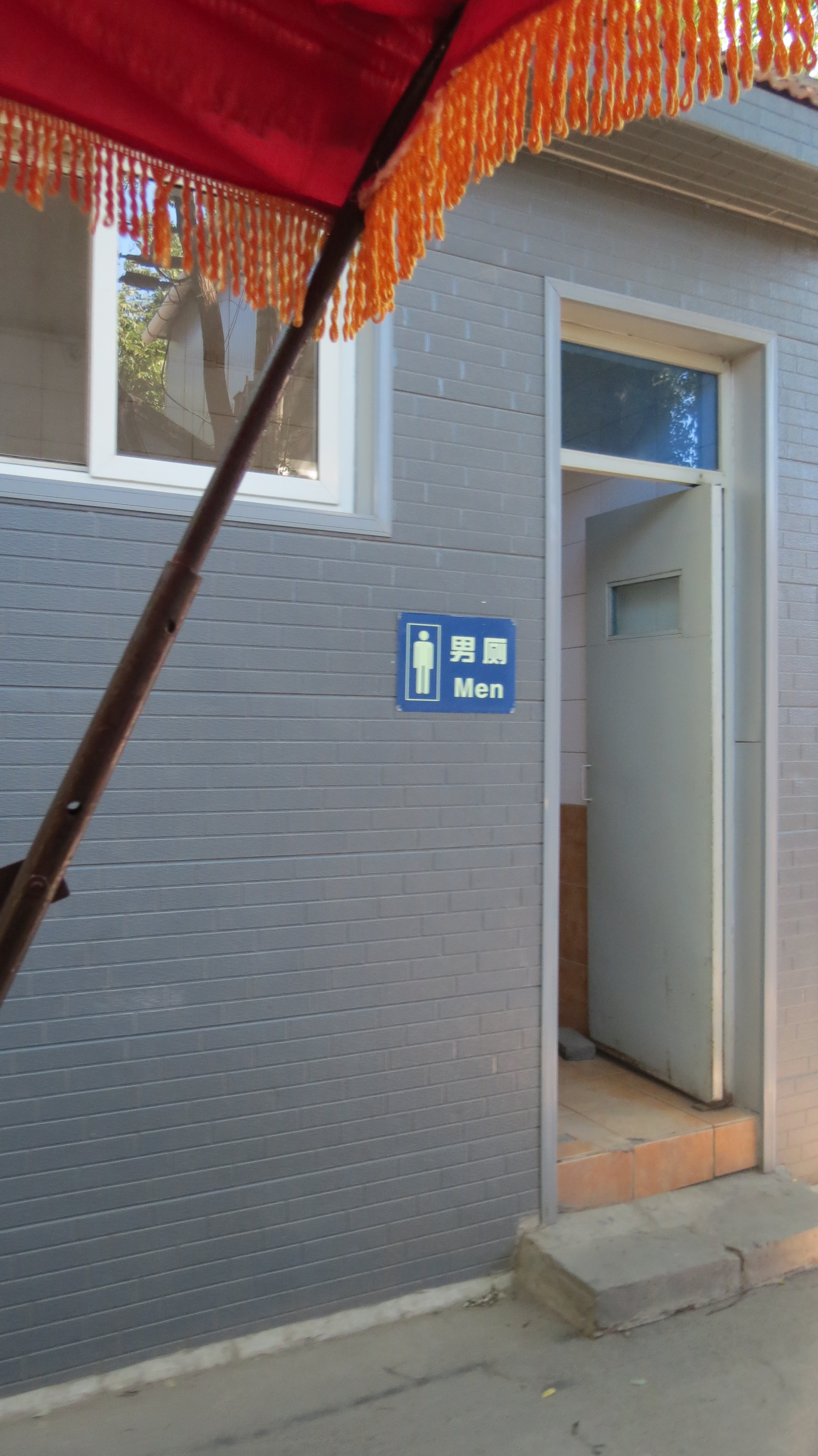
One of the many ubiquitous toilet buildings in a Beijing hutong
As part of my research into Indian food for our upcoming trip to India and Nepal, I came across a recent newspaper article about the discovery by British researchers of a vaccine “against the curse of the Delhi Belly”. Apparently, researchers from the University of Cambridge have come up with a single pill which will cure the diarrhea which so many travelers have to deal with, usually within the first week of their stay in a foreign country.
Traveler’s diarrhea is not a very entertaining subject, but it comes to the surface regularly when preparing for overseas travel. The disease rarely leads to serious health consequences, but the two or three days lost to that illness during a trip can quickly affect or even ruin a good part of your vacation. I find no comfort in the article stating that it affects more than 10 million people each year and up to half of all international travelers and that it is “most common in India and other tropical countries”. However, I frankly don’t recall ever getting traveler’s diarrhea, even though I have traveled all corners of the world many times and have lived more than four years in Mexico, where the illness is referred to as Montezuma’s Revenge, the Gringo Gallop, the Aztec Two-Step, etc… But I am getting older, so my immune system is probably not as strong as before, and it’s been a while since I’ve been to India; will it be different this time around?
Bloggers on the internet seem to indicate that the disease still affects a lot of people traveling to India. The several different names given to the illness, from Delhi or Bombay Belly to Gandhi’s Revenge, only attest to its reach across the sub-continent. It is not reassuring to read that the Delhi Belly was the first nickname for the traveler’s diarrhea to be mentioned in print, and that was in 1942, in reference to the diarrhea affecting Americans on duty overseas. I am not sure if that information is correct, as I would think even the Roman Legions, Mughal conquerors and Spanish Conquistadores had the same problems. I should probably read Marco Polo’s narrative to see if he encountered it on his travels to the east.
For our trip to India and Nepal, preventive measures seem to be the prudent course of action, recognizing the obvious fact that we can only reduce rather than eliminate the risk. Reading that one should be wary of handling the Indian currency itself, because of the germs the bills carry, almost makes one want to walk around wearing disposable gloves every day.
Drinking only bottled water, eliminating ice, closing the mouth while showering (a major concession since I love to sing in the shower!) are obvious first steps. We are used to drinking water only from sealed water bottles on our travels, but it would seem that, for India, we will have to take even stronger precautions. Too many people in India are refilling empty water bottles with tap water and resealing them with krazy glue. The first layer of protection would be to stick to the three major brands of bottled water in India, Bisleri, Aquafina and Kinley (from Coca-Cola). But that may not be enough. I think that our approach needs to be to take our bottles of water only from our five-star hotel each morning and bring them with us during our day of touring; the alternative would be to avoid water all together and move to carbonated drinks or beer (I was a heavy beer drinker when I lived in Mexico and it did preserve my health, since I never experienced Montezuma’s Revenge!).
As for food, the situation is more complicated. The advice gleamed from dozens of internet sites on the matter of eating in India seems uniform in terms of avoiding meat, fish, raw vegetables and fruit (other than the ones you can peel) and street food, and favoring the hot vegetarian cooked dishes of India. But since I am taste-allergic to coriander, yoghurt and chiles, this narrows down considerably my food options. Can I find some tasty lentil dishes which don’t come with added dairy, yoghurt, coriander or chile? The search is on!
Global Entry, TSA PreCheck, … the smart way to travel! And it is not just for US travelers!
 A few years ago, I was coming back from overseas into the US and was waiting in line for my turn to go thru passport control at the airport. While hundreds of us were standing around waiting, we could see a few travelers head to a row of ATM-looking machines on the side of the entry hall and quickly head out to the baggage claims area. Given the long lines one can frequently find nowadays at airport security checkpoints and at customs passport control areas, any way to beat the lines is worth looking into. And that is when I became interested in the growing array of services designed to make it easier for travelers to navigate through security and customs.
I don’t pretend to be an expert in the area, as I am simply a frequent international traveler trying to simplify the hassles of his trips. But what I see are more and more of these programs, and I think people need to be better informed about them. The government of the USA is clearly trying to streamline the system, and it is not alone. Other countries are themselves addressing this issue and devising systems to help travelers. I want to share my understanding of what is currently available, at least for the US traveler, with the readers of my travel blog BonVoyageurs.com (I invite you to enter your email address on the home page and perhaps become the 1,000th follower of the blog!).
First, one needs to understand that there are two basic types of programs, (1) the trusted traveler programs of the Customs and Border Protection (CBP), relating to entry into the country, and (2) the programs of the TSA, relating to going through the security checkpoints. The two types of programs are separate, but closely related in the sense that travelers who belong to some of the CBP programs, like Global Entry, are automatically eligible for some of the TSA’s programs, like PreCheck.
To enter the USA in a speedy fashion, look into one of the following four programs from the CBP:
(1) NEXUS - think of N for north - program for cross-border travel between Canada and the US.
(2) SENTRI - think of S for south- program for cross-border travel between Mexico and the US.
(3) FAST - basically for commercial truck drivers for cross-border travel between the US and Canada or Mexico.
(4) GLOBAL ENTRY - since 2008, the fast growing program for international travelers from the US. This is the program which allows the trusted traveler to use those automated machines in the entry hall of most international airports in the USA so that he/she can zoom thru passport control. Membership in the Global Entry program gets you a “membership” card, but you don’t need that card for the airports; the machines will scan your passport and determine that you are part of the Global Entry program and send you on your way.
The application process for Global Entry is pretty straightforward. You file an application online thru the GOES system (Global Online Enrollment System), after which CBP does whatever it needs to do to check you out and make sure you are not a threat to homeland security, then you get a conditional acceptance letter which asks you to make an appointment for an interview, you go to the interview where you answer questions and get fingerprinted, and voila, you are a member of the Global Entry program and will receive your card in the mail shortly afterwards.
To speed thru security checkpoints, consider the TSA’s PreCheck program. In those US airports where the program operates (more than a hundred as of this writing), PreCheck benefits include being able to go through security without removing your belt or your shoes and without having to take out your laptop or your plastic bag of liquids from your backpack or carry-on bag. It also means separate security lines for PreCheck passengers, and that usually (but not always) greatly accelerates going through the security screening process. TSA has its own application process for the PreCheck program.
However, to get the benefits of both a speedy run through security and a speedy run through passport control upon your return to the USA (in a hundred or so airports), all you need is the Global Entry program because it automatically qualifies you for the PreCheck program. And here also, you don’t need to have your Global Entry card with you when you show up at the PreCheck security checkpoint as your passport will suffice.
But Global Entry is not simply relevant to the USA. It has international dimensions as well because of agreements between the US and a number of other countries! If you are a US citizen and member of the Global Entry program, you can get expedited entry benefits for the Netherlands, Korea, Australia, even New Zealand! The arrangements vary country by country; for example, New Zealand has dedicated lanes for members of the US Global Entry program, Australia allows Global Entry travelers to use the lanes dedicated to the Australian Smart Gate program, while Korea and the Netherlands require Global Entry members to obtain membership in that country’s program before benefits can be used (SES Smart Entry System for Korea, Privium for the Netherlands). Conversely, members of those countries’ trusted traveler programs get the benefits of the Global Entry system in the US in various ways. The details do get complicated, but the bottom line for US travelers is simple: join the Global Entry program.
It will make your travels easier thru both security checkpoints and customs.