Category Archives: China SEP12
China Reflections September 1-20 2012 posted by Lynn
 ASTOUNDING PROGRESS & MANY CHANGES since our last visit in the mid’90’s …
Where are the bikes …? During our visit to the Chinese mainland in the ‘90’s, we saw few cars and virtually no traffic jams. There are so many cars in the cities (Beijing, Xi’an, Chengdu, Chongqing, Yichang, Shanghai) that there is steady congestion, especially in Beijing. We are told that the Chinese government is trying to minimize the problem in Beijing by restricting purchase of cars to a “lottery” system, and limiting daily usage of driving. Clearly, the daily commute problems have gone from physically to mentally challenging.
Where are the gray Maoist unisex uniforms? … plenty of skin now shows and the young women, in particular, are into the sexy short shorts and skirts, ultra high heels, tight leggings & tight shirts of the western world. Sensibility has disappeared and “sexy” is used to sell products – after all, the new Chinese regime is pragmatic.
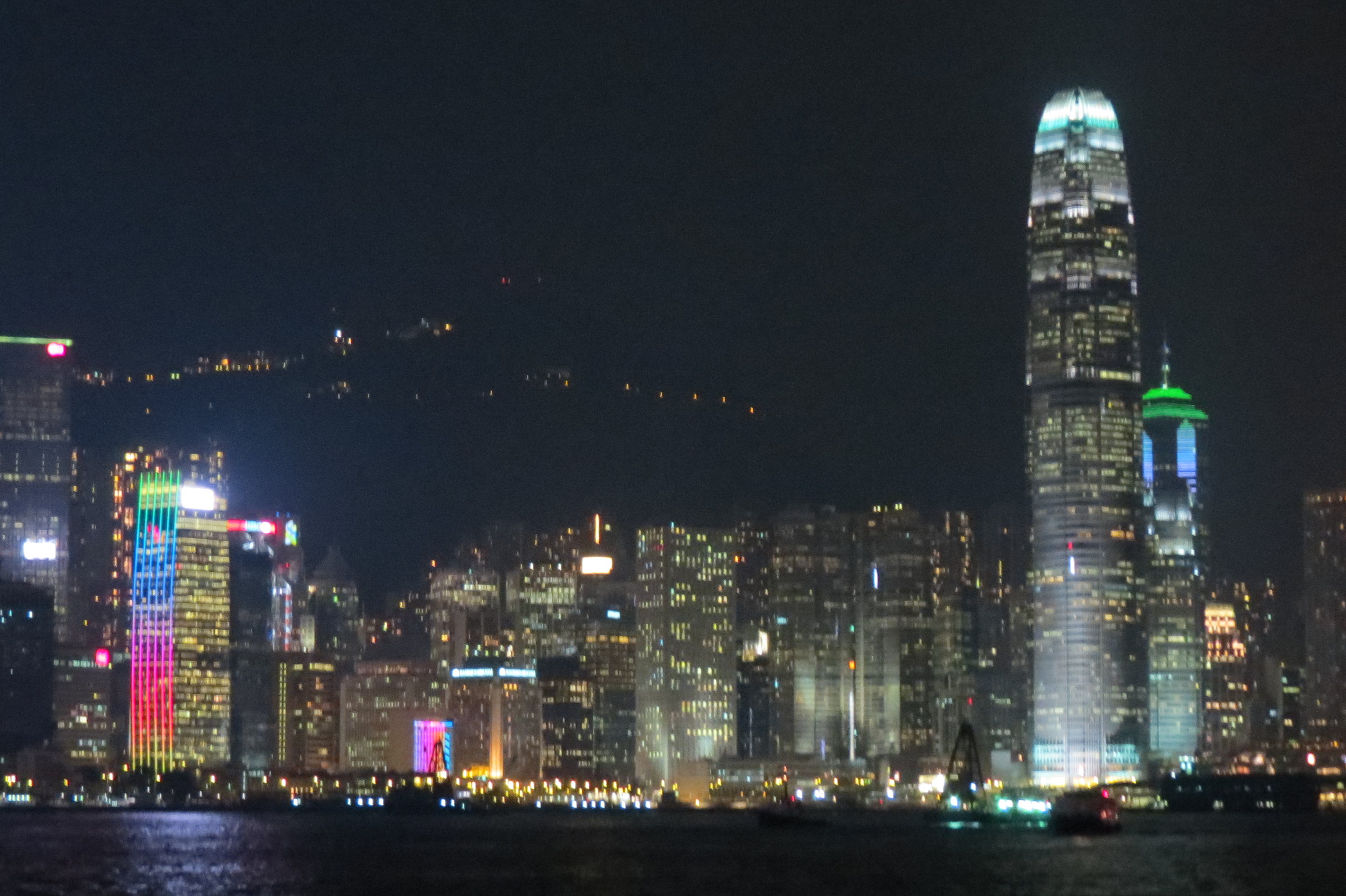
Where are the dark nights after sunset? … I wondered during our last visit if the Chinese simply went to bed after sunset because very little if any artificial lights appeared to be on in the evening, but now the Chinese live in a high tech, highly-wired, neon world and their cities are dynamically illuminated at night while their apartments and even small homes in the middle of nowhere seem to be electrified … or at least are comfortably lit up with gas lighting.
How about the “Chinese-only” food orientation, or Chinese-tasting “American” food? … this too is replaced by a wider “international cuisine” focus. Imagine, being served “pizza” and “popcorn fried chicken a la KFC” as some of the 30 or so platters at the Captain’s Banquet on board the Yangtze River cruise !
Where is the blank stare when I ask a question in English? … Since our last visit, tourism has clearly become a major industry in China and we learned from our guides that many cities now consider tourism a top priority. Consequently, the younger generation is learning English, and I rarely felt lost asking for help or directions in English … a monumental difference from our last visit. Even many of the older people we met were eager to respond to Denis as he re-surfaced his Mandarin with a big grin – either responding in Mandarin or translating from English into Mandarin when appropriate. However, it is worth noting that while Mandarin may be the official language in China, local dialects are still thriving … so don’t think that if you speak Mandarin you will understand the language everywhere you go!
Infrastructure for the 21st century has sprouted up throughout China! … The truly gigantic, ultra-modern, ultra-comfortable, well-organized airports in X’ian & Shanghai & elsewhere, the spacious 4-6 lane highways leading to China’s World Heritage sites like the Terra Cotta Warriors, the many hi-tech wide bridges spanning their rivers, the updating of many of their museums …WOW, were they impressive. While the US lets its infrastructure crumble, China is investing & investing & …
Rest Rooms from squat to super hi-tech … there seems to be a difference in preference between the more “traditionally-oriented” Beijing, Xi’an, Chengdu, etc, and the more “western-oriented” Shanghai and Hong Kong. I’ll take the “western” version of what we know as a standard toilet with a seat (even if I don’t actually sit on it) to the Chinese traditional preference of a toilet in the ground over which you have no choice but to squat and squat low or you’ll miss your aim. And please give me toilet paper and soap. Hmm … there’s some catching up in this arena for much of China. But — I was super impressed by many of the ultra high-tech bathrooms throughout Hong Kong and Shanghai with automatic everything, from flush to soap-dispensing, including both automated aeration along with incense to keep the bathroom smelling fresh.
There has been a fusion – not an invasion – of cultures here. The Chinese clearly love their traditions and their culture, but in this 21st century internet world and with the more liberal policies of the more recent Chinese governments, combined with the profits from China’s extraordinary growth in international trade, the Chinese are now becoming “trendy”, especially the younger generation. From hair dyed red to lots of makeup, to all styles of absurdly high heels and hip neon colored Converse and running shoes, from a wide selection of TV programs, to mobile phones for everyone and cars – new ones !—causing western-style traffic jams — to speaking some English, the young generation here is going to make a monumental difference in the 21st century. Freed now of the one-size-fits-all philosophy, the Chinese are embracing individualism and self-expression, and, for sure, materialism. Plus the younger generation is fleeing the farms and small rural communities for the big cities, even if that means living with their parents until they are well into their ‘30’s to be able to afford their own apartment.
Monumental changes for sure over the past 17 years !
CUISINE
The Chinese love their food … it’s a pleasure to see them enjoy and share a meal … Chinese tables, as we see in many American Chinese restaurants, are built with large Lazy Susans for “sharing dishes”. Our guide in Beijing, Jeff (his English name), told us that Chinese meals are as much about sharing the enjoyment of the food as they are about eating per se … so you might say that along with their well-known Teahouse ritual of sharing tea and conversation, eating a meal with others is also a “ritual” for the Chinese.
The Hotpot which we enjoyed for dinner in Chengdu(we are told that the origin of this dish is from Chongqing) is based on the same concept as the Swiss Broth Fondue, the dunking of meats and veggies into boiling bouillon to cook them, followed by eating them with a sauce. In the case of Hotpot, the traditional bouillon is heavily spiced with chilies, but since Denis doesn’t eat chili, we opted for a “divided” pot with one-half containing a non-spicy, wild mushroom bouillon base for cooking. At the recommendation of our guide, Ben, whom we had invited to share dinner with us, we ordered a selection of pork, beef, and mutton as well as bok choy, Chinese greens, and mushrooms. As the food simmered in its bouillon, the bouillon took on layers of flavor. So in a culture where nothing is wasted, we were served the wild mushroom bouillon to eat as soup several times throughout the meal as we used it to cook Denis’ meal and a bit of mine. Only one sauce was served for dunking the cooked food, but it was divine … a rich sesame oil flavored with minced garlic. Be forewarned if you try Hotpot … the longer you leave the chilies boiling in their cooking liquid, the spicier the liquid becomes! I ventured cautiously into the “chili” side of the Hotpot, while Denis stayed carefully on the wild mushroom side, but Ben ate uniquely from the “chili” side of the pot. By the end of the meal, his face was visibly full of perspiration and his eyes were dilated … what chili can do to you even if you are a chili habitual (!)
Breakfast … As much as I was uninspired by a Chinese breakfast when I first traveled with Denis to China in the mid-‘90’s, I actually looked forward to starting my day with a Chinese breakfast of fresh fruit – including the black-spotted Dragon fruit –, followed by some thick stir-fried noodles with thin slices of veggies and a little bit of meat. Then I spoon a little bit of chili sauce over the noodles and yum ! Or I enjoyed dim sum dipped into a simple sauce of soya, black vinegar and fresh ginger.
Noodle heaven … I wonder what would happen if the Chinese and Italians did a noodle cook-off – who would win !?! Some of our most creative and flavorful meals have been noodle dishes, noodle soups, and of course, variations on dumplings made of the same type of dough as noodles, be they wheat- or rice-based … although I have to say we have mainly eaten wheat-based noodles. Say “noodle”, and Denis lights up – here or in Italy ! From Zhajian Mian (Beijing noodles with meat sauce), Yangrou Paomo (Xi’an mutton with pancakes, which are really tiny pieces of noodle), and Dan Dan Mian (Chengdu thick noodles with spicy pork sauce) to Suzhou Tang Mian (Suzhou Noodle Soup), and other Noodle Soups, even for breakfast (cooked with egg) – some with skinny noodles, others with wide flat noodles, or deep-fried noodles, we don’t miss an opportunity to sample and savor the Chinese noodle cuisine.
We also have done our share of appreciating their Dumpling culture. One of my favorite meals was at Din Tai Fung, a Taiwanese chain specializing in dumplings, especially crab and pork ones. I’ve enjoyed my share of dumplings, or Dim Sum, in many Chinese restaurants, from Philadelphia to NYC, Montreal, San Francisco and even Rockville, Md (where there is a thriving Chinese community), but Din Tai Fung makes by far the best I’ve ever eaten. Why? … because when I bite into the dumpling, there’s an immediate pop of delightful warm flavor that exudes from the inside of the dumpling — our guide, Steve, says that he thinks this comes from the little bit of pork skin with pork fat that is put inside the dumpling for richness . Plus, the dough wrapping was light and airy … and I know why. As we were leaving Din Tai Fung, we passed by a large window which showcased at least 6 people, both chefs and cooks, most professionally rolling out little balls of perfectly textured dough into small circles, and then filling them with one of an assortment of visibly well seasoned fillings, and then exhibiting the art of twisting and sealing the little dumplings, from Shamai, with their tops left slightly open, to the more traditional closed dumplings … although these dumpling pros exhibited several ways to seal a dumpling. And when they saw Denis & me staring intensely at their work, they even came right up to our window to seal the dumpling in front of our eyes. Din Tai Fung is rightly proud of its dumplings!
Wines & wine-pairings … China is not missing the opportunity to join the civilized world on focusing on the significance of wine with food. Yes Chinese tea is still served with a meal, but expensive foreign wines are widely available, especially in Michelin starred restaurants … oh yes, they are now important in the New China … and it appears that a Tasting menu in China would now not be complete without the offering of a wine pairing … who would have expected this ???
Street food … while we didn’t dare sample it, our mouths watered at the many offerings everywhere we went. At lunchtime, tea-time and dinner-time, the streets would come alive with vendors selling local specialities. And in many locations people would come out not only to buy but to sit and eat together with their friends and communities. I thought many times how the serious, skinny, under-fed look I had noted back in the ‘90’s is now replaced by a happy, well-fed, and even perhaps a tad over-weight appearance … China certainly is feeding its people now and “Skinny” is out, “well-fed” is in! Plus the ritual of food-sharing has expanded, indeed proliferated onto the streets.
HIGHLIGHTS OF THE TRIP
Beijing … the warm celebratory welcome at the Shangri-La Hotel, from the “Welcome back, Mr. Gagnon” to the chocolate Happy Anniversary cake, bottle of French Bordeaux, card, flowers and box of chocolates in the room combined with photo-taking with and by the Horizon Club staff and a welcome serenade of Happy Anniversary” when we opened our door to our suite! … totally unexpected J
Xi’an … Muslim street which quickly showed me how the “Minority Groups”, which is the official Chinese term for non-Han peoples, live together in harmony with the rest of the Chinese people … the infra-structure built to showcase the World Heritage site of the Terra Cotta warriors, including an amazingly gigantesque airport and the super-sized, only “non-traffic-infested” highways we experienced in China … and, of course, the unearthed and archaeologically restored Terra Cotta Warriors with their horses and their accoutrements in their pits – simply awesome, especially given their production date of over 2000 years ago!
Chengdu … why feeding the pandas, of course, and having the pandas we had already fed and be-friended come when around to greet us when we moved from the front of their enclosure to the back … plus the animated stroll down Jinli Street full of its open-air shops and street food places … the head & neck massage at the open-air Tea room, and the divine Hotpot dinner in a private room with Ben, our guide, attending to our every need … and the amazingly divine room service meal we had served by the Executive Chef of the Chengdu Shangri-La himself !
Chongqing … although we only had an afternoon to quickly visit the biggest city in China (30 million including the suburbs) as we were en route to the Yangtse River cruise, the central square of this dynamic Yangtse port city with its animated street life, old China buildings, narrow streets, and magnificent views over the harbor, provided another snapshot of life in China
Yangtse River Cruise … The primary raison d’etre for taking this cruise is to visit the famous Three Gorges Dam, an architectural feat which makes the Chinese people swell with pride – in fact, Denis and I watched a very interesting PBS documentary about the building of this dam, including the displacement of millions of poor Chinese farmers in the river valley. However, we took the cruise for the sheer enjoyment of being on the water and seeing the villages as we passed them by. When we entered the ship, which Denis’ research had identified as the top-rated and newest cruising line on the Yangtse, we were extremely impressed by the beauty and quality of the ship and its high tech conveniences. Our room was surprisingly spacious for a river boat ship, we had a large balcony and a walk-in shower, spacious closets, but … I noted that all the signs were in Mandarin, the announcement signs on board the ship – Mandarin only, and I quickly told Denis that this ship was not set up to receive Anglophones. I was right.
Dinner our first night was not included in our cruising package so we had order from the menu – normally, not a problem as the menu has pictures and actually had some English. Denis saw “spaghetti Bolognese” and was set. But I wanted my daily fix of green vegetables and there was no such photo in sight. So we asked a waiter if they had green vegetables. Four waiters and a half hour later, no response, — I was fuming and Denis was disgusted, and so I finally got up and went to Reception where I pointed out that the ship was not set up to received Americans and they should never have taken our money — I told them to either find someone who can deal with us or give us our money and we leave. Well that changed things. We were served properly, given 2 magnificent portions of Chinese green vegetables and dessert on the house. And the next morning, we were told we would be taking our meals in the exclusive VIP lounge at the top desk with beautiful views and – most importantly – several charming young waiters who spoke enough English to take our order and respond to our needs. I loved these guys – they totally transformed our trip from a nightmare to a pleasure. When a young Chinese woman traveling with her parents heard me speaking English to them, she turned to talk with me, and the next thing we knew, she invited us to eat with her and her non-English speaking parents … and the waiters were moving us over to their table.
For the Captain’s Banquet the last night of the ship, we were surprised to be seated not at the table with the 2 other Anglophones on board – the English guy (married to a Chinese woman) and the New Zealand guy (also with a Chinese wife), neither of whom obviously had “translation” problems since they had Chinese wives – but with the young lady and other Chinese people from her home town in the Cantonese province of Guandong. Believe it or not, one of the men at our table offered us some of his brandy and made welcome toasts to us, Denis bought some red wine and responded in kind, and the whole table chatted with us as we relied upon my little friend’s translation and Denis’ Mandarin – which really is memorable! – to communicate. So we managed to turn lemons into lemonade and we have some very fond memories now of being on board that ship!
Shanghai … the panoramic view of the Bund and the Huangpu River (a tributary of the Yangtse) from our expansive room with its 3 (!) widescreen TVs (who needs 3 tvs?) – this view was so lovely that it was very hard to close our curtains to go to sleep at night, but we had to because the light from the river full of party and tour boats 30 floors below would have invaded our room … the views over the “new China” from the Oriental Pearl Tower … the Urban Planning Exhibition Hall with its amazing aerial reproduction of every single street & building in downtown Shanghai … the Bund, of course, but also – not too surprisingly — the French Concession (stilled so-named from the division of Shanghai into British, American, French & German concessions after the defeat of the Chinese in the Opium Wars) where French style outdoor cafes and boutiques and, dare I say a bit of “Parisian charm” abound?
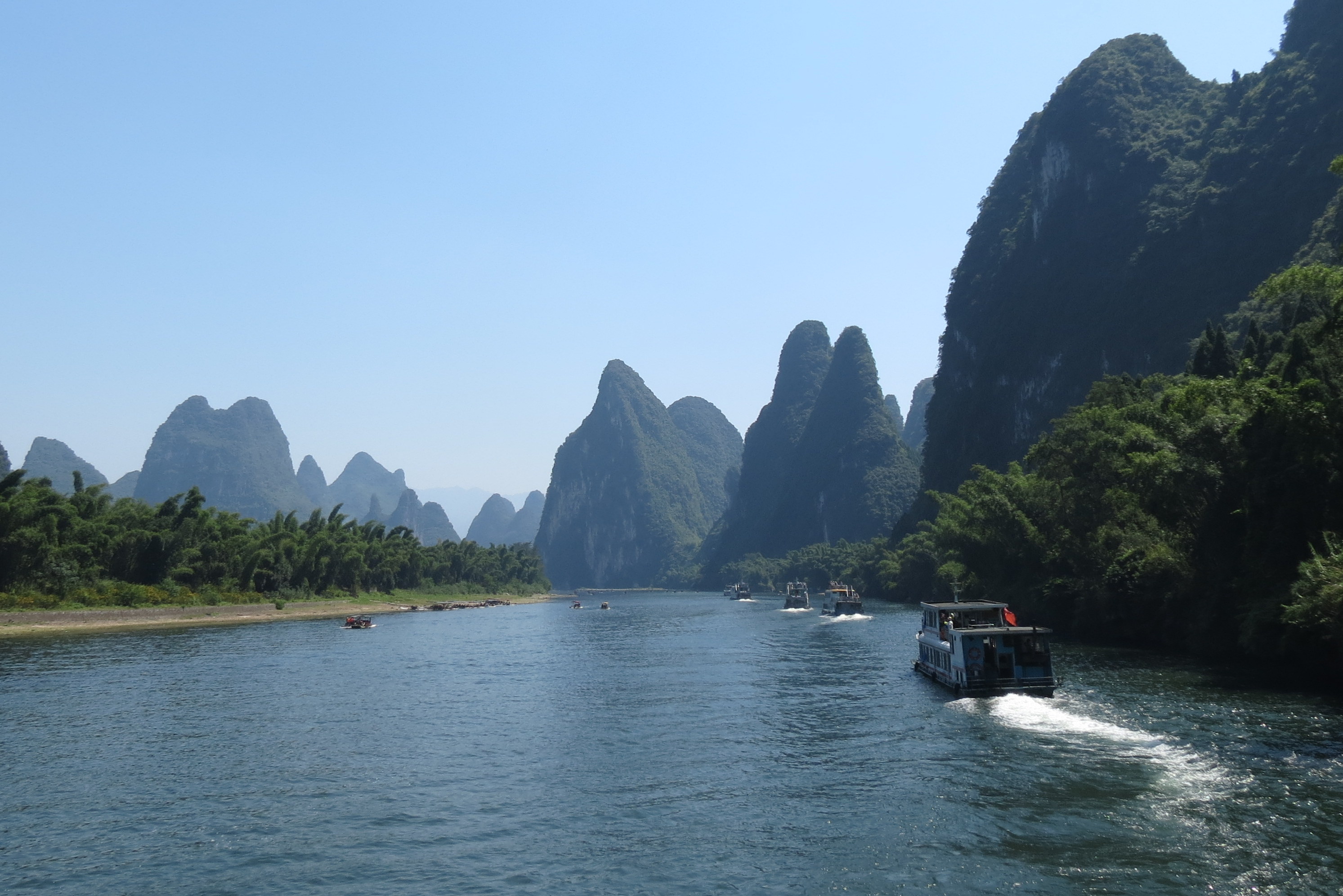
Guilin… the picturesque views of the “Karst” mountains and the not-to-be-missed 4-hour Li River Cruise down to Yichang … an immediate first impression leaves no doubt why these mountains have inspired centuries of Chinese painters
Yichang … we only had a couple of hours here after our Li River cruise docked before we had to depart for the airport , so we walked through the street market … impossible not to! … and had an unforgettable meal highlighted by Yangshuo Beerfish.
Hong Kong … the glorious views over Hong Kong, Kowloon and Victoria Harbour from Victoria Peak, and the descending views by car which were slightly reminiscent of the Grande Corniche from Monte Carlo to Nice … lunch at The Square, a one-star Michelin restaurant at The Stock Exchange … the many antique shops which we very much enjoyed wandering through but are sadly being forgotten in today’s high-tech contemporary world … our ferry trip to Macao with its very different influences of Portuguese food & culture and Las Vegas 24-hour/day gambling culture!
The Shangri-La Hotels … a mecca of pleasure and pampering, especially from The Horizon Club with its unforgettable panoramic views over the city … we will return!
The Li River cruise and Yangshuo
 We are currently on board Hong Kong Airlines flight 122 from Guilin to Hong Kong, and therefore we have said good bye to mainland China so to speak. What a surprise when our driver pulled up in front of the terminal at Guiling aiport. Two beautiful smiling young women, meticulously attired in red and grey uniforms, were waiting for us outside, literally in the street. Their task apparently was to escort us though passport control, customs, check in and security to the first class lounge located next to the departure gate.
I hope I find the strength to tell you more about it (it is now already 11pm and we have arrived in Hong Kong), but let me start by staying that the four-hour Li river cruise was fabulous from start to finish, the lunch at Yangshuo was memorable, and our arrival at the Kowloon Shangri La hotel no less spectacular. What a day!
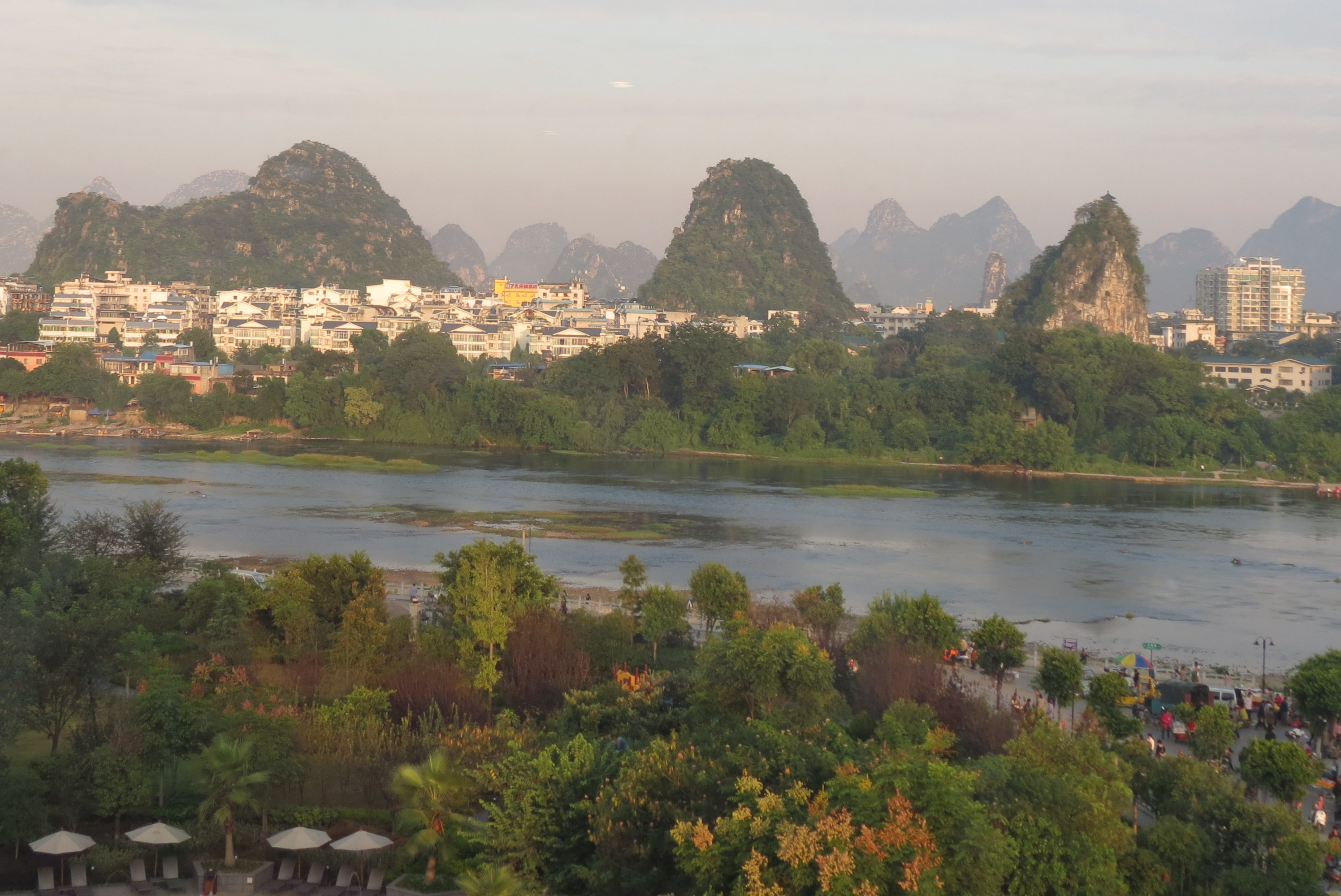
The day started with the phenomenal view from our window at the Shangri La Guilin when we woke up at 6am this morning. The view of the karsts, the Li river, the morning pedestrian traffic, the manicureed gardens and pools of the hotel, all combined to create a breathtaking picture, which we were able to experience yet again when we sat down for breakfast at the Horizon Club. Lynn again had a Chinese breakfast, including shao mai dumplings.
We then left for the 45 minute ride to one of several piers from which the Li river cruise boats depart. Our guide told us that 5,000 people a day take the cruise, most of them leaving all at the same time at 9:30 in the morning, packed 100 to a boat. This is an endless procession of three decker boats leaving the docks in quick succession. Those large boats are government owned. The locals can also sell rides down the river in their smaller boats, but they are allowed only to go down to the next village. The purpose, as the boat’s brochure describes it, is to admire the “grotesque peaks” (sic) of the karsts along the river. Although we had assigned seats inside on deck two, Lynn and I remained standing on the top deck for most of the trip, in order to take in the spectacular views which we had for at least three of the four hour downstream trip. I managed to take more than 300 pictures of this magnificent stretch of water. One area, near the vile of XingPing, is the landscape used on the 20 yuan bill of the chinese currency, and it is probably the most spectacular scenery you can imagine. There is a lot of what our guide called phoenix tail bamboo (thick bamboo about four to six inches in diameter) along the river, which used to become the material for the fishermen’s rafts; but now the government has banned the practice to save the natural environment along the river and the rafts are made of bamboo-looking plastic.
We met some interesting people on the boat. Our table had two italian doctors living and working in Paris, two newlyweds from Madrid, and two men from Iran.
After arrival in the charming and touristy village of Yangshuo, we had a great lunch consisting of the famous Pijao Yu (Yangshuo beerfish), as well as Tian Luo Nian (stuffed snails) and boiled Chinese lettuce.
After we arrived at the Shangri La hotel in Hong Kong, where they said they found records indicating that my last there was in 1998, Lynn and I received not only the usual welcoming tea (the best so far according to Lynn), vase of flowers, and platter of fruit, but also the best box of chocolates we have received on this trip (and there has been quite a few), plus a bottle of champagne, plus and additional bouquet of roses.
Hong Kong, seven million people, where our guide says that there are no houses, only skycrapers. The tallest, built in 2006, has 118 floors, including a Ritz Carlton hotel whose lobby, on the 101st floor, is the tallest in the world.
I have so much more to say, but I have to stop. The floor to ceiling view of Hong Kong Island from our room window is too awesome, and I am too tired; I’ll just sit in front of the window and admire Hong Kong. I just love it!
The postcard city of Guilin
 Our two and a half hours Shanghai Airlines flight from Shanghai to Guilin gives me plenty of time to pull out my laptop and start writing my blog of the day. It certainly is a better way to pass the time than the heavy gunfire and martial arts movies which Chinese airlines seem to put on whenever we are aboard. It is still morning but I already have more blog material than I know what to do with. Our flight was delayed at the gate for one and a half hour because of an air traffic jam around Shanghai. The stewardess we questioned about this was in no way concerned; she in fact predicted that we would be delayed for a couple of hours, as this seems par for the road at 9am at the Shanghai Hongqiao airport. This is the first delay we encounter on our entire trip so far, and it gives me some time to think about what we have experienced.
It is ten thirty in the morning, and I already have had three full breakfasts. First, not knowing what was in store for us, we had ordered a full room service English breakfast at 5:30am, since we had to leave for the airport at 6:45am and the Horizon Club lounge opens at 6:30am, too late really for us to take advantage of its offerings. The weather is clear, warm and sunny today, and the ride to the Hongqiao airport turned out to be smooth and easy, taking only twenty minutes or so, thanks to our Saturday early morning departure. This left us plenty of time to go to the Shanghai Airlines First Class lounge at Terminal 2 where, lo and behold, a phenomenal Chinese style breakfast buffet was in store for us, including an irresistible manned noodle soup station where I could get different types of meat, mushroom, vegetables and condiments to add to my noodle soup. There was also an appetizing array of bamboo containers with various types of steamed buns (baoze) and dumplings (jaoze). And then the main buffet table with a wide choice of fruit, vegetables, meats, cheese, dry noodles, etc… How could I say no?
Boarding was extremely easy, as Shanghai Airlines had a small bus dedicated to bringing first class passengers (all four of us) to the plane, a relatively new Boeing 757. But when the departure delay was announced, soon after we boarded, out came the third breakfast. Lynn ordered the Chinese breakfast and I took the Western breakfast, for comparison’s sake. My vote goes to the Chinese breakfast, even though the omelet was excellent as were the grilled tomatoes, mushrooms, potatoes and sausage. However, the porridge and the French pastry did not begin to compare with the congee, the dumplings, the steamed buns and the meat-on-a-toothpick offerings on Lynn’s tray. Both dishes had the same fruit plate; in fact, the one common denominator amid all the meals we have had in all of China so far has been the fruit plate. It is always there, and it always contains the following three fruit: dragon fruit, watermelon, and canteloupe melon. Whoever controls the distribution of those three fruits must be doing pretty well.
The stewardess presented us with a printed menu of drinks, and we selected the herbal tea, which turned out to be a glass of what I can best describe as cold caramel-flavored sugared water. Lynn promptly changed to peppermint tea, and I to English breakfast tea. However, the damage was already done; just like yesterday, I’ll have to skip the next meal if I want any chance to limit my weight gain, which I think is around six or seven pounds now. I am wondering if the wonderfully pretty smiles of the beautiful slim Chinese stewardesses has something to to with my inability to say no to whatever they are offering me. It is true that I never seem to remember the word no in Chinese.
Lynn and I have already discussed our plans for Guilin and Yangshuo, and have even discussed Hong Kong, where we land tomorrow evening. The Li River cruise and the visit of the Yangshuo town are expected to be the two main highlights of our stay in Guilin, and I suspect Lynn is looking at shopping being the highlight of our stay in Hong Kong. For me, I am very curious to see how my favorite hotel in Asia, the Kowloon Shangri-La has weathered the twenty years or so since I was last there. I was very pleased to find out yesterday that the renovation of the Shang Palace restaurant at the hotel was complete and that Lynn and I have a Tuesday evening dinner reservation to eat at that two-star Michelin restaurant, probably one of the best Chinese cuisine restaurants in the world.
I was asking Lynn earlier this morning which meal she had enjoyed the most so far during our trip. She mentioned two: the hot pot dinner in Chengdu, and the dim sum lunch at Din Tai Fung in Shanghai. I would have included the Yangcheng Lake hair crab banquet and the zhajiang mian meal in Beijing. Remembering all the Chinese food we have tasted is already proving difficult; I am very pleased that I wrote this blog as it will allow me to refresh my memory when I start writing my own Mastering the Art of Chinese Cuisine book of recipes, or failing that, when Lynn and I go out to the Sichuan Jin River restaurant in Rockville, or the noodles place whose name I have forgotten on Rockville Pike. And when will I have the time to sort through the 1,500 photos I have taken so far? There has to be one or two good ones among all those.
The scenery outside the cabin window has changed drastically now. We have gone from the central plains to a very mountainous area. We are approaching Guilin and I will therefore shut down and continue later.
Le Le is our guide for Guilin, where the climate is semi-tropical; we are now in southern China as the palm trees outside the new airport terminal remind us. The word Gui is the chinese word for the cassia tree, and the word Lin means forest. The yellow and pink flowers of the cassia tree are used to make tea as well as wine. Guilin has an area population of 5 million, of which about 700,000 live within the city. Some time ago, the government decided to emphasize tourism and moved the industry out of town. Now 70% of the economy comes from tourism, 30% from agriculture. The setting is postcard beautiful; the karst mountains spread across the city, the waters and the banks of the river Li, all a pleasure to look at. There are two rivers running through the town, the Li river and the Tao Hua He; they use the word He for a river with clear water and the word Jiang for a river with muddy water, like the Yangtze.
Le Le explains that there are monkeys and goats in the karsts, but now, with the great inflow of tourists, they hide and we will probably not see any. The farmers still use the water buffalo to plow the rice fields, but the fishermen don’t really use cormoran birds to fish anymore. They now use fishing nets, and only use cormoran for photo opps with tourists in Yangshuo. Carps and catfish are fished in the river Li; by the way, beerfish is the most famous dish of Yangshuo and we are planning to have some tomorrow.
The guide informs us that we will go first to our hotel, a 45 minute drive away. Half an hour later, as we are driving into the city, he tells us that we will go visit the Reed Flute Cave first since it is on the way to the hotel. Later, when I notice the car changing direction, Le Le explains that the Cave is only ten minutes or so out of the way! Why am I the only one thinking that I am being misled?
The people living in this part of China are part of China’s minorities, the guide explains to me. There are two such minorities here, the Zhuang and the Yao; they have a lot in common with the people from Vietnam and Laos, which are only about 500km away, an eight hour train ride. They share the same brown skin and high cheekbones. They speak a dialect which is similar to the Vietnamse language. They have their own customs. One such custom, Le Le explains, is that women wash their head with the water used a few days before to wash the rice. Nutritious, luscious, smelly is how he described it.Another custom is to keep coffins on the third floor of the house once you reach 65 years of age; the ground floor is for the animals (donkey, water buffalo, etc..) and the second floor is where they live. If they die before the age of 70, the coffin is painted red, otherwise it is painted black. They are buried facing east, facing the river and the sunrise. At Chinese New Year, you set up a chair and an empty bowl with chopsticks to remember the dead. Being minorities, the people here can have two children, and the people in the countryside can have even more. They don’t like the people from Tibet, because they are trouble makers. People here enjoy the slow and quiet pace of life.
We had a delightful afternoon visiting the magnificent Reed Flute Cave, and then two campuses of Guanxi University where paintings are being sold to tourists. We could not find something we liked enough to purchase, but we thoroughly enjoyed the experience and the visit of a Chinese university campus.
We then returned to the Shangri-La Guilin hotel, where our room has a phenomenal view of the river Li with chinese fishermen catching snails right in front of the hotel, and with a number of karsts in the background spread across the city. It is different than the view of the Bund in Shanghai, but it is still a sight to behold. We decided to try the special Saturday evening Chinese buffet dinner popular with the locals. it was indeed a new experience. I had several platters of food I am not quite sure what it was, but I do know that I had the local beer (included with the price of the buffet), the famous Guilin rice noodles, mussels and snails, steamed buns, dried pork and beef, while Lynn enjoyed some of the spicier offerings like Indian curry food. I only saw two other non Chinese couples among the hundreds of people partaking of the giant buffet in the Li Cafe of the Shangri La.
Suzhou: paradise on earth?
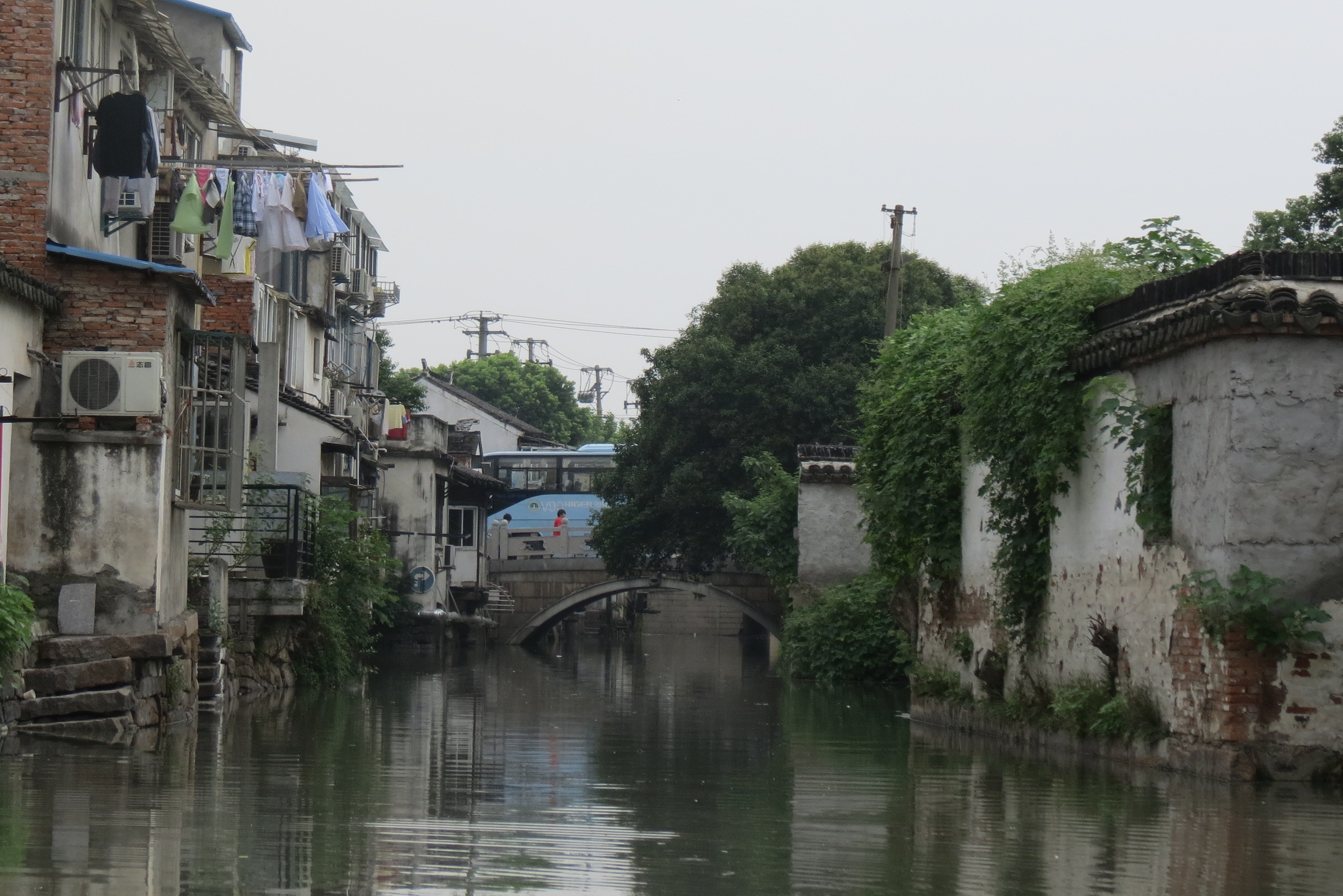 Marco Polo, the Venetian merchant who visited China around 1275 AD, wrote that if there is paradise on earth, it is in Suzhou and Hangzhou. I know Hangzhou well from my previous trips to China, and today we will be going to Suzhou, about 120km west of Shanghai. The high speed train gets there in 25 minutes, but we will be going by car, a one hour and forty minutes journey. This will give me a chance to compare the countryside to what I saw when I used to travel the area on business. Well, it has changed a great deal. There are still a few small villages surrounded by rice paddies as in the old days, but they have become hard to find. We traveled most of the way on a very busy eight lane highway (built in 1992) and saw mostly factories, warehouses, and interestingly, many clusters of high rise apartment buildings dotted all over the landscape. Mr Wong, our driver , paid 45 yuan (about $7) in tolls to get us to Suzhou.
The municipality of Suzhou counts more than 10 million inhabitants, but our guide says that only about one milliion live in the city itself. It is a very historical city, located along the Grand Canal between Beijing and Hangzhou. The Da Yun He (Grand Canal) was built several hundred years ago by an emperor for his wife, because she liked the lychee fruit from Hangzhou and wanted a good way to get the fruit to Beijing; so he had about 3.5 million people build the 1,100 mile long canal, the longest man made canal in the world. The city was known as the Venice of the East because of its many canals. It became also well known for its gardens. The city was conquered and ransacked by a number of people over the centuries, the latest ones being the Japanese in World War II, who destroyed a lot of the city.
Our first stop is the Humble Administrator’s Garden, a garden complex which has been restored and is quite large at 5 hectares. It used to be a private garden which an official built for his aging parents; unfortunately, they died before the garden was finished. The garden is surrounded by dozens of tourist shops which one cannot avoid either to reach the entrance or to leave the gardens. There is a large number of ponds full of lotus flowers, as well as many Chinese buildings and bridges. I was totally surprised by the number of tourists, and more annoyingly, by the large number of tour group guides using a loudspeaker to make commentaries to their groups. I found it impossible to enjoy the garden, and rushed Lynn quickly towards the exit. I frankly don’t see any reason to recommend a visit of this garden to anyone who has already seen Yu Yuan garden.
After walking through the unavoidable shop area at the exit of the garden, we made our way to the water edge and embarked on a sampan type boat for a ride down a small canal road. The most interesting part of that ride to me was not the old buildings and trees along the edge, but the elderly character piloting our boat. He had a great smile and a great voice as well, as he proceeded to sing us a couple of folk songs from the area. The Daning river entertainers should take lessons from him! It turns out that a very small part of Suzhou has water canals any more. The rest of Suzhou is a bustling city with no special redeeming characteristics.
We proceeded to the downtown area and the pedestrian shopping area where our lunch restaurant was located. I had reserved at Song He Lou, a 400 year old restaurant which specializes in one of the most famous dishes in China, the Songhu Guiyu (squirrel mandarin fish). Since they only take reservations for the private rooms (usually located on the second floor), that is what I reserved. It was a very nice big room, sort of like a large hotel room with a bathroom except that the only furniture consists of a large round table with a big lady susan, a serving sideboard, and a coat rack. Each room has an assigned waitress. By making this reservation, I had committed to spend at least 800 rmb ($125) on the food.
I had invited both our guide and our driver to join us for lunch, and I quickly ordered what we wanted: the squirrel mandarin fish, a platter of four vegetables (bok choy, water chestnuts and two others I forget), the famous Suzhou tang mien (Suzhou noodle soup), and the even more famous Suzhou luobosi Su Bing (fried turnip cake). To drink, rose tea, bottled water and coca cola. The waitress did not look happy and stood there motionless.
I asked our guide what was going on. He said that our order amounted to no more than a couple of hundred yuan, so she could not process it; she needed 800 yuan worth of orders to meet our minimum. So we started adding dishes. Crispy duck, a platter of assorted Chinese peas, a platter of tofu and radishes, a platter of fried shrimp. No, that was not enough. OK, add another noodle dish, noodles fried soy sauce. and a platter of fruit at the end. We then added more drinks till we had finally succeeded in topping 800!
Needless to say, we proved totally unable to eat but a fraction of the feast which we were then served, despite the help which the driver and our guide tried to give us. Lynn’s main comment about the food, which was excellent, was that it uses a lot of sugar and soy sauce. We left the restaurant full and bloated, and decided there and then to skip dinner that evening.
We made our way to the Suzhou No. 1 Silk Factory, since Suzhou is renowned for its silk, and this factory is supposed to be one of the largest in China. Lynn spent some time looking at the offerings in the very large shop which is attached to the factory.
No, Suzhou is not paradise on earth, at least not anymore. We decided to skip the scheduled visit of a second garden in Suzhou in favor of returning to Shanghai and walking town Nanjing Road, the busiest shopping street of Shanghai, which is exactly what we did. A long line of people at one of the stores along the street turned out to be people waiting to buy the store’s moon cake, which all Chinese will eat during the Mid Autumn festival next week.
On the way back to Shanghai, our guide instructed us on how numbers are shown with a hand differently than the way we do it. The numbers six, seven, eight and nine are shown with the hand imitating the image of the Chinese character for that number, oxhead for six (thunb and last finger up), chicken feet for seven (all fingers together pointed horizontally), I forget what for eight, and a sea horse for nine (thumb and first finger in a half circle). Will I ever have to use this newly acquired knowledge?
The French side of Shanghai
It is eight in the evening as I start writing this posting. Darkness has come to Shanghai, but the Huangpu river in front of me is full of ships lit with neon lights of various colors; the ships themselves are of all shapes, from old galleons to sleek multideck yachts. But they are all illuminated in bright colors and are going up and down the Huangpu river in front of the Bund, itself illuminated by all the lights of the colonial buildings and of the boardwalk. It is a sight which I wish my brother Simon would see, as he loves boats as much as I do. He probably would be able to figure out a way to take a photo of this; I tried but the reflection from the hotel room window ruined my photos. I did get some pictures in the morning, when an unceasing procession of cargo barges makes it way past the Bund.
In my blog for yesterday, I forgot to mention that, when we were finishing dinner at Jade on 36, after we had ordered and eaten our dessert, the restaurant brought us a complimentary anniversary chocolate cake with a ‘happy anniversary’ card made of chocolate. We had not yet eaten the box of dark chocolates we had received on arrival, nor the golden chocolate statue of a couple embracing surrounded by heart-shaped chocolates we had received soon afterward (well, I admit we had eaten most of those hearts). We will have to increase significantly our chocolate consumption between now and our departure on Saturday morning.
This morning, we left the delightful Pudong Shangri La hotel for the French concession area, the part of Shanghai which used to be controlled by France for the hundred years or so between the creation of the International Settlement in the 1840s until the second world war. Did you know that there are seven tunnels and five bridges crossing the Huangpu river between Pudong (east part of the river) and Puxi (west part of the river)? Unfortunately, today was a day of rain in Shanghai so it dampened a bit our ability to fully enjoy our tour of the city.
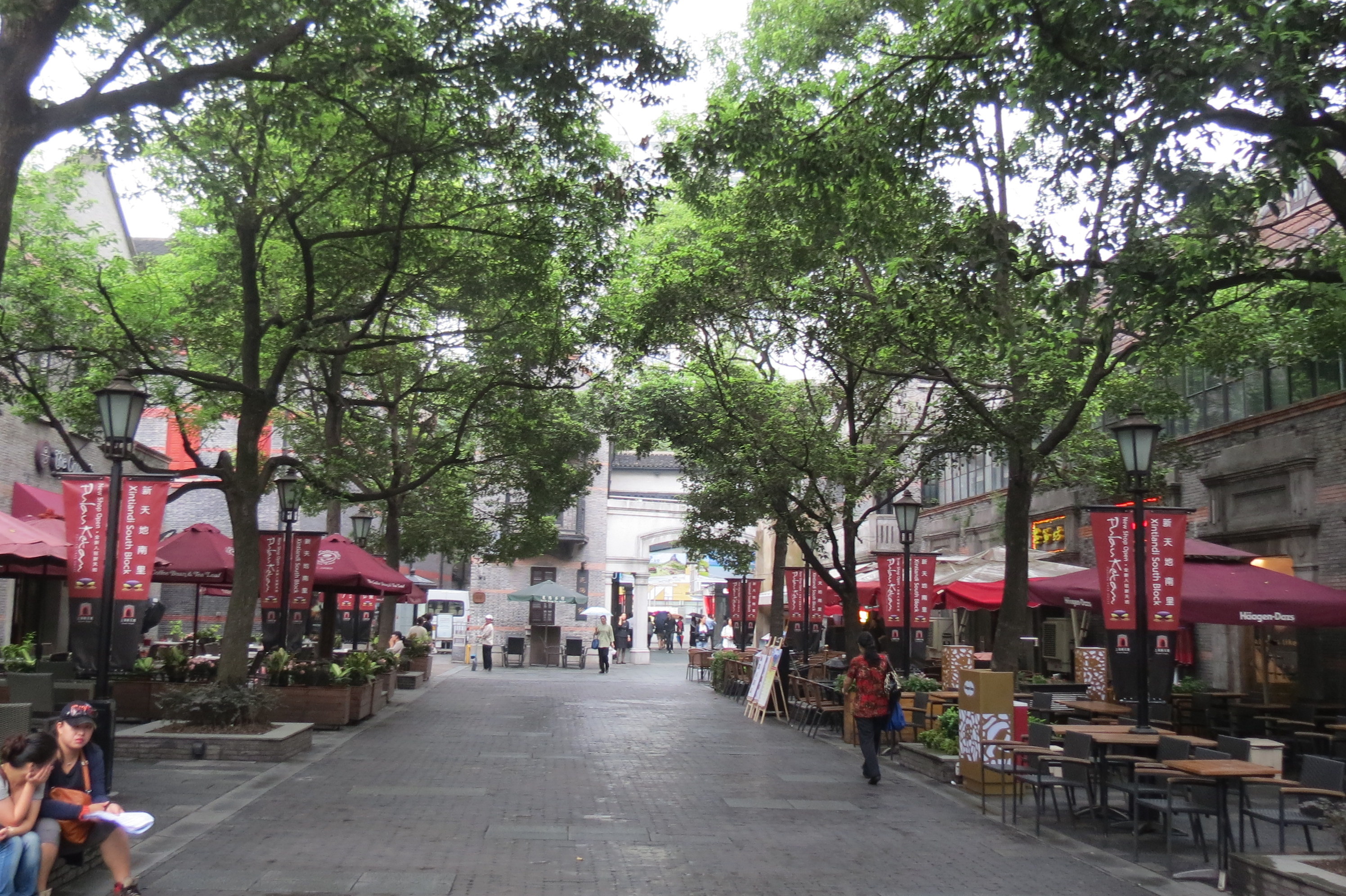
The French part of Shanghai is without doubt my favorite part. The streets are lined with French trees on both sides, and those trees tend to meet up above the middle of the street, creating a shaded relaxing atmosphere perfect for strolling along the usually wide sidewalks of the area. You could easily make the mistake of thinking that you are in Paris. Naturally, we started with Avenue Joffre, now called Huaihai Road, and made our way to Xin Tian Di (A New World), an area of shops and outdoor cafes that would make Paris proud.
As we walked through a beautiful park in the area, our guide remarked that there were very few pigeons around because some Chinese people had the habit of coming at night to steal them and eat them. We also went by a very large Apple store with a long line of people outside, probably waiting to buy the IPhone 5 which was announced earlier today in the USA.
After our walk through Xin Tian Di, we headed to another part of the French Concession, Tian Zi Fang lane, a maze of small alleys full of shops and restaurants. Quite bohemian in style, the maze is full of very eclectic establishments. You will find here everything from New York style pizza to spicy Thai food, belgian beer as well as chinese noodle shops.
Our guide then led us to a typical Shanganese restaurant, Home’s on Julu Lu. He wanted us to try what he considered to be the best Hongshao Rou (pork cooked with soy sauce) in the city. We also had another Shanghai specialty, No Rou Li (Beef in small pieces, served on a rice cracker with mushrooms) as well as Shanghai bok choy (Ji Mao Tai). According to Steven, our guide, the following is the proper order of food during the meal here in Shanghai: cold food, then meat, then vegetables, then soup, then dim sum/noodles/rice, then fruit.
Steven also indicated that most Chinese do not drink black tea; they drink green tea (Lu Cha), made from dried tea leaves. When Lynn asked him how close was the closest beach, he said one hour and twenty minutes for a beach where people wear no clothes. I am not sure whether I understood correctly; I will have to personally check that one out.
After lunch, with the rain increasing, we visited several parts of Shanghai in search of a good painting to purchase. That included the Shanghai Art Museum as well as the gallery at the Shanghai Grand Theatre.
For dinner, we went to Xinguang Jiu Jia, a restaurant specialized in one of the most famous delicacies of Shanghai, the hairy crab from Yangcheng lake. The hairy crab season is September and October, so we are in luck. People come from as far away as Taiwan and Hong Kong to eat at this restaurant. Our dinner consists of a set banquet menu of six dishes (the most basic banquet menu as the restaurant offers much more elaborate menus): 1. steamed crab claw meat 2. stir fried crab leg meat with asparagus 3. stir fried crab meat and crab roe 4. stir fried crab roe with mung bean noodles 5. dry noodles with crab meat 6. mini crab meat wonton scallion flavored soup made with crab meat.
As if that wasn’t enough, we headed for the Horizon Club lounge after our return to the hotel, initially looking for a glass of cognac, but ending up with two glasses of wine and some food still available from the happy hour offerings. On the way back to the hotel, Lynn was commenting on the large number of people out on the streets and in restaurants. The people in the city of Shanghai are out in the evening; this is not how it used to be.
Shanghai: the future of China
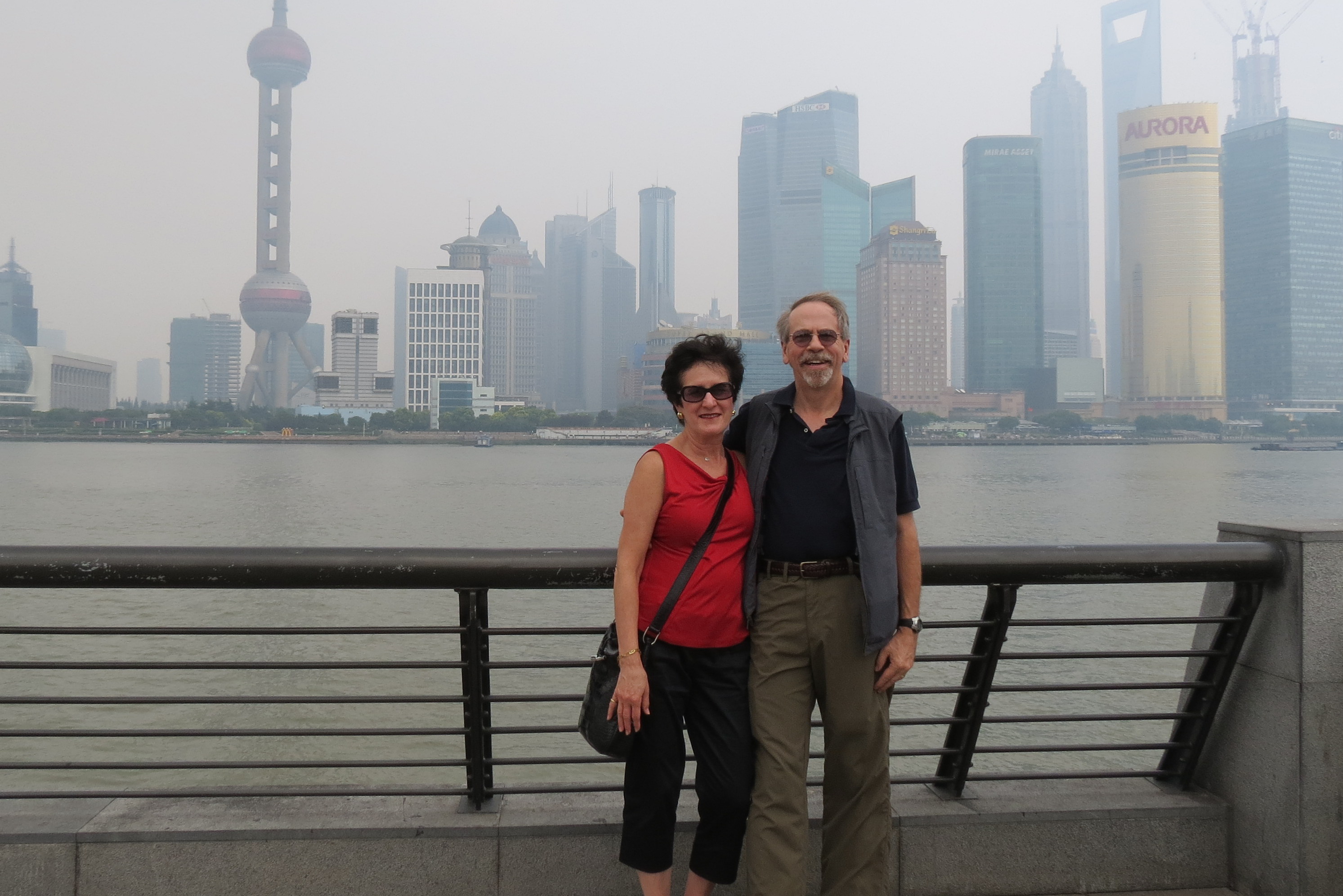 Shanghai, what a city! What progress it has made since I was last here. This is without doubt a world class city. I am sitting here at my desk with a phenomenal panoramic view of the Bund and the Huangpu river, wondering what to say about the day we have just had in one of the liveliest cities on the planet.
Our day started with a leisurely breakfast in the Horizon Club lounge on the 29th floor, after which we met our guide and driver and proceeded to our first stop for the day, the Oriental Pearl Tower, a very tall structure with two circular observation areas about 900 feet high providing fantastic views of all Shanghai; the lower observation area has a glass floor which Lynn did not dare to step on. Skyscrapers as far as the eye can see. Near the tower are the skyscrapers where Mission Impossible 3 was filmed, and where Tom Cruise crossed between two skyscrapers on a wire, an invaluable piece of information which makes the scenery that much more alluring. And at the foot of the tower is the Shanghai History Museum, which recreates the history of Shanghai in a most captivating manner. I could easily have spent the day there; it is extremely well done. You do need a piao (ticket) to get in.
Near the Oriental Pearl Tower is the Convention Center, which locals say was built to hide the unattractive chicken feet of the tower. According to our guide, the three most popular sports in China are, in order, soccer, basketball and ping pong.
We then drove across the Huangpu river to the Chinatown area, so called by the foreigners here because of its archway typical of so many Chinatowns in America and its reproduction of ancient chinese buildings. Nowadays, it is a maze of streets full of tourists shops and restaurants surrounding the famous Yu Yuan garden of Shanghai, which was our actual destination. In one of those streets, we walked past Xinxiang steamed bun restaurant, which our guide says is the most famous place for Shanghai’s xiaolongbao (Shanghai steamed dumplings); there is certainly a long line of people waiting to buy dumplings from the stall and eat them on the street just like we would eat a hot dog.
We had been forewarned by our guide about the unrelenting harassment in Chinatown by people putting beautiful pictures of watches or other products in front of us and offering to bring us to shops where we would find the most amazing deals. In practice, tourists who fall into that trap are led to a closed room which is then locked until the tourists buy some fake products at very high prices; they are locked in “because the police is outside and would stop them from offering these fabulous deals”.Alternatively, tourists are offered the chance to see a traditional chinese tea ceremony. The results is the same; they are trapped until they fork out a large sum of money. One learns quickly how to say “Wo pu yao” (I don’t want) in a firm manner.
Steven, our guide, being the thoughtful young man that he is, also reminds us of proper haggling etiquette. You take the price being asked for, you divide it in half, and then in half again, and that is what you offer back if you are interested; in other words, your comeback should be at 25% of what was being asked. The selling price should be somewhere between 30 and 40% of the price being asked for.
At the beautiful Yu Yuan garden, a large walled complex of beautiful and peaceful gardens and traditional chinese houses built in 1559 by a chinese official, Mr. Pun, Lynn gets the chance to feed hugely fat Chinese carp as well as admire Japanese koi fish of a similar size. We also try our luck at the wishing waterfall, where, after making a wish, and most importantly after you uncover where the four stone dragons are hidden among the stones, you throw a coin onto the stones; if your coin stays on the stone, your wish is granted. If it falls into the water, you will just have to wait for your wish to be granted.
As we walk by stone lions on duty in front of an old chinese house, our guide tells us that the male lion statue in China always shows the right paw over a round ball, a symbol of power, and the male lion is always on the left side (feng shui). The female lion statue has the left paw over a baby and is always on the right side.
We then make our way to a nearby restaurant, Din Tai Fung, for lunch. I knew of that name; it is part of a chain of Taiwanese restaurants specialized in and reputed for their dim sum. In our case, we are interested to go there to taste the most famous Shanghai dumpling of them all, the shie fun xiaolongbao (steamed dumpling with crab meat), as well as the niaorou mien (Shanghai beef noodle soup). Lynn always has green vegetables with her meal, so we order some jie lau as well. To drink with that, we go for Long Jing cha (Dragon Well tea), the number one tea in China which comes from the city I know best Hangzhou (where I created a joint venture years ago). Interestingly, our guide puts down the teapot with the spout aimed straight at me; oh oh, have I become a male prostitute? Upon questioning, he says he has no knowledge of this “superstition”, just another of those Beijing ignorant beliefs. Interestingly, this restaurant, like others I have seen during our trip, has chair back covers which waitresses bring and set up whenever they see something like a purse of a bag on a chair; the cover protects both the back of the chair and the belonging from being either snatched or forgotten.
I should also mention toothpick etiquette in China. Most men use toothpicks here as I do, probably as a result of decades of sub-standard dental care; but they all use toothpicks in the same manner, using both hands, one for the tooth pick, the other to hide the first hand and the toothpick. It would seem that it is very bad manners to let other people watch you in full toothpicking mode.
Everything is made fresh daily at Din Tai Fung and you can even watch the whole process of making steamed dumplings behind a glass window. I am able to not only get the bill (maitan), but also get a receipt (fa piao). And the te suo (toilets) are spotless and high tech; I used to take photos of the toilets I went in but that was purely professional necessity. I have now given up the practice, although it would have proven most interesting (at least to me) on this trip. I can just imagine Lynn’s reaction to slideshow of chinese toilets in our family room.
After lunch, we drove to the Bund, the most famous area of Shanghai if not of China, that semi-circular stretch of about 1.5 kilometers along the Huangpu river with a broad boardwalk and the most important colonial buildings of the British concession in Shanghai. The custom house and the chinese “Big Ben” (which we heard ringing as we walked by) are some of its most famous buildings. We also gave some attention to the Sasoon building, with its green triangular top, built by a rich Jewish family; we were unaware that a contingent of Jews who fled the second world war in Europe found refuge in Shanghai after being denied entry into Japan. Our guide says that the current prime minister of Israel, Ben Netanyahu (a classmate of Lynn’s at Cheltenham High School), was born in Shanghai; neither of us was ware of that fact. I will need to verify that.
We then head for Renmin square (People square), which used to be a racetrack in colonial times, and now is the center of Shanghai. In its midst lies the circular Shanghai museum; but that is not our destination. We are going next door to the Shanghai Urban Planning Exhibition Hall, which houses a huge small scale model of the whole city as well as offers a 360 degree helicopter-ride movie of the city. We discover the site of the 2010 World Expo, the size and location of Central Park (based on New York’s central park), the main areas of expansion of Shanghai over the past 20 years and its plans for the next 20.
Unfortunately, the Exhibition Hall is located right next to a major shopping area of Shanghai, and we could not resist taking a walk through a couple of department stores just across the street. They are humongous and filled with goods from all over the world. We were looking in particular for some products of interest to Dominique, relative to her startup business. I take notice of the broad boulevards, the broad tree lined sidewalks; my goodness, this is becoming such a beautiful city.
We then retreated to our hotel, for a quick rest before our formal dinner at Jade on 36, the French restaurant on top of the Shangri-La Hotel, where we were greeted by the Chef, Frank Elie. He basically explained his creations and helped us choose our menu; this was not chinese food, this was original French food at its most creative. I decided on a Gigondas to go with the veal and lamb dishes we had selected; that proved to be an excellent choice. Our table was by the window overlooking the Bund and the colored boats plying the Huangpu river, a sight unequaled anywhere in the world.
From Yichang to Shanghai
 Our Chinese is getting better; sao dan (wait a moment), pu yong shie (you’re welcome), pie tan shin (don’t worry) are some of our latest additions.
And I can’t believe how fantastic the music played on the ship’s speaker system has been. A tremendous mix of relaxing, varied music from the world over; I would have liked to meet whoever put this together.
One disadvantage of being on a Chinese ship is the difficulty in finding out what’s going on. When everyone is together in the dining hall or in the lounge, for instance, and an announcement is made about the day’s program or a change in schedule, that announcement is first made in chinese and then repeated in english. Unfortunately, as soon as the chinese language announcement is finished, everyone starts talking loudly about it so that we can’t understand what the chinese announcer is trying to say in english. He would be very difficult to understand even if everyone was silent given how poor his pronounciation is; but add to it the noise of the conversation of 300 chinese and one does not stand a chance to follow what’s going on.
It turns out that I did miss the crossing of the Three Gorges dam locks. When I woke up, our ship was docked downstream from the dam; for the first time during our trip, internet reception was spotty there. At breakfast, our new friends from Guanzhou issued an invitation for us to visit them in Guandong. I took the opportunity to give a good tip to two of the waiters who had taken such great care of us during the cruise. We then retired to our cabin to pack up our bags and basically pass the time until the ship makes its last run down through the third gorge, Xiling gorge, before docking in Yichang.
The ship was running behind schedule, and it looked like we would not have time to have lunch in Yichang, but would have to drive straight from the ship to the airport for the flight to Shanghai. Lynn called room service to ask for bananas (sorry, out of bananas), or anything else they might be able to put together for us even though we had already checked out. We waited for a while and were about to give up when one of the waiters we had tipped that morning shows up carrying a platter of two club sandwiches, banana bread and potato hash brown. On the house, he says.
The run through Xiling gorge was made in foggy weather, yet again, and with the ship going downstream quickly in order to make up some time. We spent half of that time carrying our luggage down to deck one and positioning ourselves for a quick exit once the ship docked at Yichang. I have never liked the last day of a cruise and this was no exception. All the services shut down, the hallways are full of suitcases, the lounges full of people with their belongings, and, in my case, you worry about how to handle the departure from the ship. How will I get our luggage off this ship?
We were among the first to go through the exit area when the ship finally docked, about an hour behind schedule. As we were making our way down the last corridor before exiting the ship, a group of guides boarded the ship as well as a ban ban porter whom I quickly grabbed. Again, he used the stick across the shoulders system to carry both of our suitcases out of the ship up a steep slope towards the parking lot where our driver was waiting.
My verdict on this whole cruise down the Yangtze river: not worth the money nor the time by itself. I think that Western cruise lines are investing heavily in building ships for this cruise and will make it a destination like Alaska or Norwegian fjords, but it should not be mistaken for visiting China just like looking at an Alaskan glacier does not tell you too much about life in the United States.
We headed straight for the airport, so did not get a chance to visit Yichang, a town of one and half million people. We drove past a new train station whose size astounded me; the width of that station building must have been several football fields. An interesting comment our guide made along the way was that the status symbols of the new middle class in China seems to be a BMW and a membership in a golf club.
The first class setup at the Yichang airport was reminiscent of the old days, in that first class passengers not only have their own lounge, but they also go straight from the lounge through their own private security check and their own entrance onto the boarding corridor to the plane; and a beautiful young woman in traditional chinese dress accompanies you during the whole process. This is as convenient as you can get, and used to be the way things were done in the China I used to travel. I was glad to see it has not completely disappeared yet.
We were flying Shanghai Airlines this time around for the one and a half hour flight; we left fifteen minutes early and landed fifteen minutes early at the old Hongqiao airport. But this was not the old airport I knew as we taxied at the vast and modern terminal two. In one swoop, we went from rural China to twenty first century China.
Steven, our guide for Shanghai, commented on the way from the airport that in 2008, four years ago, someone counted more than 4,000 buildings in Shanghai had more than 20 stories. I wonder what the number is now. He also mentioned the tallest building in Shanghai, the World Financial Center building, at 100 floors and 492 meters high, and its nickname, the can opener building; one look at the building and you will understand.
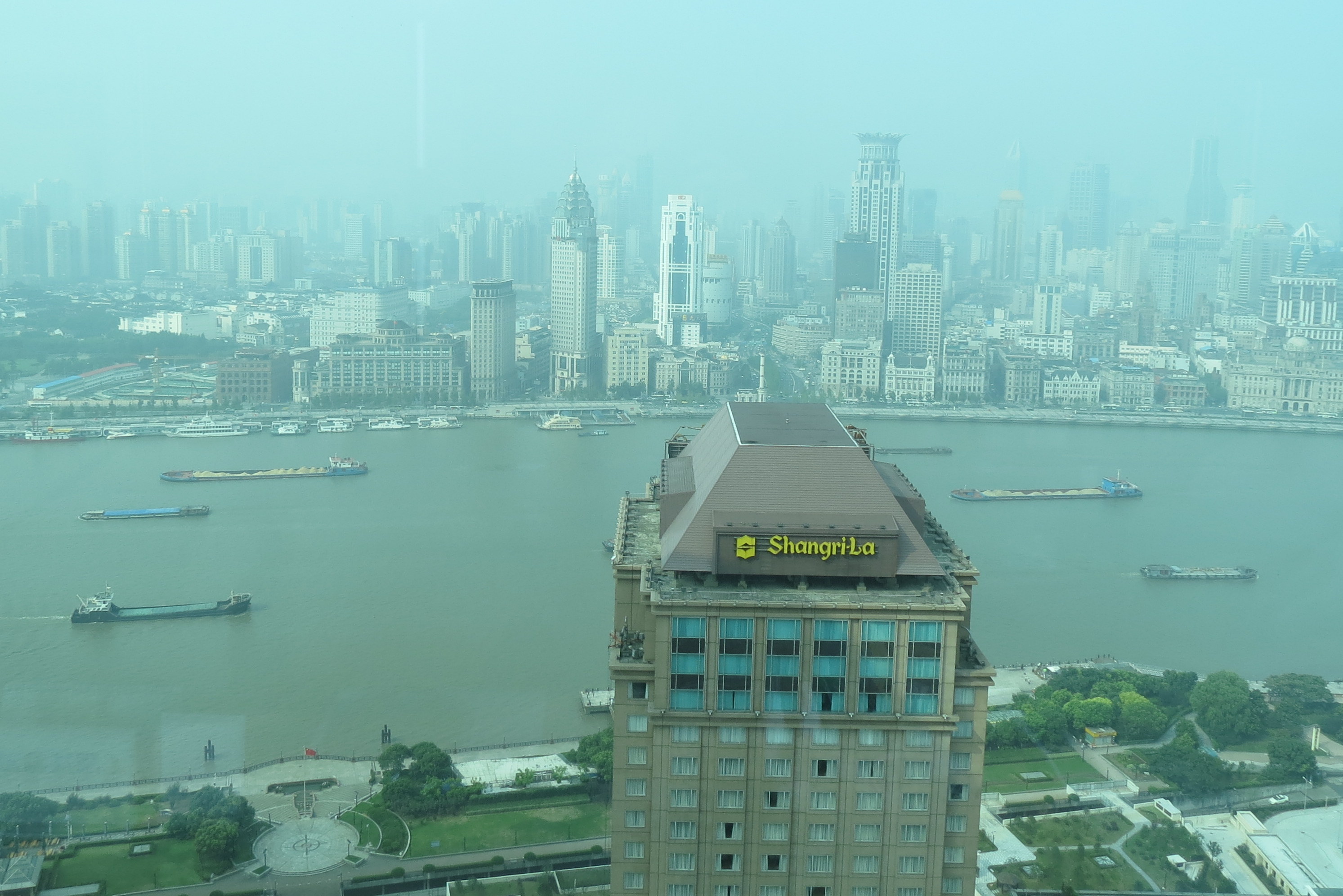
The room we have been given at the Pudong Shangri La hotel is just out of this world. It is on the 34th floor and overlooks the Bund just across the Huangpu river. Our bedroom is a long rectangular room whose long side consists of floor to ceiling windows offering a panoramic view of the Bund and the Huangpu river. I can’t think of anyone in Shanghai having a better view of the city. This certainly compares with the view of Hong Kong island from the Kowloon Shangri La.
We were escorted to our room and to the Horizon Cllub lounge by the assistant manager of the hotel, who happens to be a Canadian from Vancouver. He mentioned that the Shangri la chain is planning a push into the North American marketplace and that is one of the reasons he was hired. After I had inquired from him about the tea used for the welcoming teapot provided to guests, he later came back to see us in the Horizon Club lounge to say that he had telephoned both the Kowloon and the Xi’An Shangri La hotels and that they both were using Mo Li jasmine tea.
Yes, our box of dark chocolates was waiting for us in the room with a happy annniversary card. But then, after we came back from the happy hour at the Club lounge, we found another chocolate gift waiting for us, this time a tall sculpture made out of chocolate surrounded by sixteen chocolates in the form of a heart.
Chang Jiang Huang Jin Yi Hao
 Chang Jiang Huang Jin Yi Hao is the name of our cruise ship; it means Yangtze Gold One in Chinese, who don’t use the term Yangtze. For them, it’s Chang Jiang, the Long (or is it Eternal) River.
It is two thirty in the morning as I start writing this posting. I have just woken up and realized, to my dismay, that our ship is in the process of docking against the hull of Yangtze Gold 2. We were scheduled to start going through the five tier locks of the Three Gorges dam at 11pm, but I fell asleep before then. Did I really miss it all? The water is totally calm, and the edges of the water are straight and man-made. This might imply that we are in a holding area, in between locks, so that there might still be a chance of more locks to come. We shall see.
In any case, we had a good day on the waters of the Chang Jiang.
We were docked in Baidu City this morning, with another cruise ship on either side of us. We have seen a lot of other cruise ships during the cruise, and I have every reason to believe that our ship is the best of them all. I have seen ships with no cabin balconies, with small outside areas, with a dirty and old appearance. The Victoria cruise line ships we saw, even though I am told provide the most attentive service, looked very small, old and dirty.
After another wonderful buffet breakfast, we elected to stay aboard rather than to take the excursion to Baidu City. Lynn and I went to talk to the silk painting artist on board, finally deciding on three silk paintings representing each of the three gorges. As we were talking with him, I overhead some beautiful music being played, which I recognized as the starting music of the movie Midnight in Paris. Lo and behold, a few feet away was the ship’s cinema, totally empty, with the giant screen showing the movie in english with chinese subtitles. We decided to sit down and watch it for a while, that is until a young female attendant approached us and told us that, unless we had a movie ticket, we would have to pay 55 yuan to watch the movie, and that included free juice and popcorn. We elected to leave and head for the forward lounge on deck five. After all, we were not taking a cruise in China in order to watch an American movie we have seen several times.
A few minutes later, the young female attendant found us relaxing in the lounge and came to tell us that, even though we did not have a ticket, we were welcome to watch the movie. I would find out later that we were supposed to have received an envelope at check-in containing various tickets and info, something we never received; all I got was a room key!
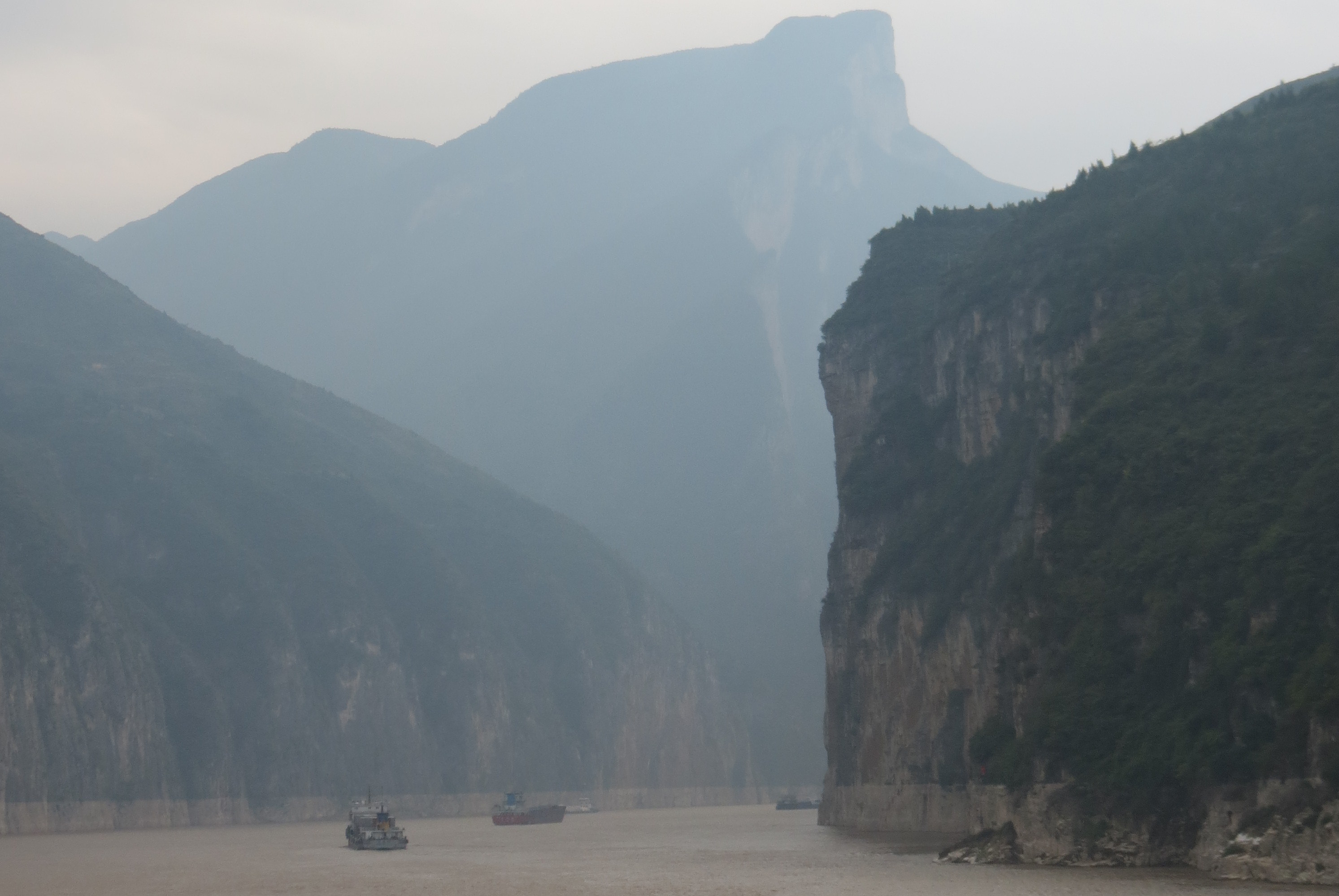
At around 11am, right after the excursion group came back aboard, our ship left for its passage through the first gorge, Qutang gorge. It was indeed magnificent to enter and go through the narrow Chang Jiang between steep cliffs and tall mountains. The weather was still foggy, and the waters still brown and muddy, but we enjoyed it nevertheless. I took a lot of pictures and will have to go through them to see which ones best reflect what we saw, and whether any resemble the silk painting we bought of Qutang gorge.
After yet another fattening buffet lunch, we took what we considered the most important shore excursion of the cruise, the excursion down the Daning river, a subsidiary of the Yangtze, to what are referred to as the Lesser Three Gorges. The ship docked at Wushan, a small town of about one million people, and we took a smaller three deck tour boat down the Daning river, which got progressively narrower and narrower until two hours later, when it became so small we were all transferred to sampan style boats for a half hour trip further down the river.
The scenery was indeed magnificent. However, the logistics of it was disappointing to say the least, although informative and revealing. First, we were bombarded the whole time by the shrill and extremely loud and deafening voice of a chinese woman screaming what I assumed was descriptive tour information through the boat’s loudspeaker system. There was no place to hide from that noise, and no way to hear clearly what the english tour guide assigned to us tried to tell us. The boat was dirty, and the sole escape we could find from the crowd and the noise was on the top outside deck, which was not as crowded simply because we had to bribe the attendants to let us through under the pretext that we were buying their lukewarm undrinkable thermos tea. Of course, we had to put up with all the cigarette smoke on the top deck, because I guess that was the only place smokers could go on that boat. Not exactly what I would call a comfortable shore excursion.
The transfer into the sampans boat was a well organized mass production operation. You had the feeling of being canned into a sardine can. Tourists were leaving sampans on one side of the dock as tourists were entering sampans on the other, and then leaving in an unceasing procession, one behind the other. Once aboard the sampan, a Chinese stood up and started shrieking (I think he would claim to have been singing), and followed that act by going around the boat asking for “donations” in exchange for a flea market key chain. To top it off, we passed by a sampan boat moored by the edge of the cliffs where three Chinese attempted to “serenade” us, supposedly singing a folk song of the area; they were clearly people who had taken up singing late in life! It really sounded to me like machinery in need of greasing. After a while, the parade of boats simply turns around and goes back, which entitles you to be serenaded again as you go by the marooned boat a second time. The whole thing was tacky.
I was thankful when we finally returned to the peace and comfort of our ship.
The Yangtze Gold One then left to go through the second gorge, Wu gorge, even more magnificent than the first with its tall pointed mountain peaks. It was very windy outside, so we watched most of it from the comfort of the forward lounge on deck five, while we shared a beer and some snacks.
We returned to our cabin shortly before 7pm, the time which our english language program set for the captain’s farewell dinner in the main dining hall, only to receive a phone call telling us to come to the main dining hall as dinner tonight was table service (rather than buffet) and dinner was currently being served. We would find out that dinner had started at 6:30pm, which was the time given to the Chinese (everyone else on board). In any case, when we entered the main dining hall, we were informed that we had been assigned table 20, not easy to find in this huge dining hall containing about 40 round tables full of people. We suddenly saw arms waving at us; it was the young Chinese woman Lynn had befriended in the VIP restaurant and her father, who were beckoning us to indicate that we were assigned to their table, table 20, which was full of people from their hometown, Guanzhou. Clearly, they had organized to have us invited to their table.
What followed was a feast Lynn and I will remember for a long time. This was the type of Chinese meal I had come to experience when I came to China on business years ago. The round table of ten people had a large lady susan in the middle, which is kept full of dishes by the attendants. One just turns the lady susan to take whatever food one likes. There are a dozen or so dishes on the lady susan, and as soon as a platter is finished, the attendants bring a new dish. We probably went through thirty different types of food or more. One of the Chinese men had brought a huge bottle of cognac which he shared with me; in return, I ordered a bottle of red wine, which Lynn and I shared with them. The conversation was extremely lively, despite the language difficulties; the young woman spent a great deal of time translating for us. I had a great debate with one of the chinese men about who was older (turns out I was older than him by eight days, as duly proven by our having to show our driver’s license).
Cruising down the Yangtze river
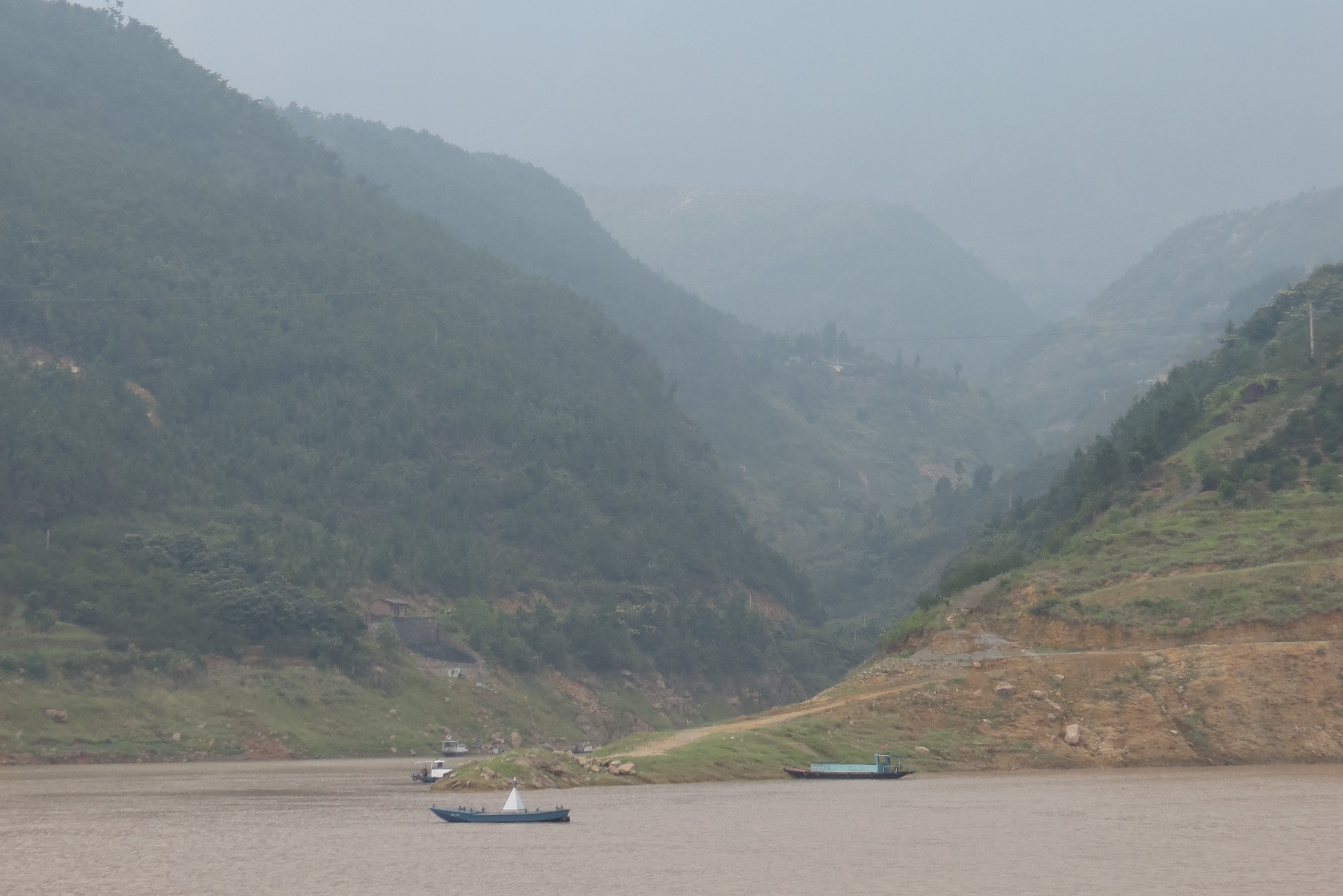 Our first day cruising down the Yangtze river towards the Three Gorges was rather quiet and uneventful.
I had purposely selected the three day (in reality two and a half days) downstream cruise, rather than the four day upstream one, partly because of the time factor, and partly because going downstream would mean much less engine noise and vibration.
When I woke up this morning, I was surprised to realize that we were still docked in Chongqing. We had not moved an inch, even though we had been scheduled to leave the prior evening at 10pm; the noise and vibration I felt during the night came from the numerous cargo barges passing us by. We actually departed at about 6am, which was great since it allowed us to take in the full view of the ship going by Chongqing and down the river. I should say limited view, because it was extremely foggy and would remain that way for a good part of the day as the ship made its way past miles and miles of skyscrapers, docks and factories. The river is rather wide during the first day of the cruise; it is supposed to narrow significantly when we arrive near the Three Gorges which we are supposed to go through on our second day. Those three gorges, Qutang, Wu and Xiling are sometimes considered as the number one tourist attraction in China, so we are looking forward to it.
We ventured out to breakfast this morning still reeling from the experience of the previous night, and very wary of what we would find. Meals are buffet style on these ships, and you are assigned a table. Well, it turns out that, probably because of what happened the previous evening, we got assigned the VIP restaurant on deck six rather than the main dining hall on deck two. This means that Lynn and I are assigned to eat in a restaurant which serves only three other tables, rather than the main dining hall which serves something like 300 people. The buffet in the VIP restaurant is a full buffet, just like in the main dining hall, and there is enough food to accommodate a hundred people. I can’t believe the layout of the breakfast buffet; in addition to everything you could hope for in a western-style buffet (eggs, hash brown, tomato, beans, bacon, sausage, etc…), there is an even bigger Chinese-style breakfast buffet, from congee to dumplings, from noodles to rice, etc… And yes, they have the egg and tomato dish I had been waiting to try all of this trip. This is breakfast heaven.
Lynn in fact was so thrilled by the Chinese layout that she decides to have a full Chinese breakfast. Meanwhile, I use my US cellphone to call Dominique in San Francisco using Skype via my mobile hotspot, and I am thrilled to see that it works rather well. So here I am, watching the Yangtze go by and talking to Dominique in SF;cool.
Lynn and I are learning some more Chinese words out of necessity. Lynn knows how to order lu cha (green tea), and I can now have my coffee tong (hot). We had to ask for kuaize (chopsticks) as the staff assumed we ate with forks and knives and could not handle the chopsticks; we are actually quite good at it now. There was a bit of a commotion at one point during breakfast; I could see the staff huddling around the buffet table, until one of them walked over to me carrying my toasted bread on a plate. He was very apologetic, and I could guess that he was asking me whether they should do another one. He pointed at a small spot of black on what was to me a perfectly well toasted piece of bread. I could only smile and reassure him that all was well.
We had similar buffet arrangements for lunch and for dinner, and I have been having my fill of Chinese noodles and assorted dishes, from spiced duck to pork feet with beans, from steamed seafood egg to Chinese pizza. We have come to know the staff well, and were even invited to join one of the other three tables for dinner as Lynn came to befriend a young woman who recently graduated from university and speaks enough English to communicate with us.
One advantage of being on a Chinese ship is that the shops on board have very reasonable prices; Lynn has been eyeing a large silk painting which might fit well in our townhouse.
We did have our massages in the afternoon. Mine was a bit of an adventure, as they first sent in a man to give me the massage. I objected, stating that I was not gay and wanted a woman. Yo Yo then came in, a young pretty woman, who then proceeded to treat my back like a piece of dough being rolled. For a while, I was wondering if I would survive the experience. But it did get better, and I particularly enjoyed the face and head massage which she gave me at the end. Having my eyelids massaged was definitely a first for me.
We briefly attended the captain’s welcome party, which included a dance performance by four couples all dressed in white (looked like wedding dresses to me) doing slow ballroom dancing on a stage. Free popcorn was included, although we arrived too late to get any. We elected not to go to the evening cabaret show, which was supposed to include both more dancing performances as well as Sichuan opera (which consists essentially of quick face mask changing at the beat of deafening drum noise).
Meanwhile, the scenery along the river has been gradually improving. We are in for a treat.
Yangtze Gold One
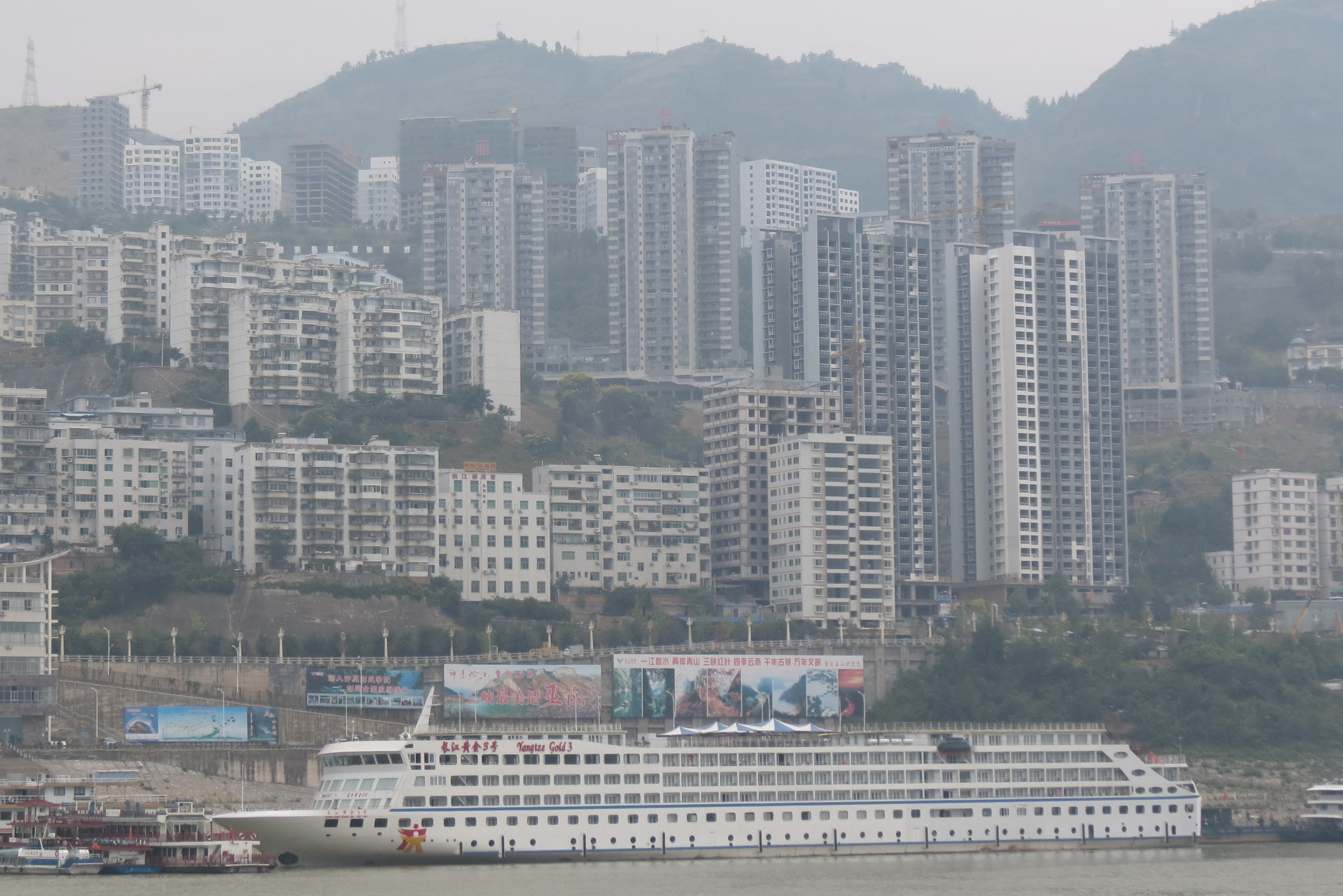 The Yangtze Gold One is the first of a new series of river cruise ships commissioned by a Chongqing based company specifically for the Yangtze river cruise. It was launched just a few months ago and is supposed to be a five star ship.
After a ban ban porter carries our two suitcases aboard (what a look he gave me when I tipped him a generous ten yuan; go back to hell you cheap foreign devil is what I thought he meant to convey), we go check in at the reception counter on deck two; the ship does look new and gold and mahonagy seem to be the main colors. I am asked to leave our passports overnight for the usual police check and we head for our cabin in the forward area of deck three. I ask Charlie, our Chongqing guide, to come with us; the cabin more than checks out. It is spacious, clean and with almost all the commodities one could hope for, including air conditioning, fully room darkening curtains, a balcony with two chairs and a table, slippers, bathrobes, a rain forest shower, hair dryer, lcd cable tv, stereo system, minibar, safe, etc… At the desk is an Ethernet connection with a paper claiming that they offer broadband internet in every cabin.
There seems to be no bottle water in the room, however; so we ask Charlie if we can buy all of the water bottles in his vehicle. He agrees and goes to fetch the eighteen or so bottles left over from our day in Chongqing. Lynn then dutifully fills the evaluation sheet which every guide seems to be required to obtain from us before we leave them; since we have to give the evaluation sheet back to the guide himself, we do not find it appropriate to give them anything but glowing comments. That is a practice the agency should change.
After Charlie leaves, I examine the room in a little more detail. The electrical plugs in the room are either two prongs or the inverted angle type, which means that I need to dig up some of my adapters stored in my backpack. In a later blog, I may well tell you the inventory I keep in my backpack for this sort of occasion. There might be Ethernet internet, but I can’t make it work, so I’ll continue to rely on my hotspot. There seems to be no spare Kleenex or spare toilet paper, so we need to call for some. The tv has a few English channels, but no CNN, and more importantly, the ship information channel, the channel which carries information about the program of the day and any and all announcements is only in Chinese. That is when I began to realize that we had truly booked ourselves onto a Chinese ship; it dawned on me that we might be the only non-Chinese aboard! We can’t tell because we are the only passengers aboard as far as we know, so we’ll have to wait to find out.
I examine the information binder which we have in the room. It is bilingual Chinese and English, although the English would qualify for a mention on the Jay Leno show. As an illustration, let me copy verbatim the description for the VIP restaurant on deck no 6: “VIP restaurant covers area about 300sq and only serve for 80 customers. There is great environment and beautiful outlook during the dinnings.” Room service is availab?le until 1am.
After checking with the front desk, we are informed that there is an English language program, and they will make a photocopy of it for us if we go to the reception desk every day. What about the movie theatre on the ship? It will have English sub-titles.
We finally head to the main dining room on deck two to try to grab some dinner. We had been told that dinner on the evening of boarding was not included in the cruise price, but would be available as an extra
. We entered this large dining hall, full of large empty round tables save one, and sat down for dinner. There were several staff on duty, and one brought us an English language dinner menu, which consisted of six to eight pages of about twenty or so large text and large picture main course dishes, like spaghetti Bolognese, or steamed dumplings. Lynn asked: Do you have any vegetables? Vegetables was a word the staff did not understand, so they retreated in a corner. I looked up the word vegetable on the English Chinese app on my iphone (a great app by the way, it speaks the Chinese word as well as shows it in both Chinese and pinyin characters), and waited for the staff to return.
But no one came. We waited a long time before Lynn had enough of it, stood up and walked over to the staff. I could see the staff in full retreat as Lynn charged ahead, finally ending up with a woman officer with lots of stripes on her shoulder and a comprehensible English. “You should not have taken our money and let us board if you can’t serve us in English”, Lynn was saying as the officer tried to apologize and find a face saving way out. Lots of discussion ensued; suffice it to say that we ended up being served not only our main course, spaghetti Bolognese (I was in no mood to experiment), but also two superb vegetable dishes, the bok choi which Lynn asked for as well as Chinese water spinach, a superbly tasty vegetable which was on the house.
During our meal, the passengers for the coming cruise boarded in droves, and yes, they were all Chinese. We are the only foreign devils on this cruise, and we are going to have to speak Chinese to get anywhere. Isn’t that great?
Our day in Chongqing
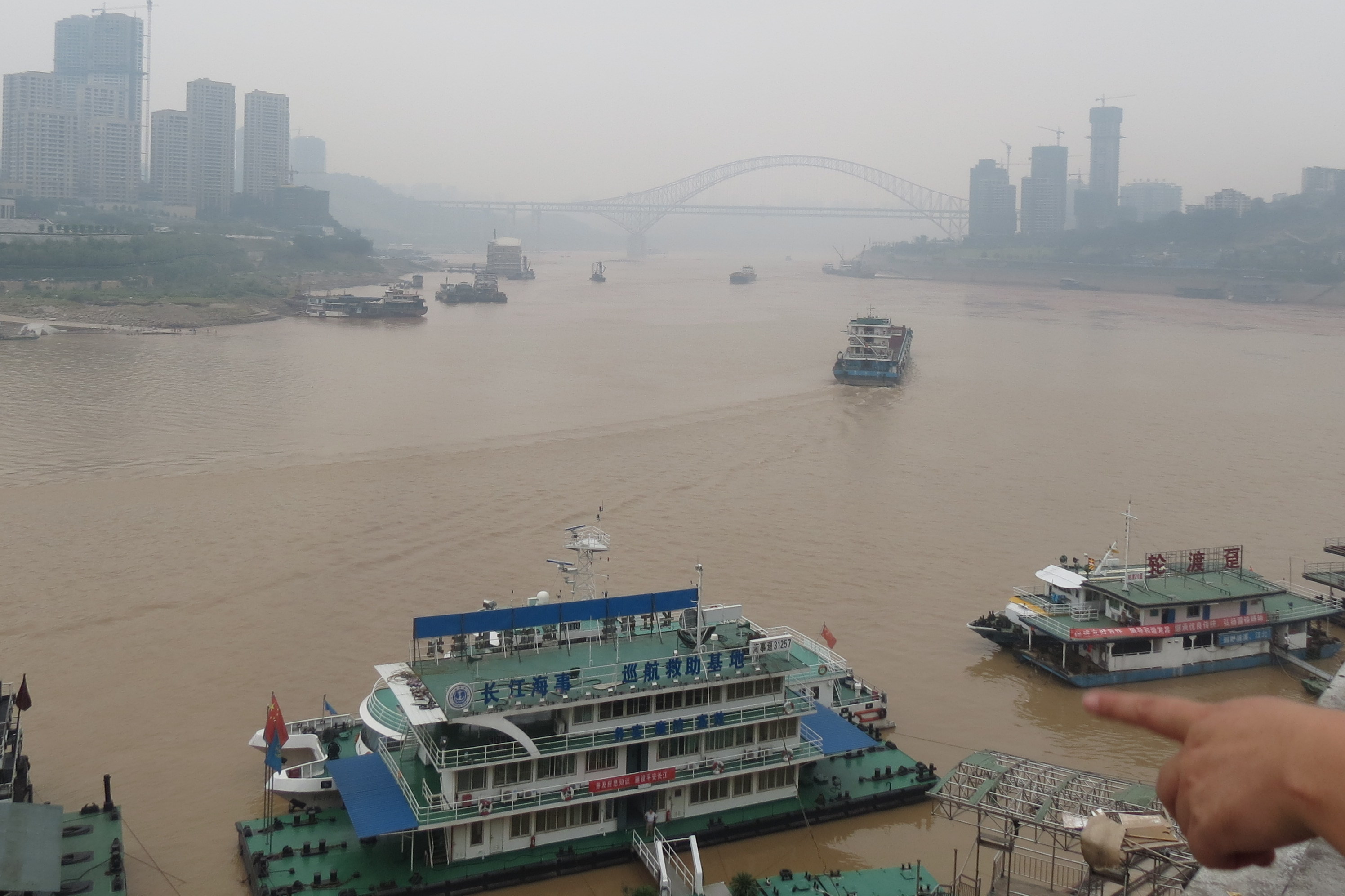 This is nothing short of fantastic. As I am sitting down to write this blog, in the observation lounge on deck 5 of our cruise ship down the Yangtze river, the speaker system is playing my favorite Chinese song, actually the only one I know and which I sang in many karaoke sessions during my travels to China many years ago. The title is something like Yuelandao Biaodeshing, which means The Moon represents My Heart. It is such a beautiful song, and I know the words! Ni wen wo ai ni … You ask if I love you… The song was made famous by a stunningly beautiful young woman singer from Taiwan, Teng Lee Jun, who unfortunately died young. My Chinese interpreter, who traveled with me for years during all of my trips to China, used to sing that song at every karaoke session which seemed to follow each business meeting we had with a state enterprise in China. I finally asked him to teach me the song so that I could sing it also!
I have just left Lynn on deck 1 for a one hour foot massage; later today, both Lynn and I will get a 90-minute Chinese health massage while the rest of the ship goes out to visit Fengdu (Ghost City) in which we have no interest. Anyway, more about our Yangtze cruise later; let’s get back to where I was in my blog, the arrival in Chongqing.
In my earlier posting, I forgot to mention that my travel vest also contains a small botlle of hand sanitizer, insect repellent, sunscreen, two pens and a notebook. The 3×5 notebook (and I have four spare notebooks in my suitcase) is my most used possession on the trip; that is where I jot down notes on anything and everything as we go about our day.
Let’s get back to Chongqing, the biggest city in the world, with a population of over 32 million. It is located at the junction of the JiaNin and Yangtze rivers. It is sometimes referred to as the Mountain City because it sits on the steep hilly edges of the rivers (which is also why you won’t see bicycles there), sometimes as the Foggy City, and there was plenty of it during our stay there, and sometimes as the Spicy City, since this is the true home of the hot pot as our guide was quick to remind us. Hot Pot came from the meals served to the porters working the docks of Chongqing.
Chongqing has a long history dating back thousands of years and I’ll let you do your own reading about that. Chongqing is a major industrial city; there are several motorcycles and car factories here as well as chemical, steel, coal, textile, … The city occupies a vast area (470km wide at its widest) and all you see are hundreds of skyscrapers on every hill you can see. But we are only here really because it is the main embarkation point for cruises down the Yangtze rivers; 40 different cruise ships do the cruise from here.
Charlie , our guide for our day in Chongqing, describes himself as a small Buddha and he certainly has the stomach to fit the name. We informed him right away that we did not wish to do the scheduled visit of the Three Gorges Dam museum, but would rather use the time in different ways. That probably threw him off his stride, because I found spending the rest of the day with him very difficult and unsatisfying. I just could not get a straight answer out of him, whether it be the translation of a Chinese word, or even a simple question such as whether the teahouse has ice cubes. Which is why we later declined to have dinner with him and we boarded our ship as soon as we could. First, we head to Ciqiku, an area going back 1,800 years which used to be the old port of Chongqing and has now become a series of streets similar to Jinli street in Chengdu or the Muslim street in Xi’An. Small
streets with old wooden Chinese buildings full of shops and stalls offering everything from food, snacks, souvenirs, etc… The street is very crowded and it is hard to make our way forward to the shores of the JiaNin river. One stall in particular has the biggest following; there is a long line of people waiting to buy some type of food there, which is freshly bagged for them and which they carry away in large bags. It is Mahua, a favorite local fried snack made of sticky rice and sesame.
Further down the street, I think I have reached an open sewer area, but I am told it is the smell of doufu (tofu). Well, now you know what I think of tofu.
We then left Ciqiku to have lunch in the downtown area. My negotiations with the guide relative to where we should have lunch were very long and very frustrating, but he eventually brought us to a very fine Chongqing restaurant, Yi Pin Xiang Jiu Lou restaurant, where we had a feast. Kung Pao Jiding (Kung Pao chicken), Piao Xiang Lou Rou (beef with green peppers), Jidan Mian (noodles with fried eggs), Ye San Tun (mushroom dish). Always with a platter of fresh fruit at the end.
We then took a five minute walk to what our guide called city hall, otherwise referred to as Congress Hall, a majestic Chinese structure with a pagoda-style roof sitting atop a hill and containing a large concert hall as well as a tourist office and two floors used by the Arts Institute of Chongqing to display the art of its students.
We then asked our guide to bring us to the Carrefour (part of the French chain of hypermarkets Lynn and I are very familiar with) store we knew existed in the city. For two days now, Lynn and I had been unsuccessfully trying to buy her some hair spray. The hotel staff brought her some gel spray, the beauty salon tried to sell her some other type of spray, wherever we turned we just could not get the right product. So we had had Ben, our Chengdu guide, write the proper Chinese characters for the “hair spray which helps hold the hair in place” on a page of my notebook and we were now going to execute our plan to locate hair spray at Carrefour.
As luck would have it, the first thing we saw as we stepped into the Carrefour entrance, was a beauty products shop carrying both Chinese and imported products; Lynn had her hair spray a minute later. So we used a few more minutes to walk down the aisles of this Chinese Carrefour, stocked with mostly Chinese products, and used the opportunity to buy some chocolate for our time on the ship.
We then walked over to an area called Hongya Cave, which housed a huge multi-story building full of souvenir shops, international restaurants, etc…. We pretty much exhausted ourselves walking through several floors of this structure before we collapsed at one of its teahouses. I kept looking at my watch, hoping that five o’oclock would come soon, the earliest time at which we could board the ship.
But since there was time left, we asked our guide to drive us to the edges of the Yangtze river, which we had yet to see. He somehow tried to dissuade us from that, offering to bring us to a temple of some sort. Thankfully, we resisted, because we then drove to perhaps what should be the first stop on a visit to Chongqing, the grand square overlooking the Yangtze river. I think the name of the square is something like Tainiamen square (as I said, I could not get a straight answer from our guide) and it is a huge plaza full of people, including some flying kites going several hundred meters into the air. From there you get a phenomenal view of Chongqing, of the junction of the JiaNin and Yangtze rivers, of some of the cruise docks below. In addition, you can walk from that plaza along the Yangtze river along a broad sidewalk for quite a distance. In fact, we ended up virtually walking to our ship, which we reached shortly after 4:30pm.
Even though we were early, I took the chance and stepped aboard our ship, the Yangtze Gold One.
Chongqing: mountain city, foggy city
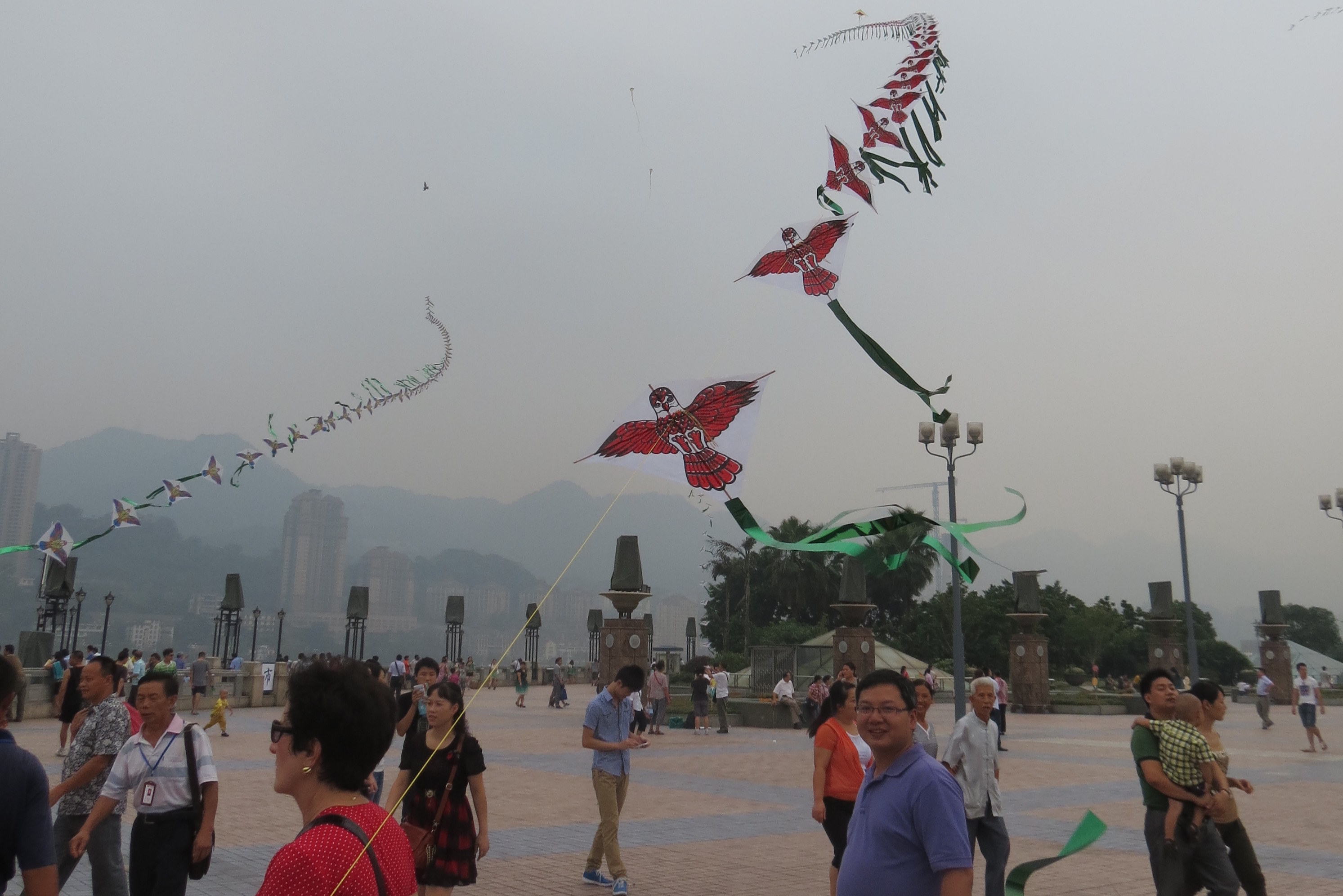 I was somewhat anxious about our scheduled train ride from Chengdu to Chongqing. Our guide had warned us that there would be a lot of stairs and there was no way I could carry both our suitcases, my backpack and Lynn’s carryon up and down a lot of stairs. But I had wanted to take at least one train ride during our trip to experience this aspect of China; after all, China in the past ten years has managed to build the biggest high speed train network in the world.
A number of streets converge onto the large square in front of the Chengdu train station and traffic grinds to a halt there. Traffic lights are useless as cars and buses clog the large intersection; it’s every man for himself and our driver has to inch his way through this maze of traffic in order to drop us off at the giant plaza in front of the station. It is seven fifteen in the morning but there are already thousands of people jamming this large plaza, many moving but many simply sitting on top of their belongings. We have to work our way through that maze of people in order to reach the station.
Airport-style security greets all entrants to the train station. I am not sure about the effectiveness of those measures, however, as I decide to keep my Scottevest travel vest on and yet breeze through without anyone stopping me. I always wear my Scottevest travel vest on trips; it has something like 22 pockets, most of them hidden and the rest securely zippered. That vest contains my ipad, my cell phone, my wifi hotspot, my chinese cell phone, my 50-hour spare battery, my usb car charger, my replacement cell phone and camera batteries, two sets of earphones, a packet of kleenex, a packet of wipes, a roll of toilet paper, a roll of litter bags, in brief the basic essentials. I keep the rest inside my Scottevest hidden cargo pants, where secret pockets contain my credit cards, my chinese as well as american cash, passports, tickets, etc… In other words, I always travel with my valuables on me, not packed or stored elsewhere. In spite of it all, I walked through that xray machine as if I had been naked.
We then inch our way through the crowd waiting for trains and head straight for the starting gates. I call them starting gates because it reminded me of the starting gate at a horse race. Several locked tall metal gates behind which an unruly crowd gathers waiting for the signal to head for the platform. There are about four gates for our train, long lines of people behind each gate. Where are the handicappers? I place my bet on gate no 3 and we patiently wait; the gates will open twenty minutes before departure time. I can see that, despite the heavy bags and other belongings which the chinese are carrying, many of them are good sprinters and may beat me around the bend. They have an edge on me as they probably know the racetrack well.
Thankfully, security has let Ben, our guide, come in to help us, so he is handling Lynn’s suitcase. When the gates finally open, we head towards platform 10 by taking an escalator up to a walkway running above the tracks and then down stairs to our assigned platform. Except that there is a suitcase ramp on the side of the stairs making it relatively easy to roll the suitcases down as you walk down the stairs. We then walk to our assigned car, which happens to be the last car of the train. We can just roll our suitcases aboard, no steps and straight on to a storage area located right behind each seat; I did not have to lift a finger!
This high speed train is as comfortable as any in Europe, and the two hour ride to cover the 300km between Chengdu and Chongqing is extremely smooth. An attendant offers coffee and tea a couple of times during the ride, and a food cart also showed up. An electronic board tells us our location, speed, and the outside and inside temperature as well as a bunch of other information written in chinese characters. The highest speed I saw was 195km/hr. My wireless hotspot worked flawlessly throughout the trip.
When we finally pulled into Chongqing Bei (north) and slowly ground to a halt, I saw that a ban ban porter (so named because of the old chinese manner of transporting things with a stick across their shoulders, and ban is the word for stick) was waiting right outside the door of our car; our Chongqing guide had sent him to transport our luggage, which he did right onto the car waiting for us outside this gigantic train station, the biggest one I have ever seen.
Panda keeper for a day
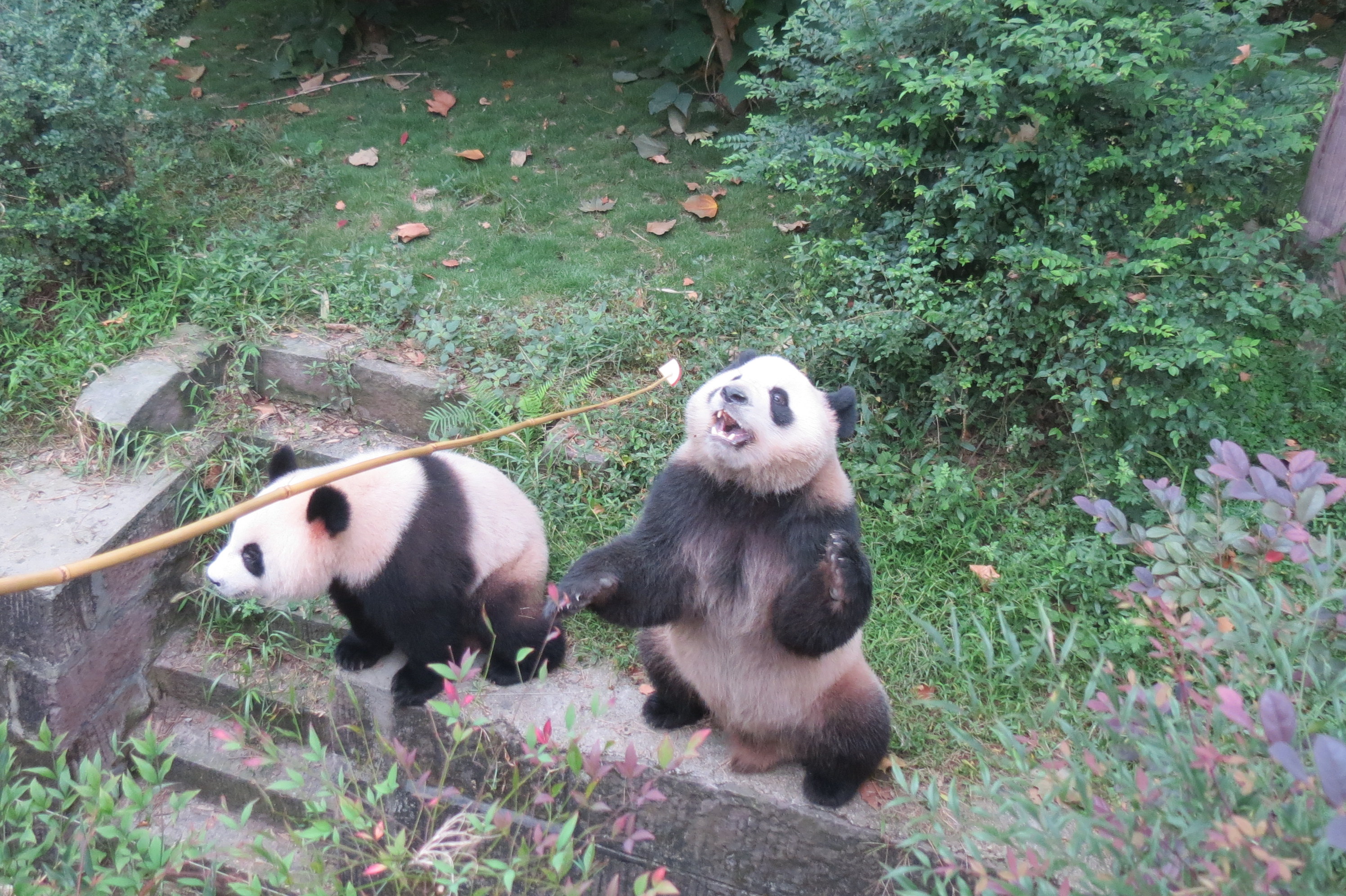 As we were driving to the Chengdu Research Base for Giant Panda Breeding (sic) north of the city, I noticed that the traffic lights had four lights rather than the usual three red, yellow and green ones. The fourth light was a bicycle light. Not that we saw many bicycles; in Chengdu, they clearly have been replaced by electric mopeds and scooters.
I asked Ben, our guide, what he had for breakfast: baozi (large dumplings) and soybean milk, he replied. Whenever he speaks, he reminds me of Dustin Hoffman in the movie Rain Man. The movement of the head and the repetitive “yaah”.
When we arrived at the Panda center, we were met by our coach for the day, Miss Lu. That is because we had paid for the honor of being panda keepers for the day. While there were large crowds of tourists invading the hilly and wooded complex, we were escorted separately to the topmost panda “enclosure”, which means a twenty minute walk up the hill (carts were also available if we had so wished). I had had a lot of questions about our day here. How much mud would there be if it rained? Answer: all the paths are very well paved so there is no need to be concerned. What about the toilet facilities? Answer: would you believe luxurious toilet facilities with fish aquariums in the entrance area, and electronic toilet seats?
There are eight panda “enclosures” in the complex, in addition to all the other buildings spread throughout the hill and housing administrative, research, kitchen, restaurant and other facilities. The pandas are a species which is more than 8 million years old, and there are something like 1,600 pandas left in the world today, of which 80% live in Sichuan province, with the remainder being mostly pandas on loan to zoos around the world. The Panda center here houses about 50 pandas and the main function of this center is artificial reproduction.
Apparently, it is very hard for a male panda to find the right female panda, which has contributed to concern about survival of the species. That is why the Chinese now resort to artificial insemination to get the female pandas pregnant, and that is the main purpose of this panda center. One big issue was sperm collection, but, after years of research, various experiments and countless hours of trial and error, they have finally found the answer: a hand job. At least, that is what I understood when they described it as “massage and stimulation”.
Thankfully, sperm collection is not the job of the panda keeper, which is our task today. There are eight panda enclosures in the center, of which two are nurseries for newly-born pandas and one is an enclosure for the red panda, a smaller version of the better known black and white panda. Our assigned enclosure houses five pandas at the moment, five pandas which we came to know well over the course of the day. First, there was Da Da (big big) and Shao Shao (small small), two three-year old females; then there was Wu Yi (five one), a male so named because he weighed only 51 grams at birth, significantly below the average 120 grams, six year old; Fu Fu (lucky lucky), a male 11 year old; and finally Bing Dian (ice point), a 12-year old male we never actually met because he slept the whole day. A panda normally lives 15 to 20 years in the wild, 20 to 30 years in captivity.
Two Japanese tourists join us for our day as panda keepers for enclosure no. 1. They are apparently Panda fanatics and come here several times a year. The first job we are given is to feed dessert to the pandas, starting with the playful Da Da and Shao Shao. The main diet of a panda is bamboo shoots, of which they eat 15 to 18 kilos a day. They are also fed apples and panda cake for dessert, with Centrum multi-vitamins hidden into the food. Did you know pandas have six fingers?
Anyway, our first task is to feed apples to the pandas. Guided by Miss Lu, we put apple pieces at the end of a long stick and feed them to the pandas in turn. Because the females need to exercise more, Miss Lu asks us to keep the end of the stick above the panda’s head so that she is forced to stand up to get the apple (pinguao). When they speak, pandas make a noise similar to the neigh of a horse.
Pandas eat for 16 hours a day, so we have our work cut out for us. After the apples come the panda cake, made of rice, soybean and corn. Lynn and I get the “chance” to taste it and frankly, it reminded me of the Scandinavian bread that Lynn eats every morning. Some of the pandas have come back inside so that we get very close to them, feeding the cake with a very short stick. Fu Fu had to be cajoled as he seemed to prefer the bamboo shoots to the cake.
Then came the task of cleaning the panda’s enclosure. As part of watching over the health of each panda, the keepers weigh separately all the left-over bamboo pieces and all the Fanbian (poop) generated by the panda. And there is a lot of it all over the floor; the only clean part of the enclosure is the elevated platform on which the panda sleeps. This part of the job is optional, as Miss Lu points out, and Lynn quickly opts out, but I tackle the job of scooping up the poop in one enclosure and then placing it into a trash bag for later weighing. The real panda keeper is watching me with a disdainful look, and quickly decides to have me fired, to my relief.
I should say that we had been provided with shoe covers and plastic throw-away aprons so that our whole job could be done without worrying about our clothing; our personal effects were stored quite securely at Miss Lu’s desk.
Throughout our morning with Miss Lu, she talked to us about the life of a panda, and I will spare you from all that information. Suffice it to say that each panda has his or her own personality and the panda keepers have to adjust to that. I became particularly fond of Wu Yi, who had had a bad experience with a female when he was five years old; the female would not let him come back inside and he had to spend all of his time outside, poor boy.
After our work shift was over, we bid goodbye to Miss Lu and visited the rest of the complex with our guide. This included visiting one of the nurseries, where we saw newborns and young pandas not much more than one hand long. We also visited the red panda enclosure as well as several of the other panda areas. As we were walking down an elevated and fenced in walkway, a red panda slowly slid under the fence on one side, walked across the pathway a mere fifteen feet away from me, and down under the fence on the other side; clearly the fence is not intended to keep the animals in, it’s to keep the humans out! We then sat down for an eighteen minute movie about the pandas before sitting down with our Shangri La lunch box for our midday meal.
We then returned to Chengdu to visit the brocade museum and shop, since Brocade has a history of more than two thousand years in Chengdu. The main river running through the city is called Jin Jiang (brocade river). This is particularly interesting since the main Chinese restaurant we go to in Rockville is called Sichuan Jin River restaurant. I never knew what the significance of that name was until now. On the way over, we crossed an area full of electronics stores which reminded me a bit of the Akihabara district in Tokyo. I counted no less than four Apple stores within one and a half block.
Although we could not find anything in the brocade store to fit our needs for the townhouse, the brocade products on display and on offer at the museum were nothing short of magnificent.
Chengdu Research Base of Giant Panda Breeding
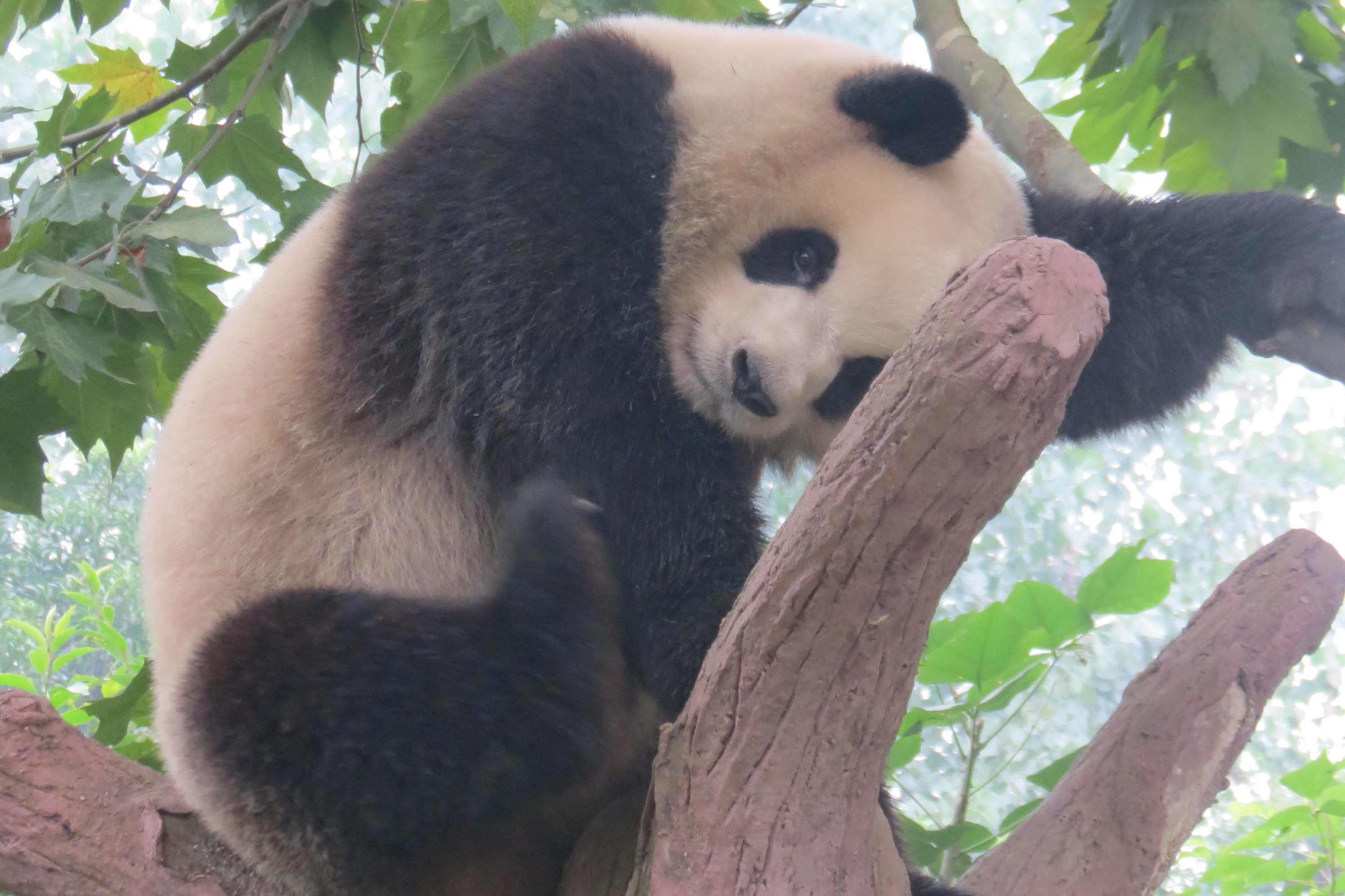 We had reservations at the very formal and top-rated Shang Palace hotel restaurant, where they serve Chinese cuisine at its finest, but at the last minute decided to take it easy and have room service instead. “Yes, I will hold” I heard her say as I focused on the CNN breaking news report of a deadly earthquake in southwest China. Wait a second, isn’t Chengdu in southwest China? C-R-I-S-P-Y, I heard Lynn spell out in a slightly elevated voice. I turned around; “she is getting someone who speaks better English”, she said. Where exactly is this earthquake which has caused 43 deaths, I thought to myself as I cursed the slow bandwidth connection available at this hotel. “I want to know what crispy lettuce is”, Lynn was keeping at it as she was now being transferred to a third person; there clearly was some frustration showing in her voice. CNN had switched its coverage to the murders in the French Alps. “Listen, you are the fourth person I am being transferred to”; there was no mistaking the irritation in Lynn’s voice. What happened to the earthquake report? I asked myself as Lynn suddenly stood up: “Listen, I am paying a fortune a night for this room; I want to know what crispy lettuce is”.
“Oh, you DO speak English”, I heard Lynn say. Finally, I thought. It turns out she is speaking to an Australian working at the hotel, who slowly and at length explains the room service menu items to her and helps her select our dinner. He does not recommend the local dan dan noodles for me, as they are spicy, but suggests the won ton noodle soup. I know what that is, I am thinking to myself, as I furiously switch the tv channels to find something about the earthquake. Lynn finally finishes with her room service order; where are the bathrobes, she asks. I look in the closet but find that there is only one bathrobe, and there are always two in a Shangri La hotel. So, I pick up the phone. “No, not a battery, a bathrobe”, I am heard shouting into the mouthpiece.
As I hang up the phone in frustration, it starts ringing. Please open your door, a sweet young voice says, which I do. Standing outside our door is the executive chef of the hotel, Peter Trewenack, an Australian, together with a hotel waiter and our room service dinner on a rolling table. Except that it is not quite the dinner we ordered; he took the liberty of adding to it an extra dessert and two fruit platters. And so there would be no doubt as to what a crispy lettuce was, there are two gigantic bowls of it on the middle of the table. We chat for a bit, and as he learns that we are thinking of doing a Shangri La Hotel tour of Asia, he invites us to contact him so that he can make sure we are properly received when we do. As he prepares to leave, the door bell rings, and I let him know that it’s probably either a battery or a bathrobe!
It was a bathrobe, thank goodness. What followed was a feast of a room service dinner like we had never had before, drowned of course with the bottle of wine which we had received as a welcome gift. According to Lynn, the sesame peanut salad dressing for the crispy lettuce was the best she has ever had. Lynn loved the dan dan noodles of Chendgu and I could not believe how fabulous a dish the won ton soup was; it did not resemble in any way what we get in the States and was a meal in itself. No wonder I could not finish the chocolate (yes, chocolate) cake dessert Peter had given us.
I still don’t know where exactly that earthquake was, and I have not even begun to tell you about the fabulous day we had at the Panda Center.
Chengdu, capital of Sichuan
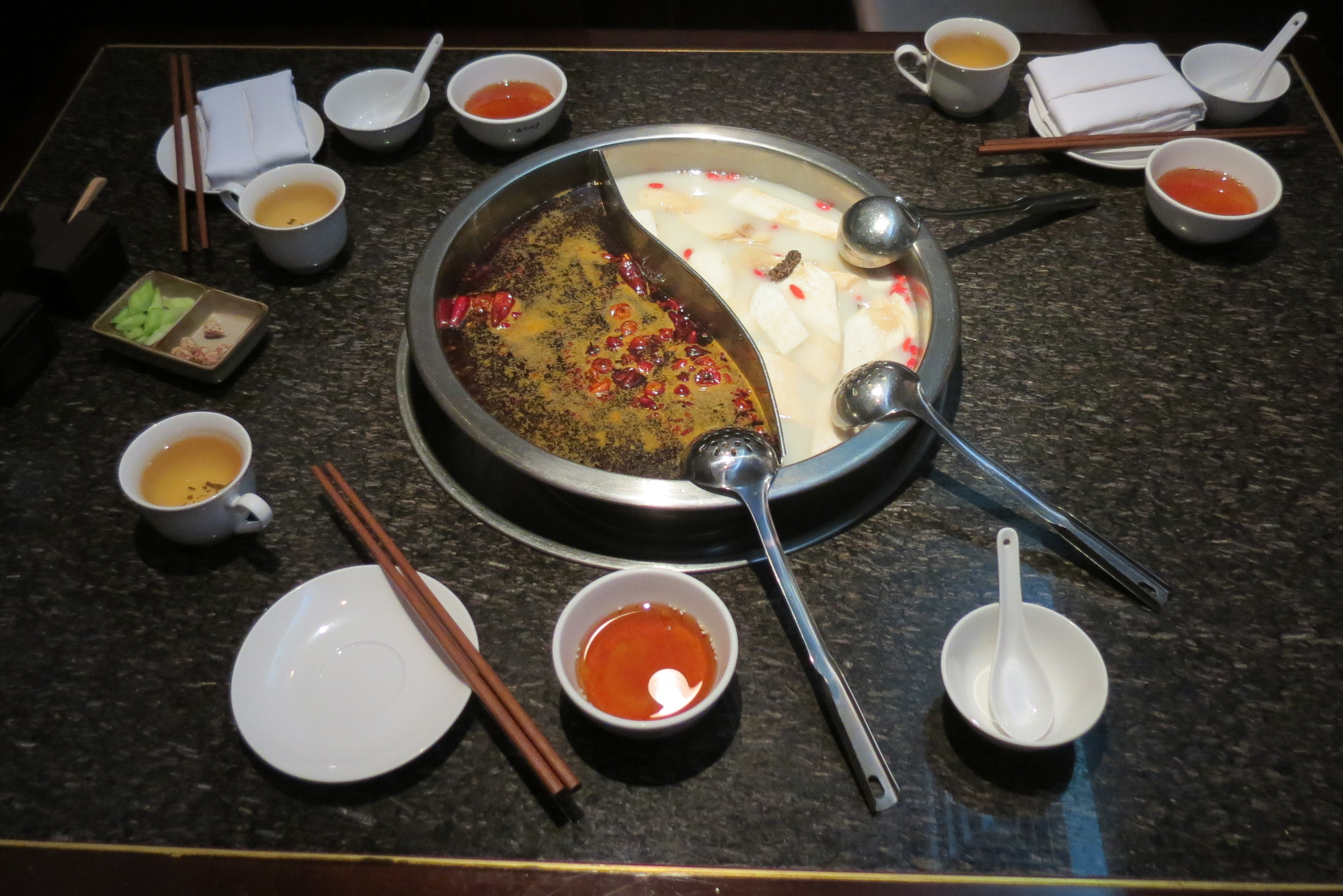 The Xi’An airport we used, which is actually located in the neighboring town of Xianyang, only just opened two months ago, or so the staff at the first class lounge informed us. And when we landed in Chengdu, we were told by Ben, our new guide, that the terminal there was brand new and had just opened. I only wish that all those Texans who like to brag about how big things are in Texas came here to visit; as soon as they would have seen what I am seeing, they would be in awe. By the way, China Southern is not as good an airline as China Eastern, and our lunch in the first class cabin was mediocre.
As we were walking through this immense terminal, I noticed that the highly polished floor, great for rolling suitcases, was interrupted by what seemed to be a line of raised grill marks. I was wondering why someone would design what would surely be an irritant to the good flow of suitcases across the terminal, and I asked Ben about it later. Those are lanes for the blind, he responded, to my great astonishment and admiration. Blind people can find their way through the terminal simply by walking along those raised marks on the floor; so ingenious.
In any case, here we are in Chengdu, capital of the Sichuan (which means four rivers) province and gateway to neighboring Tibet; a city of more than fourteen million people viewed as one of the most livable in China. Lying in a basin close to mountains means a very humid climate, great for bamboos and pandas. A prosperous city, it seems, thanks to a lot of high technology assembly plants; most of the ipads in the world are made here, I am told. I noticed a large number of electric bicycles and electric scooters (2,000 rmb or about $300 will buy you one), more than what I had seen in Xi’An or in Beijing.
There was no cake in our hotel room when we checked in, only a vase of flowers, a bottle of wine, a box of chocolates and a bowl of fruit. The teapot was there but empty. A disappointment, given our experience to date. Nevertheless, we headed out to see Chengdu, starting with Wuhou temple and JinLi street. What a fascinating and interesting walk this turned out to be. The architecture of the buildings, the food offerings of “snack alley”, the large crowd strolling through, the teahouses and bars, the unusual shops, the mere fact that this street seems to have remained unchanged for one thousand years, all contributed to a most enjoyable experience.
It only got better, as we then proceeded to Bai Wa Teng park to participate in the most quintessential experience of Chengdu, the teahouse. I tried both the Bamboo leaves tea and the local jasmine tea and selected jasmine. Both Lynn and I ended up getting a 20 minute neck and shoulder massage while we were enjoying our tea.
We then walked over to the Huang Cheng Lao Ma restaurant for a huoguo (hot pot), or more precisely a yuanyang huoguo, a hotpot with a spciy and a non-spicy side. One side contained oil full of chile peppers, the other a mushroom soup. To cook into the hot pot, we selected beef, mutton, pork, chinese lettuce, lotus roots, bamboo shoots and mushrooms. It turned out to be a most enjoyable meal; Lynn ate from the spicy side, and I from the other one.
I had thought long and hard before electing to go for a hot pot. But how could I visit Chengdu, the capital of Sichuan, and not have the most famous dish of the province? I am very glad we did; we both enjoyed it.
Lynn and I have both fallen in love with Chengdu, a city which is so far so much more appealing than either Beijing or Xi’An. I’ll write more about that when I feel less exhausted. But for now, I’ve got to get ready for an early rise for the ride over to the Panda center tomorrow.
The Terracotta army of Xi’An
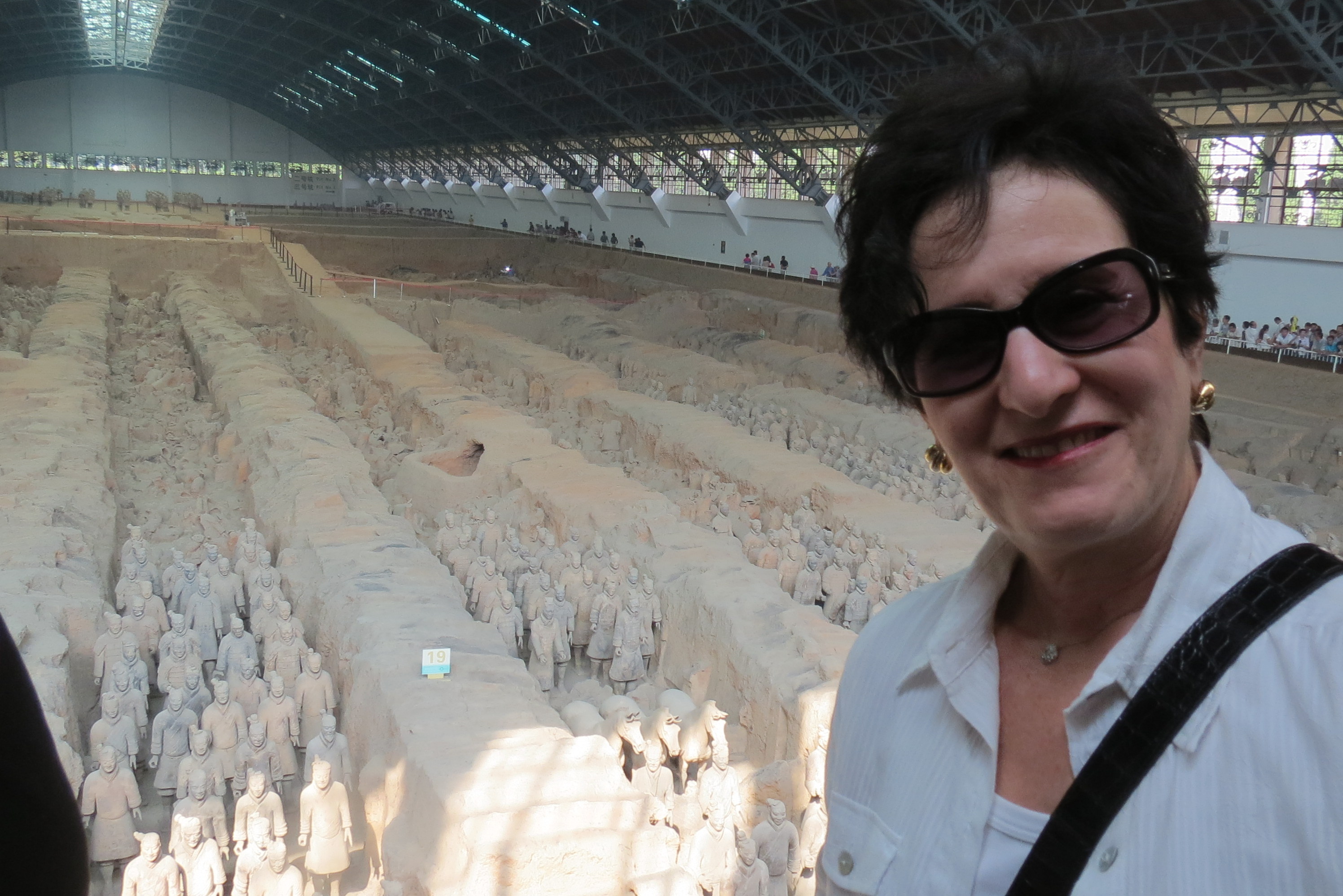 Dominique was wondering whether we were still on a diet! Yes, there is a scale in our hotel bathroom, but I tell Lynn that it is not calibrated properly. I am becoming addicted to the pain au chocolat which is on offer every morning for breakfast, together with a wide selection of other pastries and cheeses. There is nothing like a good hot cup of coffee and a pain au chocolat to make you feel good about the day ahead. Lynn and I have so far stayed away from the selection of Chinese breakfast dishes on the buffet in the Horizon Club lounge, but I may not be able to resist temptation much longer. David, our guide, told us that his breakfast consists of rice congee porridge, steamed buns, a boiled or fried egg and a glass of milk.
The Terracotta Army museum is located about an hour and fifteen minutes east of Xi’An, near the resort village of LinTong, where what I estimate to be about five hundred thousand people live and enjoy the hot springs from the neighboring LiShan mountains. We took a very modern six-lane highway to get there and passed a number of fields of pomegranate trees, interesting because each fruit has been covered by a clear plastic bag to protect it from I don’t know what.
The museum itself is a very large and modern complex; be prepared for a lot of walking around. Three pits have been excavated so far, each one having its own building. Then there is another building to house the chariots. And finally a fifth building for the imax theatre and the museum shop. While we were driven from the gate area to the first building in a race car (a twelve passenger cart driven by a grinning young woman with a very, very heavy foot and no concept of the dynamic forces at play in a ninety degree turn taken at sixty miles an hour), you have to walk your way back to the gate at the end of the visit in order to force you to go by the hundreds of shops, stalls and restaurants and bear the inevitable harassment of the shop owners.
I have been encouraging Lynn to do a posting about Chinese toilets, as she has plenty of experience on the subject so far on our trip and she always seems to come out of one with something interesting to say about it.
We drove back to the center of Xi’An in order to have lunch at Tong Teng Xiang, the best place in town for yangrou paomo (mutton meat with shredded pancake), the most famous dish of Xi’An. We were not disappointed with the experience; I think this is Lynn’s favorite dish so far on our trip, with the Zhajiang Mian noodles of Beijing a close second. Naturally, she takes it with a lot of the xian cai (coriander), la jiao (chile peppers) and tang suan (picked garlic) condiments on offer, while I stay away. I have learnt to say “Wo pu she la jiao” (I don’t eat chile peppers), as I am anxiously preparing for our visit to Sichuan province and the very hot and spicy capital of the hot pot, Chongqing. On the other hand, Lynn is looking forward to it. My Chinese is starting to come back a little; I was the one who asked for the check and paid for the meal, all 144 yuan ($20 or so).
By the way, I forgot to mention that there is no tipping in Chinese restaurants. You don’t go there for the service, something you will agree with quickly after you experience it a few times. The Chinese mentality is that you are going there for the food and that is what you are paying for. Fine with me.
We then drove to the Shaanxi Museum of History, a very well designed and fascinating museum covering mostly the history of China up to the Middle Ages, when actually China was at its peak. I still get lost with all these dynasties, Qin, Tang, Ming, Song, etc… and have made a note to myself to study harder at school next time the subject is covered.
Our guide commented on the cultural difference between China and the United States by stating that the Chinese give more importance to the larger picture. When you give someone’s address in China, you start with the country, then the province, then the municipality, then the district, then the street, and finally the street number. The exact opposite of what we do, and apparently, that shows that we are totally focused on the specific and on the individual while Chinese people put themselves within the context of the group and the country.
After the museum, Lynn and I told our driver that we would skip a visit to the Big Wild Goose Pagoda, our next scheduled stop. After all, I had already seen it from the road. More to the point, Lynn and I were totally exhausted and we wanted to take a break and rest before the big evening ahead, the dumpling banquet and the Tang Dynasty Imperial Show.
I am usually very wary of doing these touristic things, but the show is so popular that I made an exception. True to expectations, the place was packed with busloads of tourists. The food of the dumplings banquet was nothing to write home about and cannot be recommended, but we certainly were served a very wide selection of dumplings and more than I could eat. As to the show, it was actually quite impressive. Dozens of performers in very elaborate costumes performing music and dance from the Tang Dynasty period. The music is piercing, so you are glad to leave after the one hour and ten minute show, but overall I would say I am glad we went.
Xi’An, the eternal capital of China
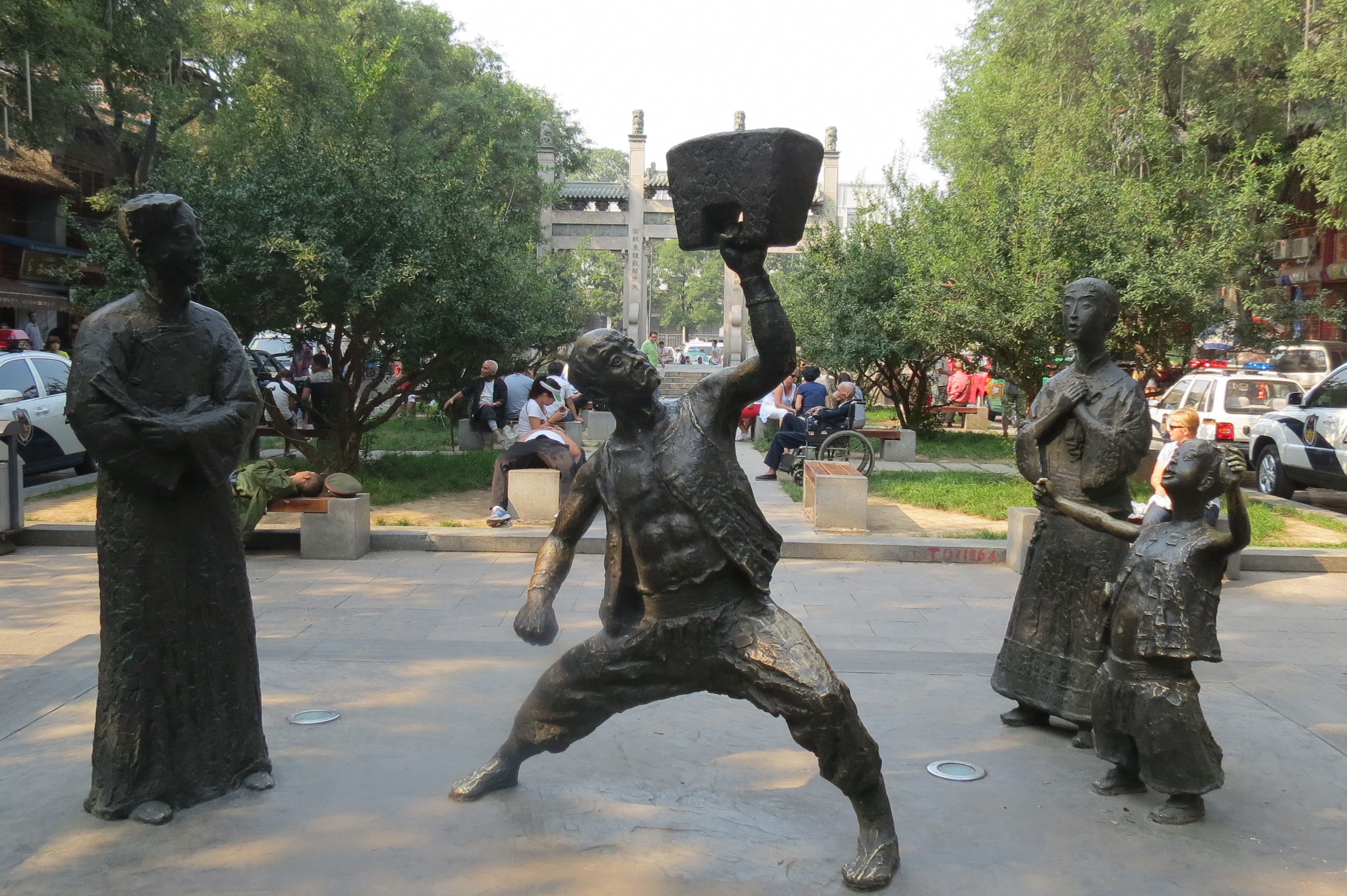 This morning’s breakfast at the Horizon Club lounge was somewhat of a challenge. None of the staff on duty at the lounge spoke English so an order for an english breakfast with scrambled eggs, tomato, mushrooms and bacon resulted in a platter where all of the above had been cooked together; Lynn’s brown toast request resulted in a platter of french toast; “dark toast” brought out the chef, who nodded in understanding, which somehow led to two platters of cooked tomatoes making their way to our table!
We then had to crawl our way to the airport in the middle of Beijing traffic, which was awful this morning; it took us almost two hours. Lynn and I took that opportunity to learn how to order breakfast in chinese so that our experience earlier that morning would not be repeated.
Our guide had told us that the chinese currency bills which I had, saved from my last trip to China about fifteen years ago, had become quite valuable since the current bills were different and my bills had become collectors’ items. So when we left him at the airport, I gave him a special tip made up of those old bills, which he said he would save for his grandchildren.
The first class lounge at the airport was excellent, as was the lunch in the first class cabin of our China Eastern flight to Xi’An (which means Western Capital), about 750km southwest of Beijing. Xi’An, now a city of about eight million people or a small town by Chinese standards, is considered to be the middle of the country, separating east from west, north from south. It is a proud and ancient city, and was the capital of China for many centuries; during the Tang dynasty and several dynasties after that, when it was called Chang’An (Eternal Peace), the city was the largest in the world. It became the starting point for the famous Silk Road to Europe.
The Xi’An airport is new, gargantuan and empty, ready to receive the billions of chinese yet to be born. My mobile hotspot is working perfectly, so we continue to have internet access wherever we go. David, our guide, tells me that the city is about 91% Han, which is about the same as the whole country, and 10 to 15% muslim. Apparently, the one child policy only applies in China to the Han, not to the minorities. And he corrects me on Shanghai being the most populous city in China; no, it’s Chongqing with its thirty million people which takes the cake.
Talking of cake, guess what was waiting for us when we checked in at the Xi’An Shangri La hotel. Yes indeed, another cake with a happy 40th anniversary card, another box of dark chocolates, a bottle of wine, a basket of fruit, a vase of beautiful lily flowers, a second box of chocolates (!), as well as the “welcome back, Mr. Gagnon” greeting and the traditional welcoming pot of tea. The Shangri La hotel tradition of providing you with a pot of hot tea upon arrival has always been dear to me.
I would have expected the tea to be perhaps the best known local tea, the White Monkey tea of the Xinling mountains south of Xi’An, so named because trained monkeys are used to pick the tea leaves from the steep mountain slopes. No, the welcoming tea at the Shangri La hotel is always the same, and the flavor of the tea is unique for me and brings back so many happy memories of the past. Just by sipping this tea, I am transported to the Kowloon Shangri La in Hong Kong and the beautiful floor to ceiling nighttime view of Hong Kong island. This time, I am determined to find out what type of tea this is so that I can try to get it back home. By the end of the day, I had managed, I think, to identify it: Jasmine Green Tea from the Boh Plantations in Kuala Lumpur, Malaysia.
Our first adventure is Xi’An is to walk the Muslim quarter in the center of town, and in particular Hua Jue Xiang (alley), near the drum tower. The goods on offer on the various stalls seem to be the same: an incredible variety of zuo (dates) all priced differently based on quality, which county they come from, etc…; lots of hetao (walnuts); shiliu (pomegrenate) which is in season at the moment. As for food, there are many stands offering shizibin (parsimmon cake), xianbin (filled in pie), and yellow bean cake. And a couple of restaurants offering the most popular dish in town, yangrou paomo (mutton soup), which is on our program for tomorrow lunchtime.
We then proceeded to the Hang Tang Tian Xia restaurant for a lesson on how to make jiaoze (dumplings), the most famous specialty of Xi’An. I had asked our guide why Xi’An was famous for dumplings when there were so many other places in China and Hong Kong where dumplings were popular; he told me that this was because of Xi’An’s winter wheat, which is regarded as providing the best flour in China for making dumplings. Little did I know that the stuff was made of wheat flour, water and salt. Lynn already knew it all and had no problem showing the chef her skills at making dough, filling it with pork, closing it and shaping it into all sorts of shapes.
Beijing
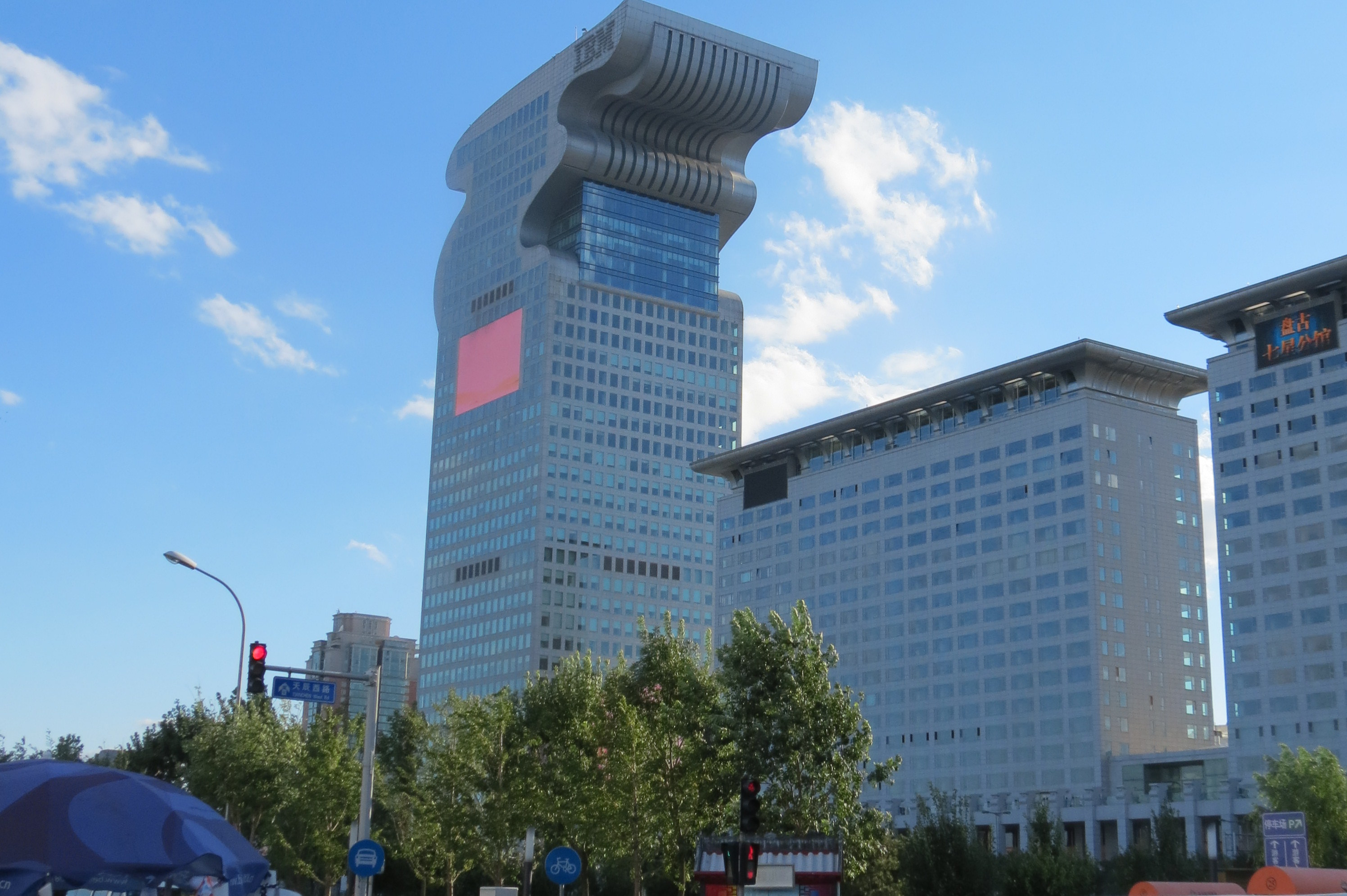 Before I forget, I need to mention that I did receive my Chinese cell phone and my Chinese mobile hotspot yesterday; they were waiting in the room for me when we arrived; I just did not initially notice in all the excitement.
Here’s something Jeff told us about the French language. He said that all Chinese know at least a few French language words. For example, he mentioned “bonjour”, “salut”, and “comment allez-vous?”. He explained that the reason for this widespread knowledge was that there were Chinese words whose pronounciation approximated closely the French words. BonJu in Chinese means Stupid Pig; SaLu in Chinese means foolish donkey; and the last expression means in Cantonese “Tonight we will be fighting tigers”.
Some cultural tidbits which we learnt today. First, was the chinese custom of using two fingers tapped on the table three times to thank someone who pours you some tea. Apparently, this goes back to Shiang Lung, the Qing emperor, who liked to go down in disguise to Suzhou and Hangzhou to find beautiful young women to bring back to Beijing. While the requirement for his officials and servants was to kowtow to the ground and tap their forehead on the ground three times in the presence of the emperor, this was impractical when the emperor tried to stay incognito; and so this was replaced by the finger tapping, and the practice just spread from there. So nowadays, when someone pours you some tea, you need to thank them by looking at them and tapping two fingers three times on the table quickly.
Secondly, when pouring tea at the table, you must make sure to put down the teapot with the spout pointing away from anyone at the table. Apparently, a teapot spout pointing at you means that you are being considered a male prostitute, the hint being the shape of the spout resembling a male organ.
Thirdly, you must never put down your chopsticks vertically into a bowl of rice or leave them in the bowl while you are talking at the table. This is a sign of death, since it is a chinese practice to honor the dead by leaving a bowl of rice with chopsticks in it at an empty chair’s place setting.
Finally, when you pour tea for someone, never fill the cup. It is a bad sign, and means you want the person to go away. Apparently comes from the cultural trait of the Chinese being very indirect about everything and the situation of people overstaying their welcome at a person’s home. Filling their cup was an indirect way to signal them to leave; funny, I never got the hint!
This morning, we were scheduled to visit a hutong, which is the name given to the old neighborhoods of Beijing. There used to be 6,000 of them twenty years ago; there are now about 1,800 left, the rest being razed to make way for high rise and other commercial projects. The word itself means water well in Mongolian. We are going to a hutong near the Bell Tower and the Drum Tower; chinese tradition was to ring the bell in the morning, beat the drum in the evening. We took a rickshaw to explore the small alleys of the hutong.
Of notice was the fact that there was a public toilet and bath area literally every 100 meters, a contribution of the communist government to reduce the spread of disease in the hutongs. The public toilets and baths have become very important to the social life of the neighborhood. Jeff explained that the men go there in the morning, squat over the chinese toilet (not much more than a hole in the ground, and without any wall or separation between each toilet) reading the morning newspaper and chatting with the other men around them doing the same thing. The men then tear up the newspaper to use as toilet paper, and finally light up a cigarette and chat some more, in part to chase away the odor.
You could tell what type of important person lived at a particular house in a hutong by the type of statues on each side of the front door, and by the number of marks above the door. A statue with a round base (shape of a drum) denoted a military official; one with a square base (shape of a book) meant an administrative official. Four marks above the door meant a really high official.
We visited a local vegetable market and then went inside one of the houses in the hutong. While these houses were initially occupied by one family, the dwelling now houses six or seven families. We visited one family and had the opportunity to talk with the Beijing housewife who lived in the tiny three-room apartment with her husband and sixteen year old s on. On the wall was a calligraphy document which supposedly was written by her husband’s father and details all the rules which a woman must follow. Her favorite food was jiaoze (dumplings), I remember her saying.
For lunch, we went to a restaurant serving typical Beijng food, Yi Wan Ju (means one bowl) on Pufang Lu, where I learnt not only how to scream at waiters like everyone else, but also how to object loudly to the bill when it came (less than $35 for the four of us) for being too much money. Apparently, I am fast becoming a Beijinger! We had a banquet of typical Beijing food, starting with zahjiang mian (old Beijing noodles with fried bean sauce), but also including ma doufu (spicy bean curd), Tie Ma Tuer (cabbage with mustard), Tsung Tao Yang Jio (shallots fried with lamb), Tsiang Goi You Tsai (bok choi with mushrooms), and Tswan Jiao Jer (sour date juice). Don’t believe any of my spellings of those chinese names.
In the afternoon, we visited the silk market (tourist filled building with 1,600 shops selling knock offs and other Chinese products), the antiques market on Panjiayuan street (hundreds of shops selling furniture, paintings, ceramics, pearls, etc…), two porcelain stores (we were looking for a large wall porcelain plate from Jingdezhen, the capital of porcelain in China and therefore the world), and a large silk factory store (forgettable). We finished the day at the Olympic Park which seems to be extremely popular with Chinese tourists, and visited the Water Cube.
We then tried to get to our dinner restaurant, Bianyifang on Bei Sanhuan Zhenglu in the Xicheng District. We could see the restaurant only a few hundred feet away, but in order to get there, we had to exit one highway and enter another, then find a way to get into the other direction of that highway, etc… Barriers and omnipresent police cameras make u-turns impossible, and rush hour traffic (at all times of the day) complicate the rest of the effort to no end. The whole thing took us an hour.
Binayifang is the oldest restaurant in Beijing for Peking duck, dating back to the 1400s, although it is now a chain of 8 to 10 restaurants in and around Beijing. We thoroughly enjoyed our meal there, where we also had the most appetizing Beijing version of spring rolls.
Welcome to Beijing!
 It is actually Monday 03SEP12 at three in the morning when I start writing this post. Lynn is sleeping but, as was always the case when I traveled the world on business, I am up in the middle of the night the day of arrival. There is no logical reason I should have this jet lag, given how well I behaved on the plane. I did not have any alcohol to speak of (although I was compelled to have some port with the appetizing cheese course), I had plenty of sleep on the very comfortable Air Canada business class bed, the flight although long was uneventful and without turbulence, and I made sure to give plenty of sunshine to my eyelids for the three hours preceding landing in Beijing, by raising the window shade and staring at the mountainous Mongolian terrain, so that my body clock would be set on daytime. I even passed on the wonderful opportunity to watch one of the many french movies on offer on board! All to no avail. Oh well; here I am and there is Lynn, sleeping like a baby, which is what she did on the plane as well.
I have just spent the past hour trying to find a way around the block which Google has put on my blog and my blogger.com account; I am pretty handy with computers but I have been unable to beat that one. Google just refuses to let me access my blog from China. So, as a last resort, I have created a new blog on a different blog site and will have to notifiy everyone of our new trip blog web location: chinasep12.blog.com.
Arrival in Beijing went smoothly. The Beijing airport is so much bigger than I remember it as. Our guide and our driver were there waiting for us as we exited the baggage claim area. A relief in itself, as this is the first time I am using this particular Chinese travel agency and I was not totally sure of what was in store for us. The car they have for us is a Volkswagen, but nothing like what I have ever seen; I first thought it was an s-class mercedes and had to double check. Luxurious, big, comfortable, with a bottle of water by each of our seats and a welcome bag with a number of useful things in it like maps, guidebook, inflatable pillow, towelettes, luggage tags, etc.. I knew then I had chosen correctly.
Jeff (easier to say than his real Chinese name) is our guide and Liu Tong Yen our driver. Jeff talked the whole way into town, telling us about the China and the Beijing of today and checking on our plans for the next day. The Beijing airport is located northeast of the city while our hotel, the Shangri La, is located on the west side, next to the third ring road (an easy way to locate yourself in Beijing is by positioning yourself relative to which ring road you are close to; they start from the city center and expand outwards). So this is about a 45 minute car ride. Along the way, I mentioned how surprised I was not to have seen one bicycle yet, only cars, and lots of them. Jeff told us that there are now more than five million cars in Beijing, a city which was built for far fewer, and they have now implemented Singapore-style restrictions on car access to the downtown area. Your license plate number determines which days you have free access to downtown; on the other days, you will be fined.
I think Jeff said that the government is limiting the supply of cars because of the limited infrastructure. A lottery system has been put in place to determine who will have the right to buy a car!
As we make our way past an untold number of high rise apartment buildings, I ask Jeff whether China still enforces the one child policy. It seems it is still very much in effect. Only one child per family gets a social insurance number, and there are now at least 13 million chinese who don’t really exist. I have no idea where he got that number; how do you count people who don’t exist. The point here is that those children don’t have a social insurance number, they cannot get an education, or receive any other government services. Some rich families are able to pay a lot of money to get their second child registered but that is rare, given the cost.
We finally pull up at the Shangri La. My first surprise comes when the porter opens the car door and says “Welcome back, Mr. Gagnon”. Wow! I am impressed; last time I was here was something like fifteen years ago, and this porter does not look much older. Little did I know what was in store for us. We make our way up to the twelfth floor and the Horizon Club for check in. Despite the very hospitable welcome we are receiving from the five staff members attending to us, I am a little bit frustrated as they don’t seem to know the whereabouts of the package containing my Chinese cell phone and my Chinese mobile internet hotspot.
We are finally escorted to our room on the sixteenth floor. I am surprised when someone from the inside opens our hotel room door. We walk in and find three hotel staff members had been waiting in our room for us. They have all sorts of gifts for us. There is a cake on the coffee table with a “Happy 40th Anniversary” sign made out of chocolate. There is a box of dark chocolates, a platter of fruit, a vase of flowers, as well as the traditional welcome tea. They even have set rose petals on the bed in the shape of a heart, as well as rose petals in and around the whirlpool in the bathroom. Wow! Out comes the camera for some pictures, including one apparently for the hotel newsletter; was I that good a customer for them back then? More likely than not, it is just the Shangri La way of doing things, which is why it has been my hotel in China for all those years.
All that was left to do to complete this day was to order jing jiang rou si (shredded pork with pancakes) from room service.
On our way to China!
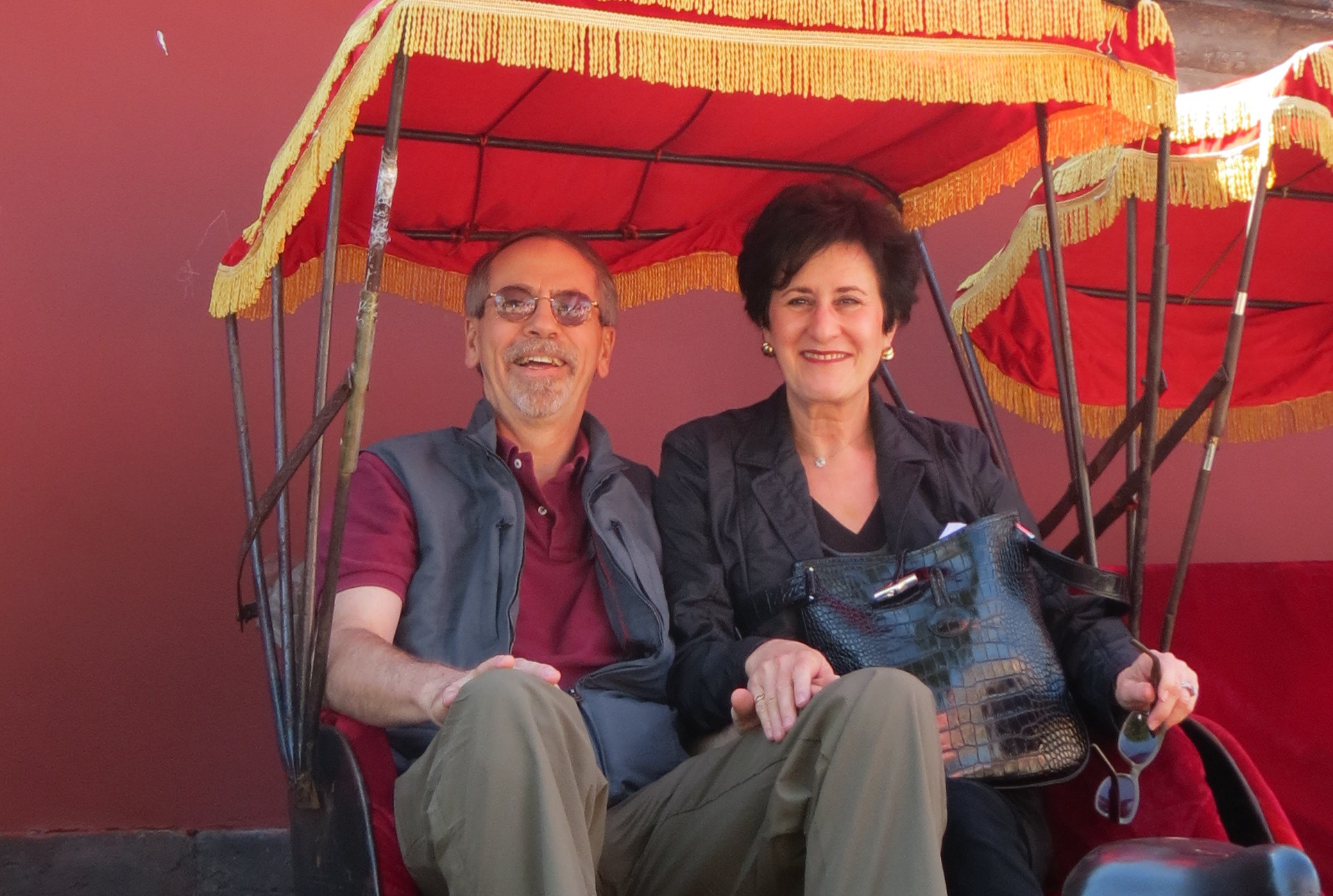 Lynn and I are on our way to China to celebrate our 40th wedding anniversary! We have just settled into our comfortable seats at the Maple Leaf lounge of the Toronto airport, as we wait to board our flight Air Canada 31 from Toronto to Beijing. How we ended up on this flight and this airline is a story in itself, as I usually prefer to fly British Airways or Singapore Airways on long haul flights to Asia. But earlier this year, a story appeared in the New York Times comparing the air fares offered by airline companies, large online travel services such as Expedia and others, and small specialized travel agencies. The article reported that the small agencies can undercut the large companies by significant amounts. Needless to say, I was quickly on the phone with KDCal Travel in California (USChinaTrip.com), which was recommended for travel to China. They offered me a range of options, all of which were less than half the quoted prices on the major airline and travel company websites, or about a third of the non-discounted fare which American Express Platinum would have used for its 2-for-1 tickets. In other words, this was a better price than what I had seen anywhere. I checked on Air Canada, the lowest priced option, and discovered that their business class seats were fully reclinable to a lie-flat bed, a sine qua non requirement for me on long haul flights. So here we are, on Air Canada, flying to the North Pole to cross over to Asia and south to Beijing.
I am not sure whether this trip is starting on the right foot, given the events of this morning. First, the name of our Ethiopian taxi driver sounded like Atchoo, and although we had received our flu shot a few days ago and had just taken our Wellborn trip pill before leaving the house, I could not help but wonder whether this was not an omen of an impending cold. More ominously, Lynn proceeded to spill tea on all of my computer equipment at the airport, just after I had set up my laptop and iphone at a work area near the gate.
In any case, I am thrilled to be going back to China, where I traveled often and extensively during the 80s and 90s. I happen to have a lot of admiration for Mao’s communist political system which delivered self-respect, freedom and basic rights to a great majority of the Chinese people in a way which the feudal and imperial systems of the past had never even tried to do. I have even more respect for Deng Xiao Ping’s brilliant decision to couple a freer economic system with the communist political system; I credit this masterstroke for the relentless rise of China since then, not only as an economic power, but also as a global power. I have no doubt that, in time, political freedom will grow, but I hope that it continues to be at a pace which protects the gains achieved by the current political structure. I was fortunate enough to travel to China from the early days of its opening (or should I say re-opening) to the West. I remember vividly the darkness of Shanghai at dusk, the absence of any neon lights and the near absence of any other lights, the vast sea of seemingly identical Mao uniforms biking home in silence in almost a regimental manner. I came to know the struggles of the state enterprises trying to adjust to the changing and new economic realities. And I came to love the Chinese people, whose warmth, friendliness and eagerness to improve impressed me to no end.
I even came to learn some Mandarin, enough to hold basic conversations and even negotiations. I have forgotten most of it now, and I will be curious to see how much comes back after a few days on the ground in China (Zhongguo, or Middle Kingdom in Chinese). I never learnt the Chinese characters, and mastering them seems to me a lifelong endeavor for which I unfortunately do not have enough time left to tackle without putting both my golf and my tennis game in jeopardy.
But I am determined to learn more about Chinese food. I never paid much attention to it during all of my trips to China. A shame really, since according to James Beard, it happens to be the greatest cuisine in the world, better even than French or Italian!
Lynn and I will start our trip in Beijing, which is where we left off on our last trip to China fifteen years ago or so. At that time, we had to cut the trip short and fly back home because Lynn fell ill in Beijing (hence my concern about catching a cold on this trip). We had already done the main touristic sites of the capital, Tiannamen Square, the Forbidden City, the Summer Palace, the Temple of Heaven, the Great Wall, etc… So we will pick up where we left off, starting our trip and Beijing and working our way south towards Hong Kong and Macau.
Beijing, which means capital of the North, is located quite far north in China, just south of Mongolia; it is further north than Pyongyang of North Korea. Its population of more than 20 million people makes it the second largest city in China after Shanghai. Beijing only became Beijing in the fifteenth century or so, during the Ming Dynasty, when the Emperor added the capital of the north (Bei means north, Jing means capital) to his main capital until then, Nanjing, in Jiansu province in the lower part of the Yangtze river just north of Shanghai.
When the Ming emperor moved to Beijing, so did his chefs and the cuisine of the Jiansu region. The Huaiyang cuisine, as it is known, has become the most illustrious of the four grand cuisines of China, the other three being Shandong, Cantonese and Sichuan. Chinese food offered in America tends to be derived from Cantonese and Sichuan food to a large extent. By the way, below the four grand cuisines are a myriad of regional cuisines, generally categorized in eight main cuisine categories and innumerable sub-categories. I will never but touch the surface of what there is to learn about Chinese cuisine; at this point, I can’t even figure out how many different types there are.
The state banquet given to President Bush in 2002 was done with Huaiyang cuisine, as was the first state banquet of the People’s Republic of China in 1949, and the 50th anniversary state banquet in 1999. Shandong cuisine also later became part of Beijing cuisine through the influx of chefs from the Shandong region. So I am looking forward to some dishes from both the Huaiyang and the Shandong cuisines while in Beijing.
There is a general saying in China about the food, and it translates as follows: east is sweet, south is salty, west is sour, north is spicy. Thankfully, Beijing’s cuisine imported the best food from the rest of the country because of the Forbidden City and therefore offers plenty of non-spicy dishes. Beijing cuisine is further subdivided into the imperial cuisine, the aristocrat cuisine, and what I guess is the rest of the people’s cuisine. Being in the dry north of the China, it is more wheat based than in the wet south where rice is king. Lamb and pork seem to predominate. Since we only have three meals in Beijing, excluding breakfast, I have put my sights on three famous dishes from the area; jing jiang rou si (shredded pork), zhajiang mian (noodles with fried meat), and of course Peking kaoya (Peking duck).
Now, time to relax and enjoy a salad lunch before departure.