Daily Archives: September 8, 2012
Yangtze Gold One
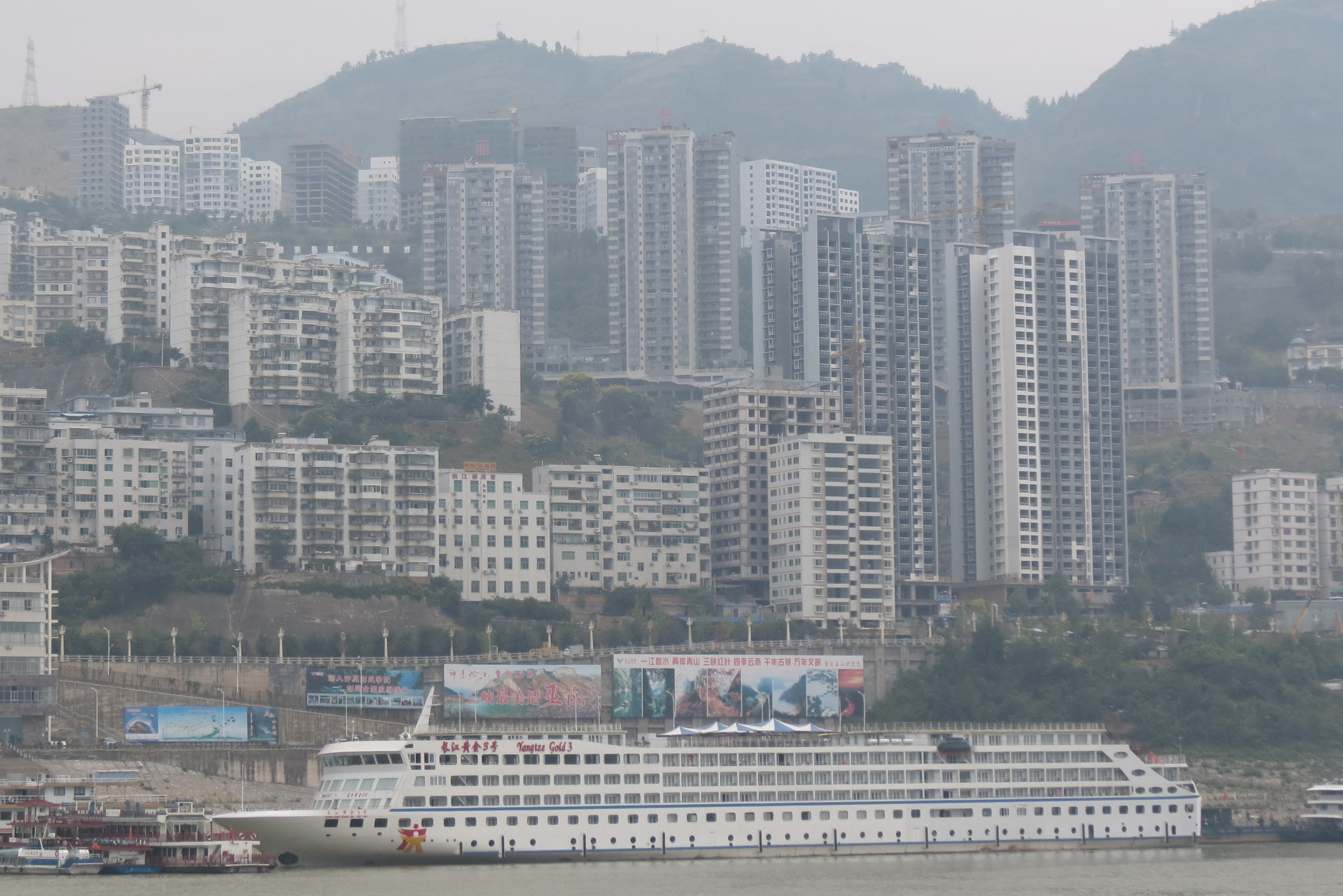 The Yangtze Gold One is the first of a new series of river cruise ships commissioned by a Chongqing based company specifically for the Yangtze river cruise. It was launched just a few months ago and is supposed to be a five star ship.
After a ban ban porter carries our two suitcases aboard (what a look he gave me when I tipped him a generous ten yuan; go back to hell you cheap foreign devil is what I thought he meant to convey), we go check in at the reception counter on deck two; the ship does look new and gold and mahonagy seem to be the main colors. I am asked to leave our passports overnight for the usual police check and we head for our cabin in the forward area of deck three. I ask Charlie, our Chongqing guide, to come with us; the cabin more than checks out. It is spacious, clean and with almost all the commodities one could hope for, including air conditioning, fully room darkening curtains, a balcony with two chairs and a table, slippers, bathrobes, a rain forest shower, hair dryer, lcd cable tv, stereo system, minibar, safe, etc… At the desk is an Ethernet connection with a paper claiming that they offer broadband internet in every cabin.
There seems to be no bottle water in the room, however; so we ask Charlie if we can buy all of the water bottles in his vehicle. He agrees and goes to fetch the eighteen or so bottles left over from our day in Chongqing. Lynn then dutifully fills the evaluation sheet which every guide seems to be required to obtain from us before we leave them; since we have to give the evaluation sheet back to the guide himself, we do not find it appropriate to give them anything but glowing comments. That is a practice the agency should change.
After Charlie leaves, I examine the room in a little more detail. The electrical plugs in the room are either two prongs or the inverted angle type, which means that I need to dig up some of my adapters stored in my backpack. In a later blog, I may well tell you the inventory I keep in my backpack for this sort of occasion. There might be Ethernet internet, but I can’t make it work, so I’ll continue to rely on my hotspot. There seems to be no spare Kleenex or spare toilet paper, so we need to call for some. The tv has a few English channels, but no CNN, and more importantly, the ship information channel, the channel which carries information about the program of the day and any and all announcements is only in Chinese. That is when I began to realize that we had truly booked ourselves onto a Chinese ship; it dawned on me that we might be the only non-Chinese aboard! We can’t tell because we are the only passengers aboard as far as we know, so we’ll have to wait to find out.
I examine the information binder which we have in the room. It is bilingual Chinese and English, although the English would qualify for a mention on the Jay Leno show. As an illustration, let me copy verbatim the description for the VIP restaurant on deck no 6: “VIP restaurant covers area about 300sq and only serve for 80 customers. There is great environment and beautiful outlook during the dinnings.” Room service is availab?le until 1am.
After checking with the front desk, we are informed that there is an English language program, and they will make a photocopy of it for us if we go to the reception desk every day. What about the movie theatre on the ship? It will have English sub-titles.
We finally head to the main dining room on deck two to try to grab some dinner. We had been told that dinner on the evening of boarding was not included in the cruise price, but would be available as an extra
. We entered this large dining hall, full of large empty round tables save one, and sat down for dinner. There were several staff on duty, and one brought us an English language dinner menu, which consisted of six to eight pages of about twenty or so large text and large picture main course dishes, like spaghetti Bolognese, or steamed dumplings. Lynn asked: Do you have any vegetables? Vegetables was a word the staff did not understand, so they retreated in a corner. I looked up the word vegetable on the English Chinese app on my iphone (a great app by the way, it speaks the Chinese word as well as shows it in both Chinese and pinyin characters), and waited for the staff to return.
But no one came. We waited a long time before Lynn had enough of it, stood up and walked over to the staff. I could see the staff in full retreat as Lynn charged ahead, finally ending up with a woman officer with lots of stripes on her shoulder and a comprehensible English. “You should not have taken our money and let us board if you can’t serve us in English”, Lynn was saying as the officer tried to apologize and find a face saving way out. Lots of discussion ensued; suffice it to say that we ended up being served not only our main course, spaghetti Bolognese (I was in no mood to experiment), but also two superb vegetable dishes, the bok choi which Lynn asked for as well as Chinese water spinach, a superbly tasty vegetable which was on the house.
During our meal, the passengers for the coming cruise boarded in droves, and yes, they were all Chinese. We are the only foreign devils on this cruise, and we are going to have to speak Chinese to get anywhere. Isn’t that great?
Our day in Chongqing
 This is nothing short of fantastic. As I am sitting down to write this blog, in the observation lounge on deck 5 of our cruise ship down the Yangtze river, the speaker system is playing my favorite Chinese song, actually the only one I know and which I sang in many karaoke sessions during my travels to China many years ago. The title is something like Yuelandao Biaodeshing, which means The Moon represents My Heart. It is such a beautiful song, and I know the words! Ni wen wo ai ni … You ask if I love you… The song was made famous by a stunningly beautiful young woman singer from Taiwan, Teng Lee Jun, who unfortunately died young. My Chinese interpreter, who traveled with me for years during all of my trips to China, used to sing that song at every karaoke session which seemed to follow each business meeting we had with a state enterprise in China. I finally asked him to teach me the song so that I could sing it also!
I have just left Lynn on deck 1 for a one hour foot massage; later today, both Lynn and I will get a 90-minute Chinese health massage while the rest of the ship goes out to visit Fengdu (Ghost City) in which we have no interest. Anyway, more about our Yangtze cruise later; let’s get back to where I was in my blog, the arrival in Chongqing.
In my earlier posting, I forgot to mention that my travel vest also contains a small botlle of hand sanitizer, insect repellent, sunscreen, two pens and a notebook. The 3×5 notebook (and I have four spare notebooks in my suitcase) is my most used possession on the trip; that is where I jot down notes on anything and everything as we go about our day.
Let’s get back to Chongqing, the biggest city in the world, with a population of over 32 million. It is located at the junction of the JiaNin and Yangtze rivers. It is sometimes referred to as the Mountain City because it sits on the steep hilly edges of the rivers (which is also why you won’t see bicycles there), sometimes as the Foggy City, and there was plenty of it during our stay there, and sometimes as the Spicy City, since this is the true home of the hot pot as our guide was quick to remind us. Hot Pot came from the meals served to the porters working the docks of Chongqing.
Chongqing has a long history dating back thousands of years and I’ll let you do your own reading about that. Chongqing is a major industrial city; there are several motorcycles and car factories here as well as chemical, steel, coal, textile, … The city occupies a vast area (470km wide at its widest) and all you see are hundreds of skyscrapers on every hill you can see. But we are only here really because it is the main embarkation point for cruises down the Yangtze rivers; 40 different cruise ships do the cruise from here.
Charlie , our guide for our day in Chongqing, describes himself as a small Buddha and he certainly has the stomach to fit the name. We informed him right away that we did not wish to do the scheduled visit of the Three Gorges Dam museum, but would rather use the time in different ways. That probably threw him off his stride, because I found spending the rest of the day with him very difficult and unsatisfying. I just could not get a straight answer out of him, whether it be the translation of a Chinese word, or even a simple question such as whether the teahouse has ice cubes. Which is why we later declined to have dinner with him and we boarded our ship as soon as we could. First, we head to Ciqiku, an area going back 1,800 years which used to be the old port of Chongqing and has now become a series of streets similar to Jinli street in Chengdu or the Muslim street in Xi’An. Small
streets with old wooden Chinese buildings full of shops and stalls offering everything from food, snacks, souvenirs, etc… The street is very crowded and it is hard to make our way forward to the shores of the JiaNin river. One stall in particular has the biggest following; there is a long line of people waiting to buy some type of food there, which is freshly bagged for them and which they carry away in large bags. It is Mahua, a favorite local fried snack made of sticky rice and sesame.
Further down the street, I think I have reached an open sewer area, but I am told it is the smell of doufu (tofu). Well, now you know what I think of tofu.
We then left Ciqiku to have lunch in the downtown area. My negotiations with the guide relative to where we should have lunch were very long and very frustrating, but he eventually brought us to a very fine Chongqing restaurant, Yi Pin Xiang Jiu Lou restaurant, where we had a feast. Kung Pao Jiding (Kung Pao chicken), Piao Xiang Lou Rou (beef with green peppers), Jidan Mian (noodles with fried eggs), Ye San Tun (mushroom dish). Always with a platter of fresh fruit at the end.
We then took a five minute walk to what our guide called city hall, otherwise referred to as Congress Hall, a majestic Chinese structure with a pagoda-style roof sitting atop a hill and containing a large concert hall as well as a tourist office and two floors used by the Arts Institute of Chongqing to display the art of its students.
We then asked our guide to bring us to the Carrefour (part of the French chain of hypermarkets Lynn and I are very familiar with) store we knew existed in the city. For two days now, Lynn and I had been unsuccessfully trying to buy her some hair spray. The hotel staff brought her some gel spray, the beauty salon tried to sell her some other type of spray, wherever we turned we just could not get the right product. So we had had Ben, our Chengdu guide, write the proper Chinese characters for the “hair spray which helps hold the hair in place” on a page of my notebook and we were now going to execute our plan to locate hair spray at Carrefour.
As luck would have it, the first thing we saw as we stepped into the Carrefour entrance, was a beauty products shop carrying both Chinese and imported products; Lynn had her hair spray a minute later. So we used a few more minutes to walk down the aisles of this Chinese Carrefour, stocked with mostly Chinese products, and used the opportunity to buy some chocolate for our time on the ship.
We then walked over to an area called Hongya Cave, which housed a huge multi-story building full of souvenir shops, international restaurants, etc…. We pretty much exhausted ourselves walking through several floors of this structure before we collapsed at one of its teahouses. I kept looking at my watch, hoping that five o’oclock would come soon, the earliest time at which we could board the ship.
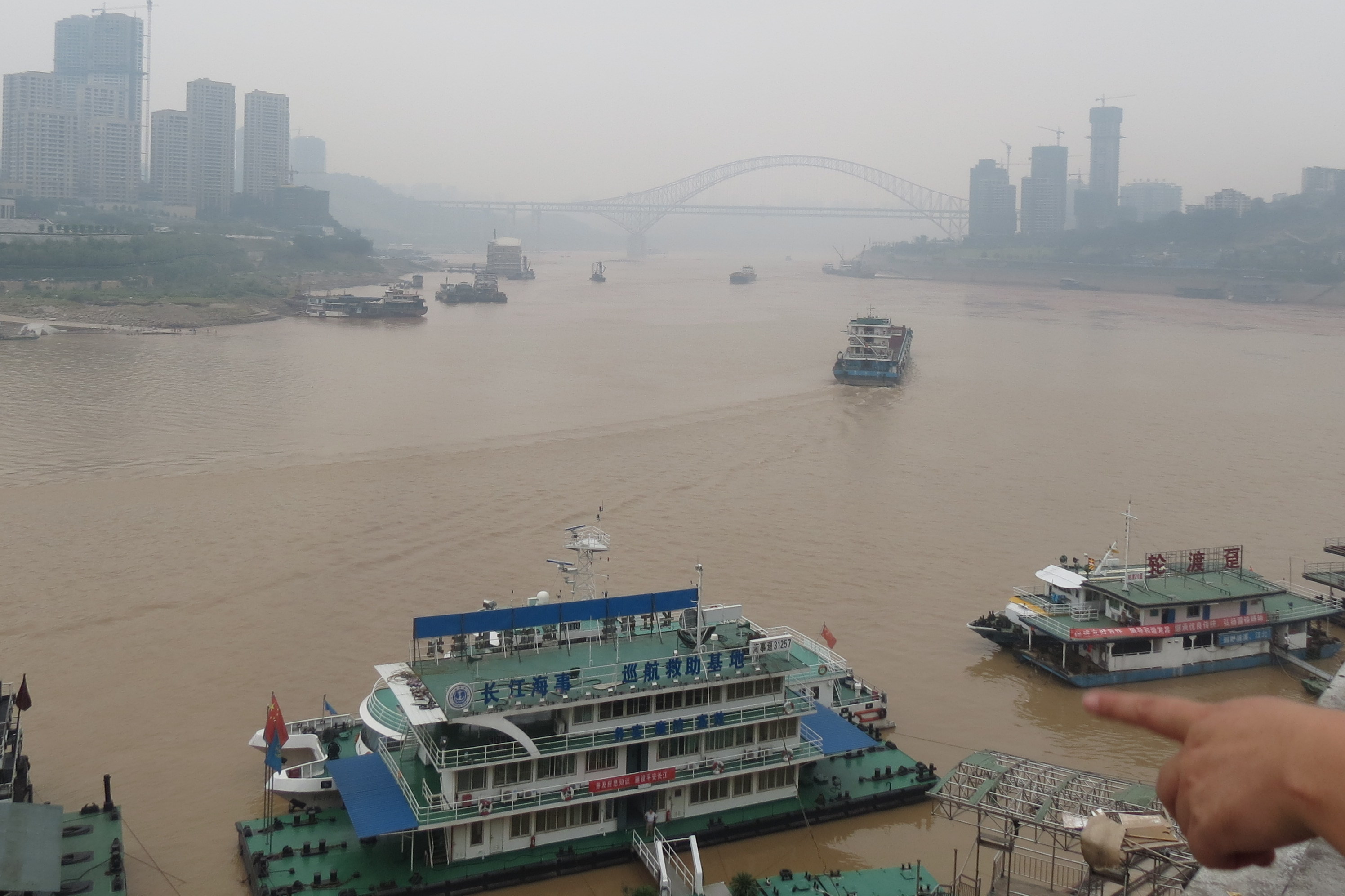
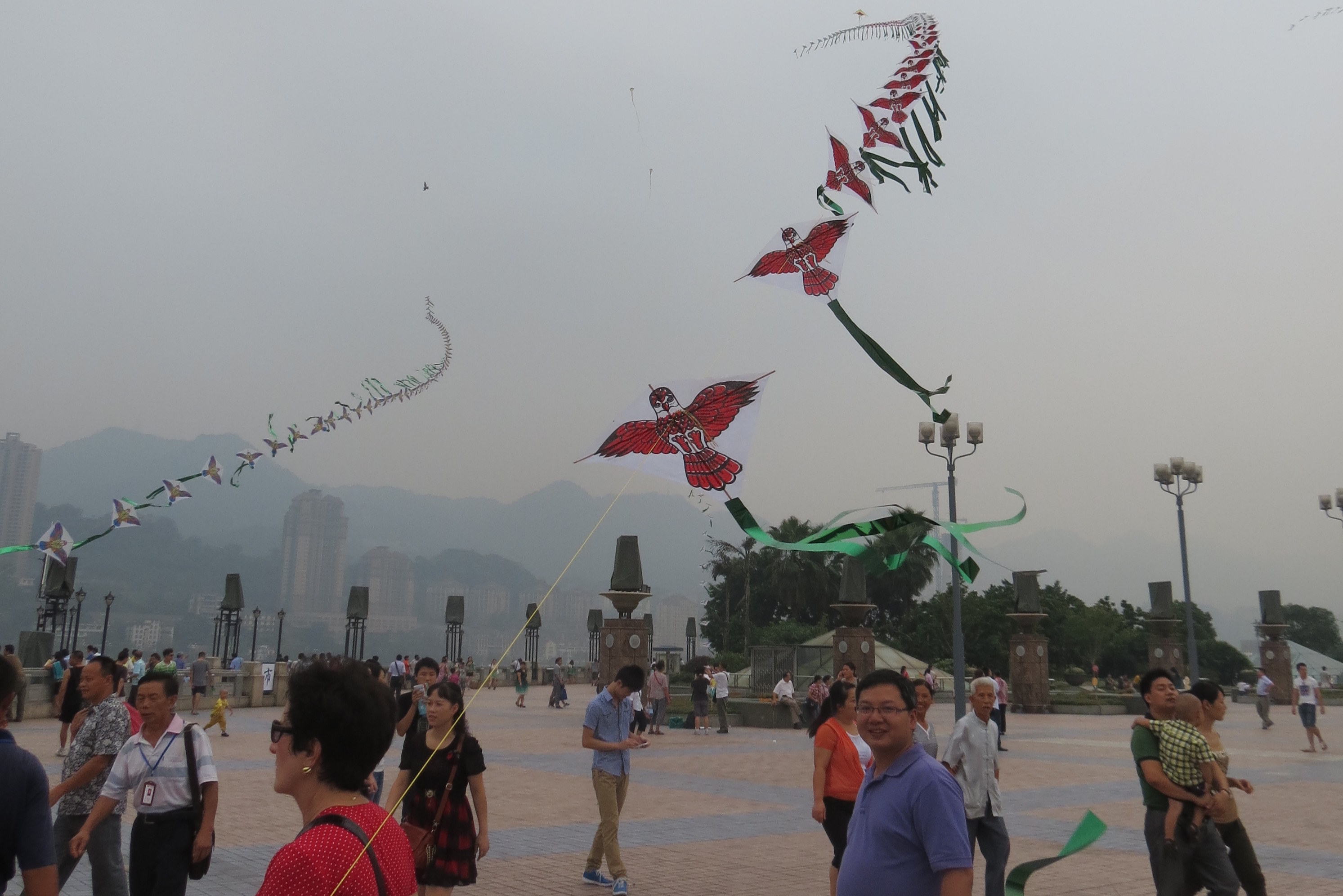
But since there was time left, we asked our guide to drive us to the edges of the Yangtze river, which we had yet to see. He somehow tried to dissuade us from that, offering to bring us to a temple of some sort. Thankfully, we resisted, because we then drove to perhaps what should be the first stop on a visit to Chongqing, the grand square overlooking the Yangtze river. I think the name of the square is something like Tainiamen square (as I said, I could not get a straight answer from our guide) and it is a huge plaza full of people, including some flying kites going several hundred meters into the air. From there you get a phenomenal view of Chongqing, of the junction of the JiaNin and Yangtze rivers, of some of the cruise docks below. In addition, you can walk from that plaza along the Yangtze river along a broad sidewalk for quite a distance. In fact, we ended up virtually walking to our ship, which we reached shortly after 4:30pm.
Even though we were early, I took the chance and stepped aboard our ship, the Yangtze Gold One.
Chongqing: mountain city, foggy city
 I was somewhat anxious about our scheduled train ride from Chengdu to Chongqing. Our guide had warned us that there would be a lot of stairs and there was no way I could carry both our suitcases, my backpack and Lynn’s carryon up and down a lot of stairs. But I had wanted to take at least one train ride during our trip to experience this aspect of China; after all, China in the past ten years has managed to build the biggest high speed train network in the world.
A number of streets converge onto the large square in front of the Chengdu train station and traffic grinds to a halt there. Traffic lights are useless as cars and buses clog the large intersection; it’s every man for himself and our driver has to inch his way through this maze of traffic in order to drop us off at the giant plaza in front of the station. It is seven fifteen in the morning but there are already thousands of people jamming this large plaza, many moving but many simply sitting on top of their belongings. We have to work our way through that maze of people in order to reach the station.
Airport-style security greets all entrants to the train station. I am not sure about the effectiveness of those measures, however, as I decide to keep my Scottevest travel vest on and yet breeze through without anyone stopping me. I always wear my Scottevest travel vest on trips; it has something like 22 pockets, most of them hidden and the rest securely zippered. That vest contains my ipad, my cell phone, my wifi hotspot, my chinese cell phone, my 50-hour spare battery, my usb car charger, my replacement cell phone and camera batteries, two sets of earphones, a packet of kleenex, a packet of wipes, a roll of toilet paper, a roll of litter bags, in brief the basic essentials. I keep the rest inside my Scottevest hidden cargo pants, where secret pockets contain my credit cards, my chinese as well as american cash, passports, tickets, etc… In other words, I always travel with my valuables on me, not packed or stored elsewhere. In spite of it all, I walked through that xray machine as if I had been naked.
We then inch our way through the crowd waiting for trains and head straight for the starting gates. I call them starting gates because it reminded me of the starting gate at a horse race. Several locked tall metal gates behind which an unruly crowd gathers waiting for the signal to head for the platform. There are about four gates for our train, long lines of people behind each gate. Where are the handicappers? I place my bet on gate no 3 and we patiently wait; the gates will open twenty minutes before departure time. I can see that, despite the heavy bags and other belongings which the chinese are carrying, many of them are good sprinters and may beat me around the bend. They have an edge on me as they probably know the racetrack well.
Thankfully, security has let Ben, our guide, come in to help us, so he is handling Lynn’s suitcase. When the gates finally open, we head towards platform 10 by taking an escalator up to a walkway running above the tracks and then down stairs to our assigned platform. Except that there is a suitcase ramp on the side of the stairs making it relatively easy to roll the suitcases down as you walk down the stairs. We then walk to our assigned car, which happens to be the last car of the train. We can just roll our suitcases aboard, no steps and straight on to a storage area located right behind each seat; I did not have to lift a finger!
This high speed train is as comfortable as any in Europe, and the two hour ride to cover the 300km between Chengdu and Chongqing is extremely smooth. An attendant offers coffee and tea a couple of times during the ride, and a food cart also showed up. An electronic board tells us our location, speed, and the outside and inside temperature as well as a bunch of other information written in chinese characters. The highest speed I saw was 195km/hr. My wireless hotspot worked flawlessly throughout the trip.
When we finally pulled into Chongqing Bei (north) and slowly ground to a halt, I saw that a ban ban porter (so named because of the old chinese manner of transporting things with a stick across their shoulders, and ban is the word for stick) was waiting right outside the door of our car; our Chongqing guide had sent him to transport our luggage, which he did right onto the car waiting for us outside this gigantic train station, the biggest one I have ever seen.