Category Archives: Nice SEP13
Where joie de vivre meets art de vivre!
 I have been compelled to make another lunch reservation, this time at La Colombe d’Or in Saint Paul de Vence (I wonder if Anne-Marie has been there yet). This is not because the only thing I do on a vacation is eat lunch; it is because (1) the only way to see the amazing artwork owned and displayed by this hotel/restaurant is to either stay or eat there, and (2) there is a fascinating history associated with this place.
The founder of this hotel/restaurant in 1920 was a Paul Roux, who happened to like art, and his café in Saint Paul de Vence quickly became a hangout for artists, after Modigliani, Bonnard and Signac started meeting there. Picasso, Matisse, Miro, Leger, Braque, Chagall, Calder, Buffet, Dufy, Utrillo, etc… are all reputed to have been regulars, who sometimes paid for their meals with artwork, paintings, sculptures and/or drawings, thus creating a priceless legacy. The reputation of La Colombe d’Or only served to attract other artists, movie stars and other famous people to the place. Hemingway and later John Houston were regulars at the bar. The signature book of La Colombe d’Or is filled with drawings, artwork and signatures from famous people who continue to make a pilgrimage to La Colombe d’Or.
Two historical incidents seem to be frequently mentioned. The first relate to a jealous row between F Scott and Zelda Fitzgerald over the Russian ballerina Isodora Duncan. Gerald and Sara Murphy were having dinner at La Colombe d’Or with the Fitzgeralds when F Scott Fitzgerald spotted the beautiful Isadora Duncan at a nearby table. Gerald Murphy got up to make the introductions and before you know it, F Scott Fitzgerald was at Isadora’s feet (the stories seem to vary as to whether he knelt down or sat down at her feet). Zelda, furious at all this, got up onto their dinner table, which was next to a ten foot ravine, and simply threw herself off the table into the ravine, resulting in bleeding and bruises and probably more.
Like a magnet the Art Hotel attracted the greatest film directors, actors, singers and writers of the day: Renoir, Prevert, Chaplin, Truffaut, Signoret, Piaf, Montand and Deitrich. It became one the most famous celebrity salons in the South of France. The second incident relate to Yves Montand who apparently met Simone Signoret at La Colombe d’Or, which explains why they later married there in Saint Paul de Vence. Today, nothing has changed. The likes of Michael Caine, Bono, Roger Moore, Richard Attenborough, Elton John, Madonna, etc… can be sighted lunching at a table on the terrace.
As for the food, I am told not to miss the famous hors d’oeuvres (appetizers). I know that F Scott Fitzgerald did not go to La Colombe d’Or for the food; he is said no to have cared much for French or Provencal food and simply asked for a club sandwich in every restaurant.
I just found out that there is a guide to the restaurants of Nice as well the rest of the French Riviera. It is called Guide Gantie and is available at guidegantie.com. A welcome addition to Michelin and Trip Advisor. I also found out that there’s a Musee Auguste Escoffier in Villeneuve Loubet, not far from the Musee Renoir in Cagnes. The king of chefs and the chef to kings, as he is referred to, may deserve a visit; something else to investigate. The list of places to visit in the Nice area is getting too long; I am going to have to prioritize and cut. One outing that will not be cut is the bouillabaisse at La Mere Germaine on the port in Villefranche, one of the few places on the French Riviera which serves the “real” bouillabaisse, prepared the old fashioned way (check the recipe on the website, just reading it is mouth watering).
L’Oisivete me fatigue! (Idleness tires me!)
 Whenever we rent an apartment in a large city somewhere in the world or stay for an extended period , as we have done a number of times so far in Paris, London, Rome, Florence, Buenos Aires, etc.., we try to divide our touring up by sections and dedicate a whole day to each part of town or suburb. That is also the plan for our upcoming trip to Nice, and my initial look at all there is to see and do in the region is that, if I am not careful in my planning, we will run out of days!
Between Cannes and San Remo, each of which will warrant a day, and Nice itself, which warrants at least three days, I should normally have to reserve at least a day each for Antibes, Juan les Pins, Saint Paul de Vence, Villefranche sur Mer, Saint Jean Cap Ferrat, Eze, Beaulieu sur Mer, Menton, and Monaco, all of which are within one hour at most from our Nice apartment. That’s already fourteen days! When do I have time to simply waste the day strolling on the Promenade des Anglais and putting my feet up on the beach? And what about my idea of making a little side trip to Corsica, since Nice is a port for several ferries going to and from Ajaccio, Calvi and other ports in Corsica?
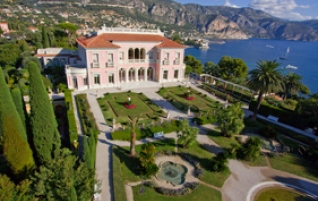
Take Saint Jean Cap Ferrat, for example. Set on a beautiful peninsula in the eastern suburbs of Nice, it would usually justify a nice walk all around the peninsula to take in the incomparable sea views. It should be said that the price of real estate in this area is by far the most expensive anywhere in the world, several times the price per square meter one can find in New York, London, Paris or Tokyo. Since I could not manage to get an invitation to either Bill Gates’ villa or King Fahd’s small palace nearby, Lynn certainly will insist on visiting the Villa Ephrussi de Rothschild, one of the most magnificent villas on the Cote d’Azur. Built at the beginning of the twentieth century on the narrowest part of the Cap Ferrat peninsula, the villa and its gardens occupy a large piece of land with incomparable views of the Mediterranean.
Beatrice Ephrussi de Rothschild, who was the heir to the vast fortune of her extremely rich banker father Baron Alphonse de Rothschild, fell in love with the area after she visited Villa Kerylos nearby in what is now Beaulieu sur Mer, a Grecian style villa being built by her husband’s cousin, Theodore Reinach. Later separated from her philanderous and gambling addicted Russian banker husband Maurice Ephrussi, the Baroness divided her time every year between Deauville, Paris and Monaco, and also traveled the world to build up her art collection of great masters. She had her own private zoo on the property, raised horses, and was not only a good tennis player but even joined a flying club. She apparently knew how to throw a party; the poet Andre de Fouquieres wrote: “I remember, in particular, one summer night, when we had the privilege to see, in her gardens, which drew from her mansion across to the sea, and bathed in moonlight, Anna Pavlova dancing to the Chopin nocturnes.”
After her death in 1934, she bequeathed the Villa Ephrussi property to the Academie des Beaux Arts of France for use as a museum, which explains why we are able to visit this beautiful property.
The villa has a tea room and lunch restaurant in a fabulous circular domed room with floor to ceiling windows as well as a terrace overlooking the Mediterranean, which is most certainly where I will plan to have lunch that day. I probably need to call tomorrow and make a reservation. .
But where should we head to after lunch? How about Villa Santo Sospir and the Grand Hotel du Cap Ferrat, both located in Cap Ferrat?
Villa Santo Sospir is so named because her owner was the well heeled Brazilian born Francine Weisweiller, who moved to France and who was to become an early patron for both Yves Saint Laurent and Jean Cocteau. The villa itself has become known in French as “La Villa Tatouee”, the tattoed villa, because of what Jean Cocteau did to it.
When Jean Cocteau, a very well known French multi-talented artist, poet, novelist, filmmaker, etc… made a film out of his book “Les Enfants Terribles”, the principal actress in the film, Nicole Stephane (real name: Nicole de Rothschild), introduced Cocteau to her friend Francine Weisweiller, and the two of them hit it off immediately. Francine invited Cocteau to spend a week at her villa in Cap Ferrat.
A couple of days later, Cocteau, who is reputed to have said “L’oisivete me fatigue et me desseche” (Idleness tires me and dries me up), started decorating the walls and doors of the villa with frescoes and other art and apparently did not stop until the whole place, including the floors, were covered with his art.
One aspect of Jean Cocteau’s life is of particular interest to me. Jean Cocteau was very much bi-sexual and is well known for his affairs with famous women and famous men alike. What I did not know until a few days ago was that his lover for many years was none other than Jean Marais! Yes, the Jean Marais. Ok, you don’t remember? Well, when I was a little boy and watched with excitement the French swashbuckling movies of seventeenth or eighteenth century musketeers or other heroes fighting with panache the evildoers (usually the English), Jean Marais was the principal actor and hero in many of those movies. I was not aware that he was gay, not that it makes any difference. Le Bossu (The Hunchback) is a movie from those days that I still remember fondly.
Unfortunately, I have an issue with Jean Cocteau, and that may well make me very reluctant to pay a visit to Villa Santo Sospir. Jean Cocteau was vocally and loudly pro-Hitler during the second world war, even going as far as complaining that the French people were being “disrespectful” towards the Fuehrer! Do I really want to lend any support to such a person by the simple act of visiting Villa Santo Sospir? A moral dilemma I shall have to mull over.
The issue with the Grand Hotel du Cap Ferrat is of a different order. Set at the southernmost extremity of the Cap Ferrat peninsula, the hotel has commanding views not only of the Mediterranean but also on the west side it offers fabulous panoramic views of all of Nice and the bay of Angels. Being in the best location in the best real estate area in the world comes with a price tag for the guests. Just for fun, I checked what the room prices were for the period we were going to be in the area; the cheapest room was about $2,500 per night! We could simply just go eat there, right? Well, yes we could if we were willing to pay $250 for lasagna. This is one I don’t need to mull over; we will walk around it or find something else to do. After all, I already knew as a child that “l’oisivete est la mere de tous les vices” (Idleness is the mother of all vices).
La Cuisine Nissarde: Best of Provence and Italy
 When one thinks of Nice, one immediately thinks of Salade Nicoise, that refreshing summer day salad which seems to always include tuna, anchovies, hard boiled eggs, olives, corn, boiled potatoes and green beans. As I prepare for our trip, I am discovering, much to my delight, that there is a lot more to the cuisine of Nice than salade nicoise. But before I get into the details of my findings, I do need to mention that the salade nicoise, as we know it, may not be the real salade nicoise after all.
Le Cercle de la Capelina d’Or is a committee of people from Nice set up to defend the honor of the real authentic salade nicoise. Approved ingredients include tomatoes, hard boiled eggs, salted anchovies, tuna, onions, basel and olives from Nice, with garlic, salt and olive oil. In season, beans, artichokes, hearts of celery and/or green pepper may be added. But it is blasphemy to include potatoes and green beans, and even more heretical to add corn to the mix. It was apparently the renowned chef Auguste Escoffier, the pope of French cooking, who committed the sin of adding potatoes and green beans to the recipe for salade nicoise. The committee is quick to point out that Escoffier, whom we all thought came from Nice, is actually not a local, since his neighborhood of Villeneuve-Loubet is separated from the center of Nice by a small river!
I was quite unaware that the region of Nice has its own cuisine, called cuisine nissarde. I was even more ignorant of the fact that the people of Nice had their own language (which explains why they say nissarde instead of nicoise), still spoken and written a bit around town. This all comes from the fact that Nice, up until 1860, was part of Italy not France. The whole French Riviera, starting past Antibes eastward was until then part of the Italian Riviera. During the seventeenth, eighteenth and nineteenth centuries, the ownership of Nice shifted back and forth between French and Italian lords, kings or emperors. In 1860, the Italians gave the region of Nice to France as a reward for France’s support of the second war of Italian independence against the Austrian empire; this was supported by a referendum held among the local population. Giuseppe Garibaldi, one of the founders of modern Italy, was opposed to the cession and claimed that the referendum had been rigged by the French. Italian nationalists ever since have laid claims to the region. And that is why, during the second world war, Nice was briefly given back to Italy by the Germans and was run by Italy during 1942 and 1943. I did not know that; no wonder the people of Nice would want their own language!
Not surprisingly, given that the ownership of Nice went back and forth between Provence and Italy, the impact of all this history is that the cuisine of the region is a blend of the cuisine of Provence and the cuisine of Italy. Since those two cuisines happen to be individually among my favorite foods in the world, I am in seventh heaven and eager to discover the many unique dishes of the region. Here are some of the most famous ones: Salade Nicoise, Ratatouille Nicoise, Daube Nicoise, Raviolis Nicoise, Gnocchi Nicoise, Farcis Nicoise, Ganses Nicoise, Sardines Farcies a la Nicoise, Pan Bagnat, Poche de Veau Farcie, Tian de Courgettes, Pissaladiere, Tarte de Blette, Beignets aux Pommes, Socca, Stockfish. So much to learn and to enjoy! And I can drown all that great food with the local wine, called Bellet wine, grown in the hills behind the city for centuries.
The cuisine seems to be based in large part on fresh vegetables, seafood and pasta. I can’t think of a better combination. I am overjoyed at the possibility of being able to buy freshly made pasta when I go out to get the morning baguette, croissants and pains aux chocolat. Actually I expect we will be eating our main meals out most if not all of the time. Fortunately, many restaurants in the region claim to respect the tradition of the cuisine nissarde and I have time to go through the list to pick my favorites. I was looking at some of the menus and they are indeed appetizing.
So I have a lot of work yet in store to prepare for the trip. Checking out the recipes of the cuisine nissarde dishes, checking out the restaurants and their menus, learning about the Bellet wine and its vineyards. Spaghetti aux fruits de mer, here I come!
Lunch at the Hotel Cap Eden Roc in Antibes
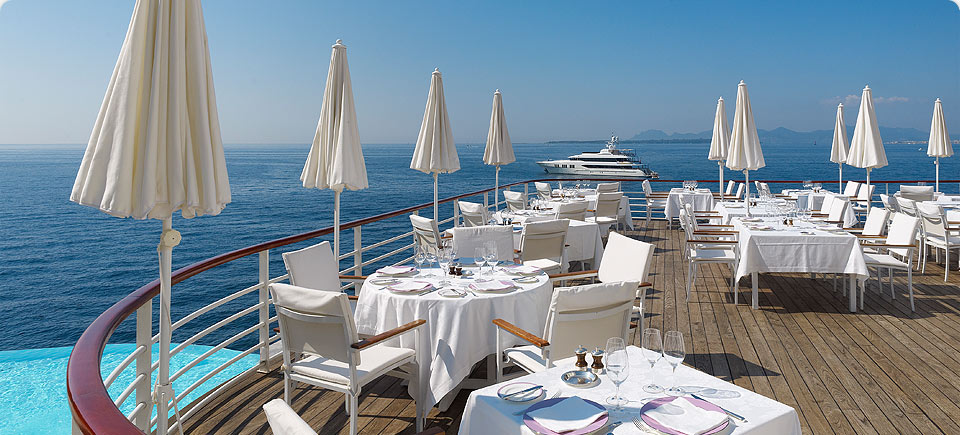 I have asked for a lunch reservation at the Hotel du Cap Eden Roc in Antibes. Yes, the beautiful restaurant terrace overlooking the Mediterranean where a simple starter salad like a Salade Nicoise will cost you US$80. Visiting this hotel for its phenomenal position on the Cote d’Azur and its gastronomic excellence might be reasons enough for the well heeled, and they have indeed done so. But why would we go there for lunch?
Well, for one thing, staying there is nowadays quite costly, with the cheapest room going for about US$1,000 per night. But we do need to go there because of the historical significance of this hotel and its importance in the world of art and literature.
Started as a writer’s retreat in 1870, Villa Soleil was transformed into Hotel Cap Eden Roc by Antoine Sella at the turn of the twentieth century. Initially open only during the winter months, which was when the English and Russian aristocracies used to visit the French Riviera until the first world war, the hotel started to open some rooms for the summer when Gerald and Sara Murphy wanted to visit Cole Porter who was renting a villa nearby and convinced Antoine Sella to keep a small staff and a floor open. Gerald Murphy had been a schoolmate of Cole Porter at Yale and is even said to bear some responsibility for encouraging Cole Porter to write and sing songs.
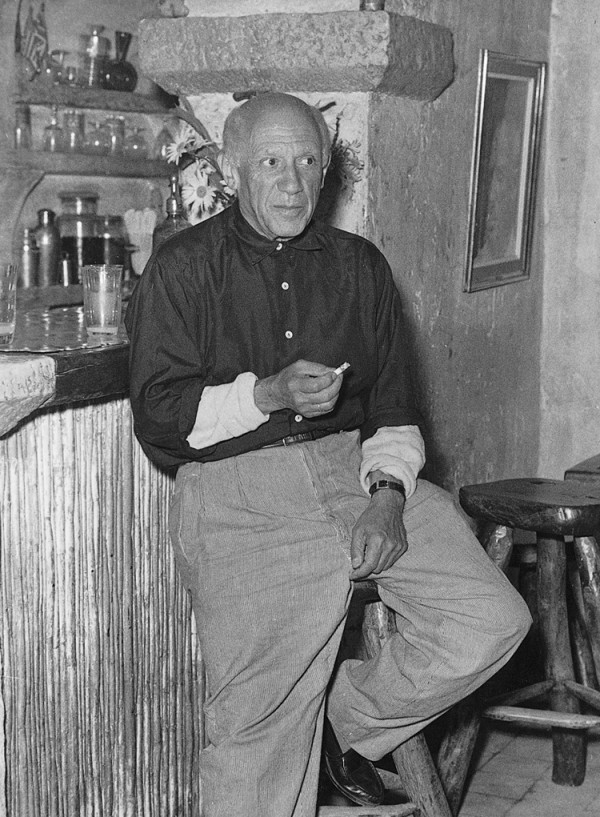
By the time they descended on the Cote d’Azur, the Murphys had become close friends of Pablo Picasso in Paris. Gerald loved Picasso’s art, and Picasso loved Gerald’s wife, Sara, who is said to have become his muse. The Murphys invited Picasso down to Antibes and he agreed, coming with his young beautiful Russian wife of the time. The Murphys were also friends of F Scott and Zelda Fitzgerald, and the Fitzgeralds also came down to the Riviera. F Scott Fitzgerald, who apparently liked to test the sexuality of his friends, had fixed up Gerald with a young South American man, Eduardo Velasquez, who had just been ejected from England for having had an affair with a male member of the royal family.
F Scott Fitzgerald wrote The Great Gatsby in Antibes, and also a couple of years later, he wrote Tender is the Night, which was published in 1930. Gerald and Sara Murphy are the models for Dick and Nicole Diver in that book.
George Bernard Shaw also returned for many years at the Hotel Cap Eden Roc. The Duke and Duchess of Windsor were married at the hotel after he abdicated the throne in England.
After the war, Picasso rented or bought the Grimaldi castle nearby in Antibes and came to eat frequently at the hotel. The Chateau Grimaldi is now the Picasso Museum in Antibes, and that is why our plan is to visit the museum in the morning and then have lunch on the terrace at the Hotel Cap Eden Roc.
Marc Chagall was also a frequent customer of the hotel.
Since that time, the hotel has received the most important guests in the world, from Eisenhower to Churchill, from Kennedy to Madonna, etc…
That is why I have made a lunch reservation at the Hotel Cap Eden Roc for Wednesday September 4th at 1pm.
Is Nice still nice?
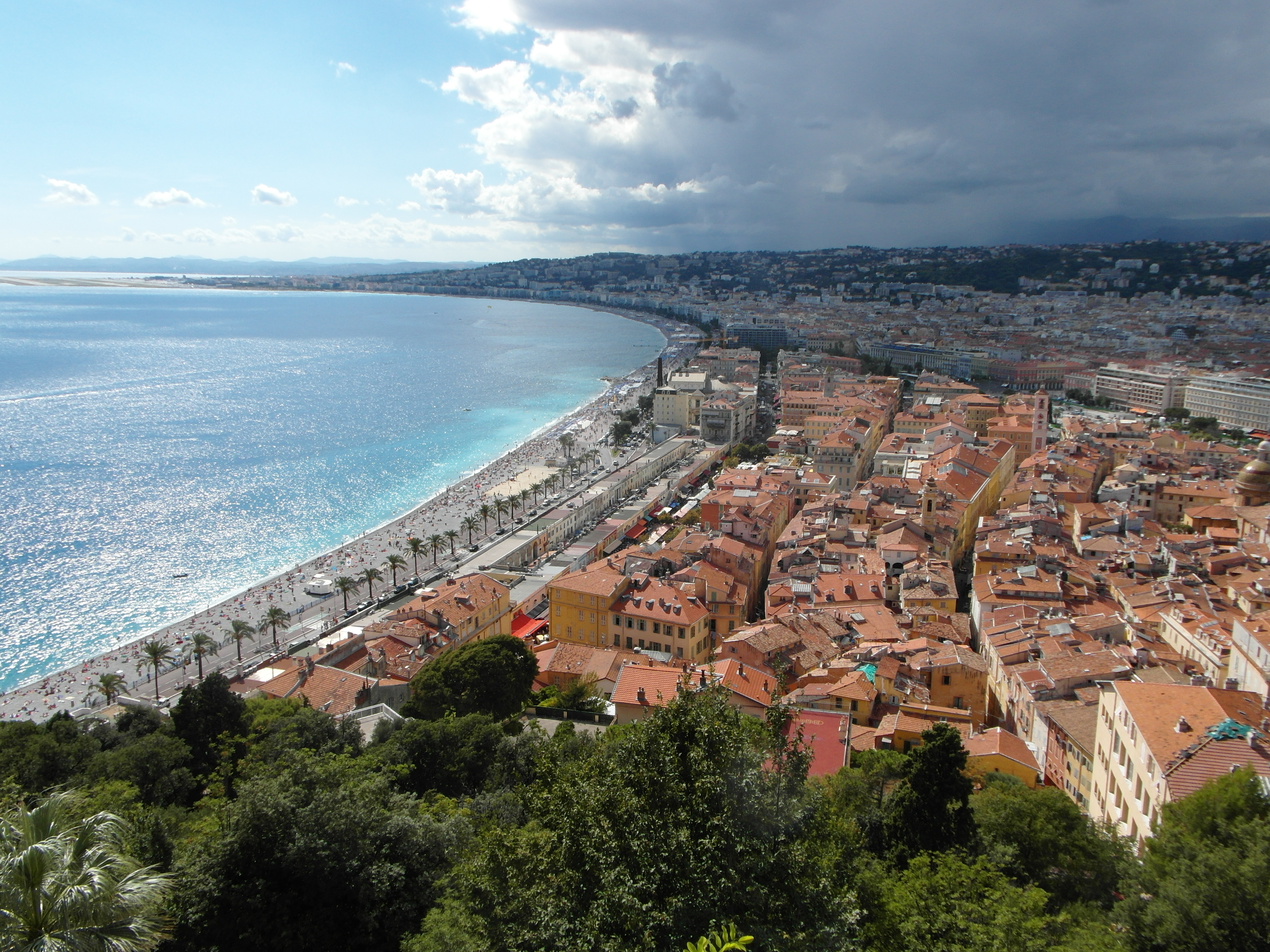
Making the headlines these past few days was the $136 million jewelry heist made in broad daylight by a single man from the Carlton Hotel in Cannes on the French Riviera. Since we are scheduled to leave for the French Riviera in a few weeks, the news caught my attention. We have rented an apartment in Nice, the largest city on the Cote d’Azur, for about three weeks, and the question must be asked: is Nice still nice?
Excluding our recent one day trip to Marseilles to taste once again its bouillabaisse in the old port, the last time we spent any amount of time on the Cote d’Azur goes back almost thirty five years. In those days, in the mid-seventies, the major issue in France related to the 800,000 or so pieds-noirs (“black feet”) who had emigrated to France during the sixties, following the end of the Guerre d’Algerie (“Algerian War”) in 1962. The pieds noirs were French citizens born in Algeria who had to leave all their possessions behind and made up most of the ghetto suburbs of the large French cities. My closest co-worker in my first job in France in 1974 was a pied-noir, a charming man who as a hobby liked to raise pigeons for his dinner table.
France is a very different country today, following the expansion of Europe and other globalization trends. The largest minority in France today are the more than five million muslims who have mostly come from the Mahgreb and other past colonies of France in Africa. Twenty five percent of the population of Marseilles is Muslim; I don’t know the ratio for Nice, but I would not be surprised if it were a similar percentage. There are almost ten times as many muslims in France as there are Jews.
Last year, the French government created fifteen special zones (zones de securite prioritaires or zsp) which would receive extra police attention in an effort to reduce the soaring crime rate. The mayor of Nice was furious that Nice had not been initially included in the zsps, claiming that Nice also had areas of “deeply rooted anti-social behavior”; Nice made the list in early 2013. Recent reports that crime had gone down by 20% in the first half of the year are not sufficient to alleviate my concerns.
I am well versed in the art of eliminating the risk posed by pickpockets. However, we are talking more here about the risk of being mugged, assaulted, raped, etc…, a whole different level of risk requiring different steps and plans. I may well have to change my habit of carrying all our valuables in my hidden pant pockets; that is an effective deterrent against pickpockets but won’t go very far with a band of thugs. This may well affect our daily schedule; for example, if walking the streets at night is not safe, we will switch to having our big meal at lunchtime and having a light dinner at home. If walking to the train station is unsafe, we will have to take a taxi. And so on.
I have three weeks or so to study the situation and prepare. But we will have to be there to really find out : is Nice still nice? Stay tuned on my travel blog, BonVoyageurs.com, and find out!