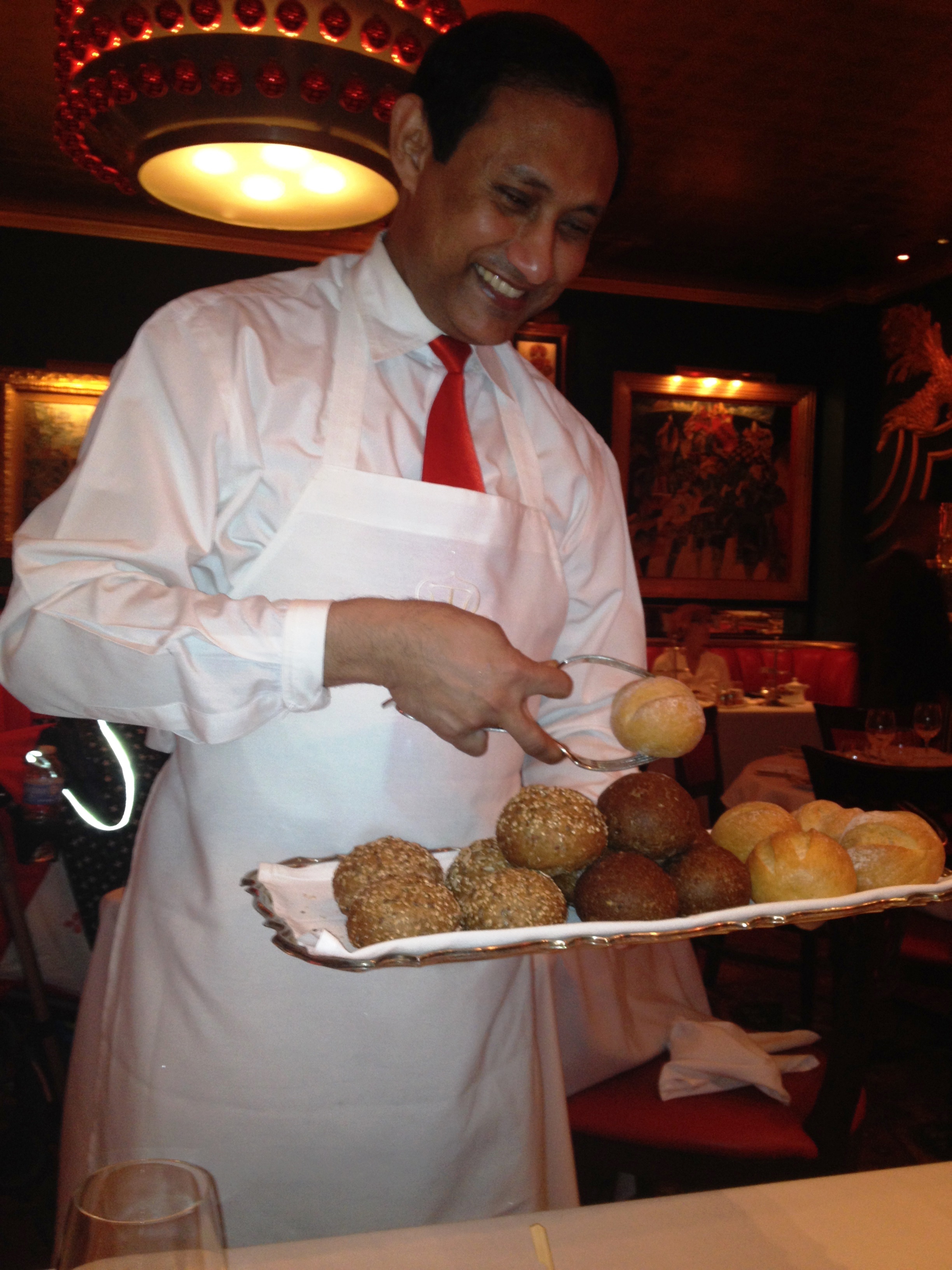
Category Archives: Culinary Spotlight

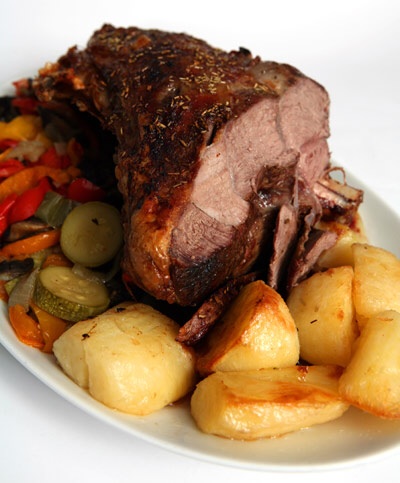
BEST of Australia food : Roast Lamb !

Roast Lamb was voted last year as Australia’s national dish, in a very close win over the traditional and very popular meat pie. I think this is a well deserved win, don’t you?
image


Photo Heatbeads.com.au

Recipe for Australian roast lamb from Australianfood.about.com:

The Roast is one of Australia’s and New Zealand’s favorite ways to eat lamb.

This recipe could not be simpler. The lamb is just oiled, salted and seasoned with garlic and rosemary.

The two most common lamb roast cuts are the leg and the shoulder. I used a shoulder here. This cut has more fat than the leg and therefore requires slower cooking.

If you have chosen to use a leg instead of shoulder, simply cook it for 20, 25 or 30 minutes per pound depending on whether you want rare, medium or well-done meat.

Prep Time: 15 minutes

Cook Time: 1 hour, 30 minutes

Total Time: 1 hour, 45 minutes

Ingredients:

1 kg (2.2 lbs) leg of lamb
1/4 cup of olive oil
2.5 tsp of sea salt
6 cloves of garlic, cut into slivers
Several sprigs of fresh rosemary
8 potatoes
2 large sweet potatoes
2 white onions
Mint Sauce
Serves 4
Preparation:

Preheat the oven to 290F.
Cut the potatoes and sweet potatoes into inch-thick slices. Cut the onions in half and then place vegetables into a baking tray.
Drizzle the vegetables with olive oil and sprinkle on some salt. Place tray in the oven on the bottom rack and roast.
Cover the lamb in olive oil and then sprinkle with sea salt.
Use the point of a sharp knife to make small incisions all over the lamb.
Place the garlic slivers and rosemary springs in the holes.
Place the lamb onto the middle oven rack with the vegetable baking tray beneath it to catch drippings.

BEST of Aruba food : Keshi Yena !

Keshi Yena, the national dish of Aruba, is a spicy mixture of chicken and peppers, capers, olives and tomatoes baked in a Gouda or Edam cheese “shell”.
Can you really visit Aruba and not try this wonderful dish?

Photo TripAdvisor.in

Here’s the recipe for Keshi Yena as provided by VisitAruba.com:

Ingredients
1 lb. chicken breasts
1 lb. chicken thighs
Salt and pepper
Poultry seasoning
Minced onion
4 quarts water
2 tsp. salt
12 peppercorns
1 or 2 onions
1 celery stalk with leaves bay leaf, bruised
3 tomatoes, peeled and chopped
4 onions, sliced
1 large green pepper, chopped
1Tbs. parsley, minced, or a few drops Tabasco sauce
Salt and pepper
2 Tbs. ketchup
1/4 cup pimento olives, sliced
1 Tbs. capers
1/4 cup raisins
2 Tbs. piccalilli
3 eggs, reserving about 6 Tbs.
1 or 2 hard-cooked eggs

Preparation Directions
Frugality was the keynote of island living in earlier times, when provisions had to last from the visit of one sailing ship to the call of another. In this classic recipe the shell of a scooped Edam (the thin rind remaining after a family had consumed the four pounds of cheese) is filled with spiced meat, then baked in the oven or steamed in the top of a double boiler. For these methods of preparation the red wax must be removed from the empty shell after is has been soaked in hot water. In a more dramatic version the filled Edam, with the red wax intact, is. tied in cheese cloth and suspended in boiling water for twenty minutes. The wax melts away in the hot water, leaving a delicate pink blush on the cheese. Use chicken or beef for the filling.

For the chicken filling, rub with the juice of several limes:

1 lb. chicken breasts
1 lb. chicken thighs

Season the breasts and thighs with:

Salt and pepper
Poultry seasoning
Minced onion
Let them stand for several hours. Then either arrange the pieces in a shallow baking dish, and after browning the chicken under the broiler, bake it for one hour at 350? , deboning it when cool enough to handle, or choose this more frugal method of preparation. Brown the chicken in three tablespoons butter, then place it in a heavy kettle with:

4 quarts water
2 tsp. salt
12 peppercorns
1 or 2 onions
1 celery stalk with leaves
bay leaf, bruised
Bring to a boil, reduce heat and simmer for twenty minutes, or just until chicken is tender. Strain and reserve the broth, discarding the vegetables

Debone the chicken and set aside.

After the chicken has been prepared by one of the above methods, sauteed two tablespoons butter:

3 tomatoes, peeled and chopped
4 onions, sliced
1 large green pepper, chopped
1Tbs. parsley, minced, or a few drops Tabasco sauce
Salt and pepper
Add and stir in well:

2 Tbs. ketchup
1/4 cup pimento olives, sliced
1 Tbs. capers
1/4 cup raisins
2 Tbs. piccalilli
The chicken, or 1 lb. ground beef, lightly browned, if beef is to be substituted for the chicken.

Simmer until the tomatoes are reduced, about twenty or thirty minutes. Remove from the fire and permit mixture to cool. If keshi yena is to be baked, preheat oven to 350 , if it is to be steamed, begin heating water in the bottom of a double boiler.

Beat and add to the meat mixture:

3 eggs, reserving about 6 Tbs.
Generously butter a casserole or the top of a double boiler. Before placing the cheese shell in it, spoon three tablespoons of the reserved beaten egg into the bottom of the container. Half fill with the meat mixture and add:

1 or 2 hard-cooked eggs
Fill shell to the top with remaining meat and cover with:

The original cap of the Edam, from which the wax has been removed, or a few slices of cheese. A word of caution! Never use soft young cheese for keshi yena.

Drip the remaining three tablespoonfuls of beaten egg over the top of the cheese as a sealer. (Place the lid on the double boiler). Set the casserole in a pan of hot water, or the double boiler top over the simmering water. Cook for one and one-quarter hours. Reverse keshi yena on a heated platter and keep warm for the cheese becomes hard and unappetizing if permitted to cool.

In place of the cheese shell, two pounds of Edam or Gouda slices may be used to line the cooking container. The slices should overlap and create the same effect as the shell. Add filling cover with additional slices and follow directions for baking or steaming the shell. The traditionalist with a great deal of time and patience, may scoop out a four pound Edam or Gouda, taking care not to pierce the shell.

BEST of Armenia food : Harissa, aka Herriseh !

Harissa, which I could also call chicken risotto with wheat, is not only the national dish of Armenia, but also a rallying symbol for Armenia’s courage and fortitude across centuries of tribulations! A stick-to-the-ribs comforting dish perfect for a cool day!

Photo BarevArmenia.com

Here’s the recipe for chicken Harissa (or Herriseh) from TheArmenianKitchen.com :

Ingredients:
1 whole chicken, approximately 3 lbs.
8 cups water
2 cups whole wheat kernels, rinsed in cold water and drained
2 tsp. salt, or to taste
cumin
paprika, optional
butter, optional

Directions:
1. Rinse chicken. Place in large pot with 8 cups water and salt. Bring to a boil, then reduce heat to medium. Cook, with lid tilted, for about 45 minutes to 1 hour, or until chicken is cooked.
2. Remove chicken from liquid; place on platter until cool enough to handle. Discard skin, bones and fat. Shred chicken; cut into smaller pieces, if necessary.
3. Strain broth. Measure broth, and add enough water to make the 8 cups needed. (Note: Some of the original amount of water will have evaporated, so this step is important.)
4. Place broth in large pot. Add wheat, shredded chicken, and salt if necessary. Bring to a boil; reduce heat to low. Remove any foam which rises to the surface.
5. Simmer on a very low heat, covered, for about 4 hours — without stirring! — until almost all liquid is absorbed.
6. Beat vigorously with a sturdy, long-handled, wooden spoon, mashing the wheat and chicken until they resemble thick oatmeal. Adjust salt, if needed.
7. To serve: place in bowls. Add a pat of butter, if desired. Sprinkle with a dash of cumin or paprika.

Robyn’s Notes:
A.) Cooking the chicken a day in advance allows you to chill the broth and discard excess chicken fat.
B.) Time-saving hints:
1. Leftover cooked chicken, lamb or turkey, and commercially prepared broth can be used to
shorten preparation time.
2. Using an immersion or stick blender, instead of beating with a wooden spoon (see step #6), will
save you a lot of time and energy!
C.) Leftover Herriseh freezes well. Just defrost, and reheat with a little extra liquid.

BEST of Argentina food : the Asado !

I can’t think of anything more Argentina than the Asado, the Argentina barbecue!

The secret to a great asado? Here’s the scoop from ArgentinoGrill.com :

In Argentina, an “Asado” is not just a way of cooking meat; it is an art form. Every chef has his own personal secret when it comes to arming the parrilla(grill), whether it is the heat of the fire, the ratio of coal to wood, or at what moment they turn the meat on its back. Grilled meat is part of the Argentine national identity, infinitely associated with the romanticism of the Pampa region and the wanderlust of the gaucho. Whether the individual comes from Córdoba, the Province of Santa Cruz, or the banks of the Rio de la Plata, Argentines are born knowing how to make asados.

The tradition dates back to an era when gauchos, or cowboys, roamed the interior Pampa region and lived entirely off the land and their stock. Many of the gauchos were of Italian descent, and they brought those cooking traditions with them to the kitchen when preparing meat. Their cow-centric livelihood created a need to be resourceful and thorough- and they let no part of the animal go to waste.

The asado tradition continues to this day, and there are many regional variations throughout the country. Whatever you do in Argentina, do not miss out on an asado. Not only are you failing to engage in one of the most delicious meals of your life, but you are not experiencing an important aspect of Argentine culture.

A traditional asado, or Asado Criollo is a specific way of grilling meat. There is an entire method and system in place for cooking, serving, and eating the meat. In other words, an asado is not just a throwing meat on the grill, it is an elaborate and purposeful set of customs.

When cooking the meat, the chef needs to be attentive to factors both above and below the grill. Beneath the grill, a traditional asado typically combines brasa (red hot coals) and leña (firewood), although the type of wood used is up for debate and varies region to region. The actual temperature of the grill, the distance from the coals, and the cooking times vary chef to chef, but generally the meat rests for the majority of time on one side (again, depending on the chef, tendency of the grill and the cut of meat), and is seasoned only with a pinch of salt. Borrowing from the gaucho need for conservation, an asado does not just include the best cuts of meat- there are potentially dozens of different parts of the animal served during the meal.

Generally, an asado begins with chorizo (sausage) and a black pudding, followed by various achuras (sweetbreads), before the serving of the meat. Ribs are traditionally brought out first, followed by the hindquarter cut; occasionally a third cut of meat is included. In all, a whole meal may consist of numerous cuts and preparations of the meat, including ribs, chorizo, black pudding, chinchulin (intestine), riñones (kidney), hindquarter meat, udder meat, criadillas (testicles), sweetbreads, stomach, and matambre. Many asados also include chicken, pork, lamb, and vegetables (most commonly peppers).

The meat is traditionally served with a chimichurri sauce, a mildly spicy mixture that includes spices, garlic, onion, and vinegar. All asados are also accompanied by a mixed salad and ideally served with a Malbec, a strong and slightly spicy red wine for which Argentina is known.

BEST of Antigua and Barbuda food : Fungee and Pepperpot !

Fungee and Pepperpot is the national dish of Antigua and Barbuda. That is somewhat strange, as pepperpot is a hearty meat stew, more frequently associated with colder climates. Fungee is cornmeal with okra. Both fungee and pepperpot are food preparations whose origins apparently predate the arrival of Columbus to the islands of the Caribbean! So fungee and pepperpot is probably as authentic a Caribbean dish as you will find.

Photo CaribbeanTravelDestinations.com

Recipe from InternationalCookingProject.blogspot.com, which modifies the traditional recipe to account for local ingredient availability:

Pepperpot

Ingredients:
-1 lb. corned beef brisket, cut into 1″ pieces
-1.64 lb. ham, cut across lengthwise (the original recipe didn’t specify an amount; this is what I used)
-8 c. water
-2 T. vegetable oil
-1 lg. onion, chopped
-4 green onions, chopped
-3 garlic cloves, minced
-1 habañero pepper, seeded and minced
-14 oz. can of whole tomatoes, drained
-1/4 c. tomato paste
-1 T. fresh chives, chopped
-1/2 tsp. ground thyme
-1 med. eggplant, cut into 1″ pieces
-1 lb. acorn squash, peeled, seeded and cut into 1″ pieces
-1/2 lb. yam, peeled and cut into 1″ pieces
-1/4 lb. fresh baby spinach
-16 oz can blackeyed peas, drained
-1/4 tsp. freshly ground black pepper

Directions:
1) In a 4 qt. Dutch oven, bring the corned beef, ham and water to a boil over high heat. Reduce heat to low and simmer until the meat is tender, about 1.5 hours. Drain the meat, reserving both the meat and the cooking liquid. Coarsely chop the ham.
2) While the meat is simmering, take the time to peel and cut all of the vegetables.
3) In the same 4 qt. Dutch oven, heat oil over medium heat. Add onion, green onions, garlic and habañero pepper. Cook, stirring often, until the onion has softened, about 4 minutes.
4) Stir in the tomatoes, tomato paste, chives and thyme, breaking up the tomatoes with a spoon. Bring to a boil, reduce heat to low and simmer 10 minutes.
5) Stir in the eggplant, squash and yam. Cook for 5 minutes, stirring often. Stir in meat and reserved meat cooking liquid. Bring to a boil, reduce heat to low and simmer until vegetables are done, about 20 minutes.
6) Stir in the peas and spinach. Cook until the spinach has wilted, about 5 minutes.
7) Season with pepper.
8) To serve, scoop 1-2 cups over fungee.

Fungee

Ingredients:-4 c. water
-2 c. yellow cornmeal
-1 tsp. salt
-6 okras, sliced
-butter

Directions:
1) Place water, okra and salt in a medium saucepan; bring to a boil. Cook until okras are done, about 5 minutes.
2) Remove about 2 c. liquid from pan.
3) Meanwhile, add cold water to cornmeal a little bit at a time until the cornmeal reaches a pasty batter. (I think that I ended up using about 1 c. cold water).
4) Add cornmeal mixture to okra water. Over low heat, stir continuously with a wooden spoon until mixture becomes fairly stiff. (I did this for about 7 minutes; I think I should have stirred for closer to 10). When the mixture breaks away clearly from the pan, the fungee is ready.
5) Butter a bowl. Turn the mixture into the bowl and shake it into the shape of the bowl. Turn it out onto a serving dish,
6) Serve with pepperpot.

BEST of Angola food : Moamba de Galinha !

Moamba de Galinha, portuguese for chicken stew, is the national dish of Angola. This very tasty dish is usually prepared with palm oil, a major crop of Angola. If you prefer not to use the traditional palm oil for the recipe, you can substitute a high temperature cooking oil of your choice.

Moamba de Galinha and Funge.
Photo Chefonline.Continente.pt

Recipe from Food.com :

Ingredients (Serving 4):
3 tablespoons fresh lemon juice (1 lemon)
4 garlic cloves, crushed
1/2 teaspoon salt
1 1/2 teaspoons chili powder
1 chicken, quartered
1/2 cup red palm oil
3 onions, chopped
1 chili pepper, left intact
3 tomatoes, quartered
1 lb butternut squash or 1 lb pumpkin, cut into 1 1/2-inch cubes
1 cup chicken broth
1/2 lb frozen okra, thawed

Directions:
1 Combine lemon juice, 2 of the garlic cloves, salt, and chili powder; rub all over chicken and marinate at least 1 hour up to overnight.
2 Heat oil in a Dutch oven, over medium heat, and brown chicken on all sides, in batches, if necessary.
3 Add onion, remaining garlic, chili pepper and tomatoes; bring to a boil, cover, reduce heat, and simmer until chicken is tender, about 1 hour.
4 Add squash, chicken broth, and okra; coom until vegetables are tender, about 15 minutes.
5 Serve with boiled yuca or over rice.

BEST of Andorra food : Escudella!

Escudella, which basically means soup, is considered the national dish of Andorra. This hearty dish is essentially a ham, chicken, sausage, potato, and al stew.

Escudella, the national dish of Andorra. Photo RoastedMontreal.com


Here’s the recipe I borrowed from EzineArticles.com :

The Ingredients:
2 cups dry white beans
1 small ham bone
1 marrow bone (veal or beef)
1/4 chicken (or used several pieces, according to your taste for white or dark)
400 g raw pork sausages, sliced or formed into balls
2 slices cured ham, cut in chunks
1 large potato, cut in eights (Desiree or white)
1/4 cup rice
1 cup of pasta noodles (or pasta shells)
1 cup of cooked chick peas (yes, you can used canned ones to save time)
Salt and pepper (according to your tastes)

The Instructions:

Gently cook the sausage pieces/balls in a cast iron Dutch oven with vegetable oil over medium heat until browned. If you don’t have Dutch oven, a pot or flame proof-Casserole dish will do just as well.
Rinse the dry white beans in cold water and tie the ham bone and marrow bone in cheesecloth.
Put the beans, bones in cheesecloth, cooked sausage and ham in the pot or casserole. Fill it up with 8 cups of cold water, and add salt according to taste.
Bring to a boil, then reduce the flames and let it cook gently, covered, for about 2 hours. A good test of seeing whether it is ready is to check that the beans are cooked, and whether the chicken is very tender.
Remove the bones and discard them. If you like eating marrow, and most people do, you can save it for later.
Remove the chicken pieces and put them aside.
If there is only a little liquid left, you can add a bit more water.
Bring it to a rapid boil.
When it’s boiling, put in the cabbage, potatoes, rice, noodles (or shells), cooked chick peas and add pepper to taste.
Turn the flames down to a medium heat.
Cook for 30 minutes. You can test to see whether it’s ready by checking on the softness of the rice and potatoes.
Before serving, put the chicken back inside. If it’s on a bone, and you don’t like bones, you can remove them from the meat before putting it back into the pot or casserole.
Cook for a few more minutes. This is so that the chicken in the stew/soup is heated back up.
Season to taste.
Serve warm.

Recipe Source: http://EzineArticles.com/5461538

BEST of Algeria food: Saffron and Raisin Couscous!

Couscous is a staple food in Algeria. Saffron and Raisin Couscous with Fresh Mint is Algeria’s national dish.

Photo Hotfreeads.com

Saffron and Raisin Couscous with Fresh Mint recipe from TheGutsyGourmet.net :

Serves 6
Ingredients:
1 1/2 cup water
3/8 teaspoon saffron threads
3/4 teaspoon extra virgin olive oil
3/8 teaspoon salt
1 1/2 cup couscous
0.188 cup raisins
2 1/4 tablespoons chopped fresh mint

Directions:

1) In a saucepan, bring the water to a boil and add the saffron. Remove from the heat, cover, and let
stand for 30 minutes.

2) Return the pan to the heat, bring to a boil, and mix in the olive oil, salt, couscous, and raisins.
Remove from the heat, cover, and let stand for 30 minutes.

3) Using a fork and your fingertips, fluff the couscous to separate the grains. Taste and adjust the
seasonings. Stir in the mint. Serve warm or at room temperature.

BEST of Albania food: Tave Kosi!

Tave Kosi is Albania’s national dish. Baked lamb and rice with yoghurt.

Tave Kosi, the national dish of Albania. Photo by Epicurus.com

Here is the recipe I borrowed from Epicurus.com:

Tave Kosi : Baked Lamb with Yogurt
Recipe type: Lamb or Mutton
Serves: 6
Ingredients

1 1/2 pounds lamb leg or shoulder
salt, to taste
freshly-ground black pepper, to taste
3/4 Cup butter
2 Tablespoons rice
2 Tablespoons oregano leaves, fresh
1/2 teaspoon; garlic, crushed
2 pounds yogurt
5 eggs; beaten
1 Tablespoon flour

Prepare the Recipe

Cut meat into 4 serving pieces. Season with salt and pepper to taste. Dot with 1/4 Cup butter and bake at 350 degrees with the oregano and garlic, basting now and then with pan juices, about 40 minutes, or until well browned. Stir rice into pan juices. Remove baking pan from oven and set aside while preparing yogurt sauce.
Combine yogurt with salt and pepper to taste. Stir in eggs until smooth. Set aside.
Melt remaining 1/2 Cup butter and add flour. Saute until smooth. Add yogurt mixture and stir until smooth. Pour yogurt sauce in baking pan, stirring it with meat pieces, and bake at 375 degrees 45 minutes. Serve hot.

Best of Afghanistan food: Qabili Palau !

Qabili Palau is Afghanistan’s national dish. Tender meat (usually lamb) is covered by a mountain of rice mixed with lentils, raisins and carrots

Qabili Palau, the national dish of Afghanistan. Photo by GetMeCooking.com

Here’s the recipe I borrowed from the Afghan Culture Unveiled blog of Humaira:

Afghanistan’s National Dish Qabili Palau

3 cups basmati rice
5 skinless chicken legs
5 skinless chicken thighs
2 large yellow onions, peeled and quartered
½ c plus 2 tbsp. olive oil or vegetable oil, divided
5 tsp. salt
1 cup chicken broth
3 large carrots, peeled
1 cup black raisins
½ cup slivered almonds
3 tbsp. sugar
¾ cup water
2 tsp. ground cumin
1 ½ tsp. ground cardamom
½ tsp. ground black pepper
12 cups water
2 tsp. browning sauce such at Kitchen Bouquet (optional)*

Instructions:
Preheat the oven to 500 degrees.
Immerse rice in a bowl of water and drain in a colander. Repeat this step 3 times.
Wash and dry the chicken. Set aside.
Chop the onions in a food processor using the pulse button. Don’t puree the onions. You can do this by hand if you prefer.

Choose a sauté pan that is at least a couple inches deep and large enough to fit all the chicken. Pour ½ cup of the oil in the pan and sauté the onions over high heat, stirring quickly, until brown (5-10 minutes). Don’t burn them. Add the chicken to the pan and sprinkle with 3 tsp. of the salt. Cook the chicken over medium-high heat for 6 minutes, turning from time to time so all sides turn golden brown. The onion will start to caramelize and turn into a thick sauce. Add 1/4 cup of the chicken broth, and continue stirring to keep the chicken from burning. Once the liquid has been absorbed, add another 1/4 cup of, bring it to a boil, cover with a lid or aluminum foil, and simmer for 10 minutes. The sauce should turn a dark brown. If your sauce does not take on a dark color you can add the Kitchen Bouquet to give it color.

While the chicken is cooking, cut the carrots into long matchsticks, about 4 inches long and 1/8-inch thick. Make sure that they are not too thin. In a large frying pan add ¾ cups of water and bring to a boil, add the carrots and cook until tender and a deep orange hue, 5 to 7 minutes. Keep a close eye on this to make sure you do not overcook them. Once the carrots are done, drain any leftover liquid out of the pan. Add the remaining 2 tbsp of oil, raisins, almonds and sugar to the carrots. Stir quickly over medium-high heat and keep stirring for about 3 minutes. The raisins will look plump; the carrots will take on a nice sweet flavor. Remove from heat and package the carrots into a sealed aluminum foil pouch about the size of a small paperback novel.

Remove the chicken pieces from the broth and set aside. Stir the cumin, cardamom and black pepper into the broth. Continue to cook on low for 5 minutes to allow it to thicken.

Meanwhile, measure 12 cups of water and the remaining 2 tsp. of salt into a large Dutch oven or pot (see our Palau post for photos) with a fitted lid. Bring it to a boil. Add the rice to the water and boil until it is al dente (nearly cooked, though still slightly crunchy). This will take just a few minutes depending on the rice you use. You will have to taste it to check for doneness. Do not overcook it.

Immediately strain the rice through a colander. Put the rice back into its cooking pot and add the broth. Mix well. Arrange the chicken pieces on top of the rice. Set the aluminum package of carrots on top of the rice. This will keep the carrots warm and deepen the flavors without mixing with the rice yet.

Bake the rice for 15 minutes in 500 degrees then drop the temperature down to 250 degrees. Cook for another 20 minutes.

Arrange the chicken pieces on a large platter, cover with the rice. Sprinkle the carrots, raisins, and almonds on the rice. Serve with a simple salad.

Serves 6-8

CULINARY SPOTLIGHT on WOODY ALLEN’S NEW YORK: The Not-to-be-missed New York Deli!

20140524_204321819_iOS

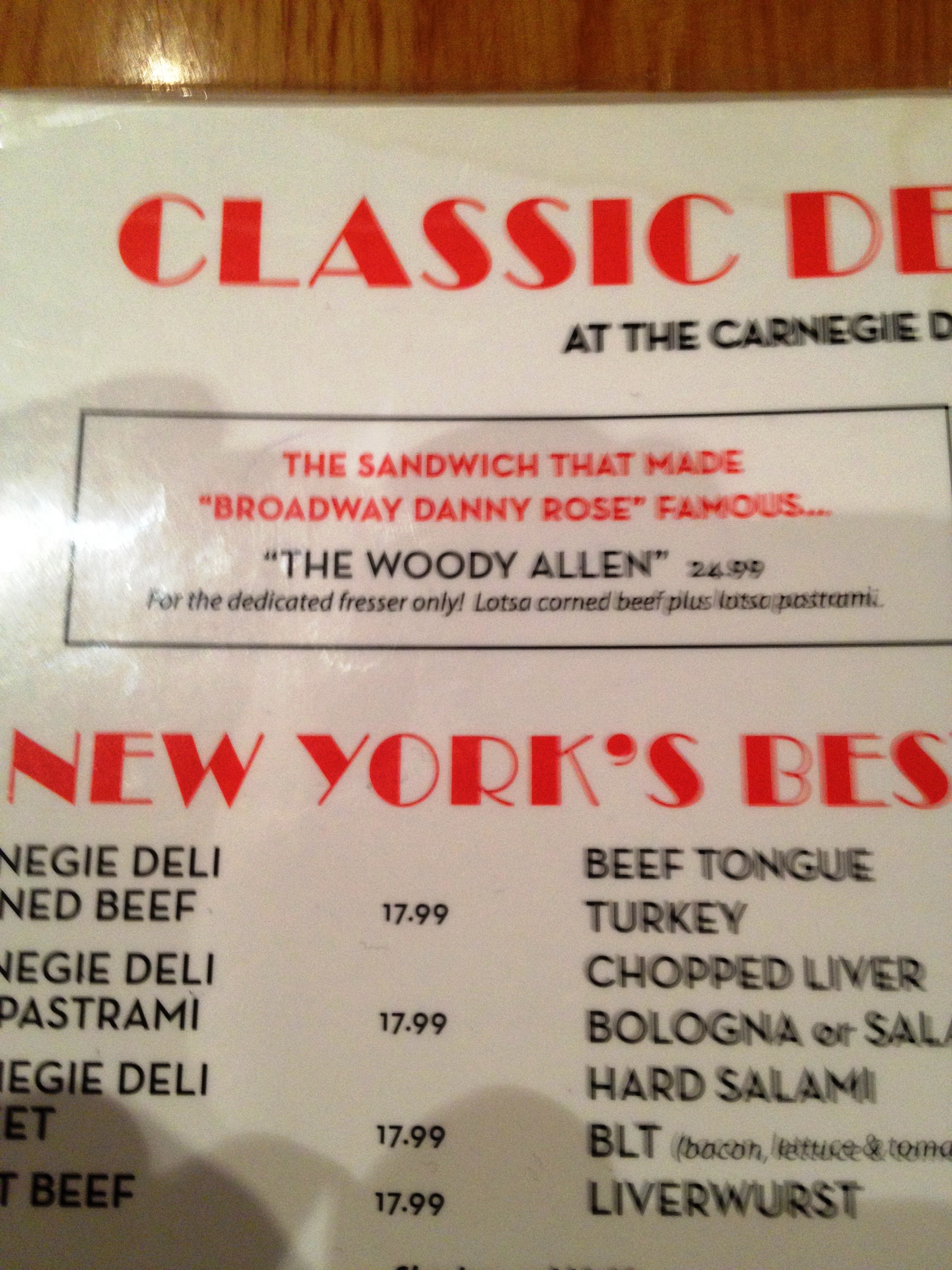
Speaking of walking in Woody Allen’s footsteps! Our last meal in NYC was at the Carnegie Deli in the theatre district where we aptly selected what the menu bills as

20140524_204347818_iOS

THE SANDWICH THAT MADE
“BROADWAY DANNY ROSE” FAMOUS…
“THE WOODY ALLEN”
For the dedicated fresser only! Lotsa corned beef plus lotsa pastrami.

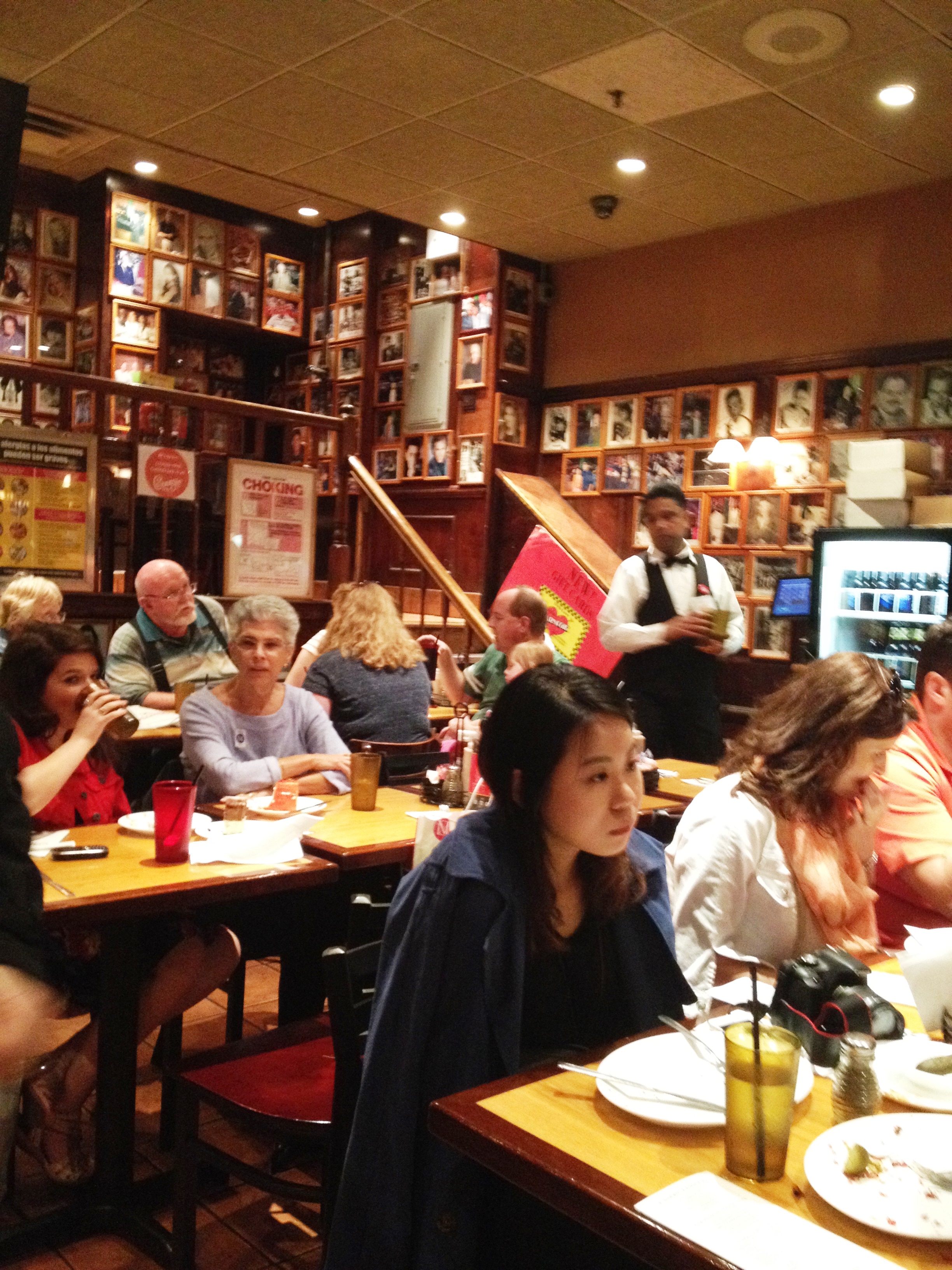
Woody filmed “Broadway Danny Rose in 1984 in black & white with the iconic opening scene depicting a group of comedians having lunch at the Carnegie Deli – a place which has photos on the walls of everybody who’s anybody and which has barely changed over the past 30 years.

20140524_204110129_iOS

So what is a “fresser” you may ask? … “one who devours food, eating fast and hungrily” … perhaps borderline “gluttony”?

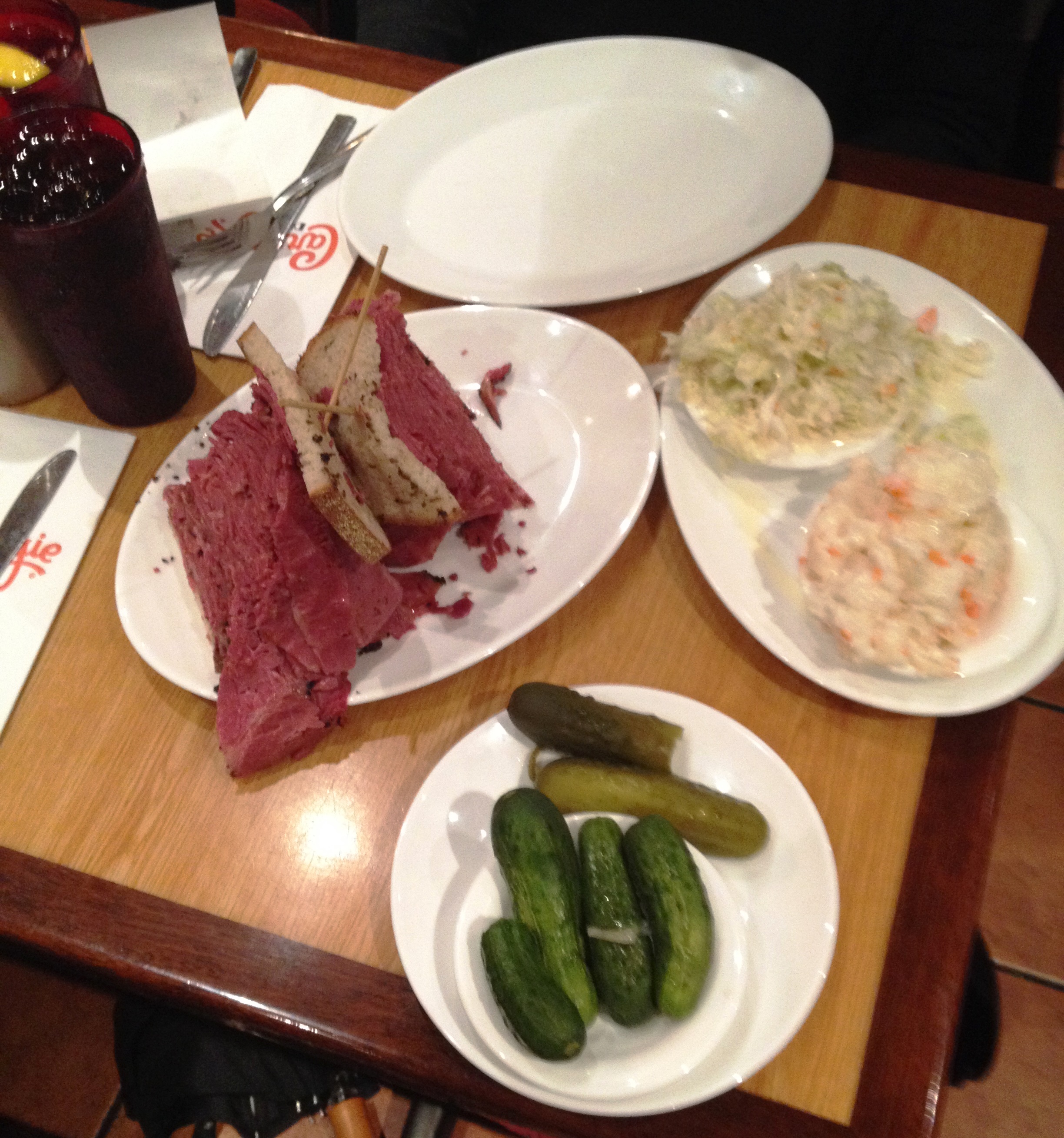
Wisely, Denis and I decided to share this humongous sandwich, piled 7-8” high with – to be completely honest — the best corned beef and pastrami we have ever had.

20140524_205423169_iOS

Enjoyed with well-done kosher pickles and sides of coleslaw and potato salad, and with the equally delicious rye bread generously slathered with Deli mustard, we had more than a huge meal each! Huge in size, huge in satisfaction, and not really so difficult to consume. I didn’t manage to match Denis’ heroic effort at completion, but I came close. This is a NYC treat not to be missed, but come Hungry with plenty of time to walk off the meal!

CULINARY SPOTLIGHT on Woody Allen’s New York: where to dine in NYC instead of flying to LA to receive a Lifetime Achievement Award at the Golden Globes

20140523_162538685_iOS

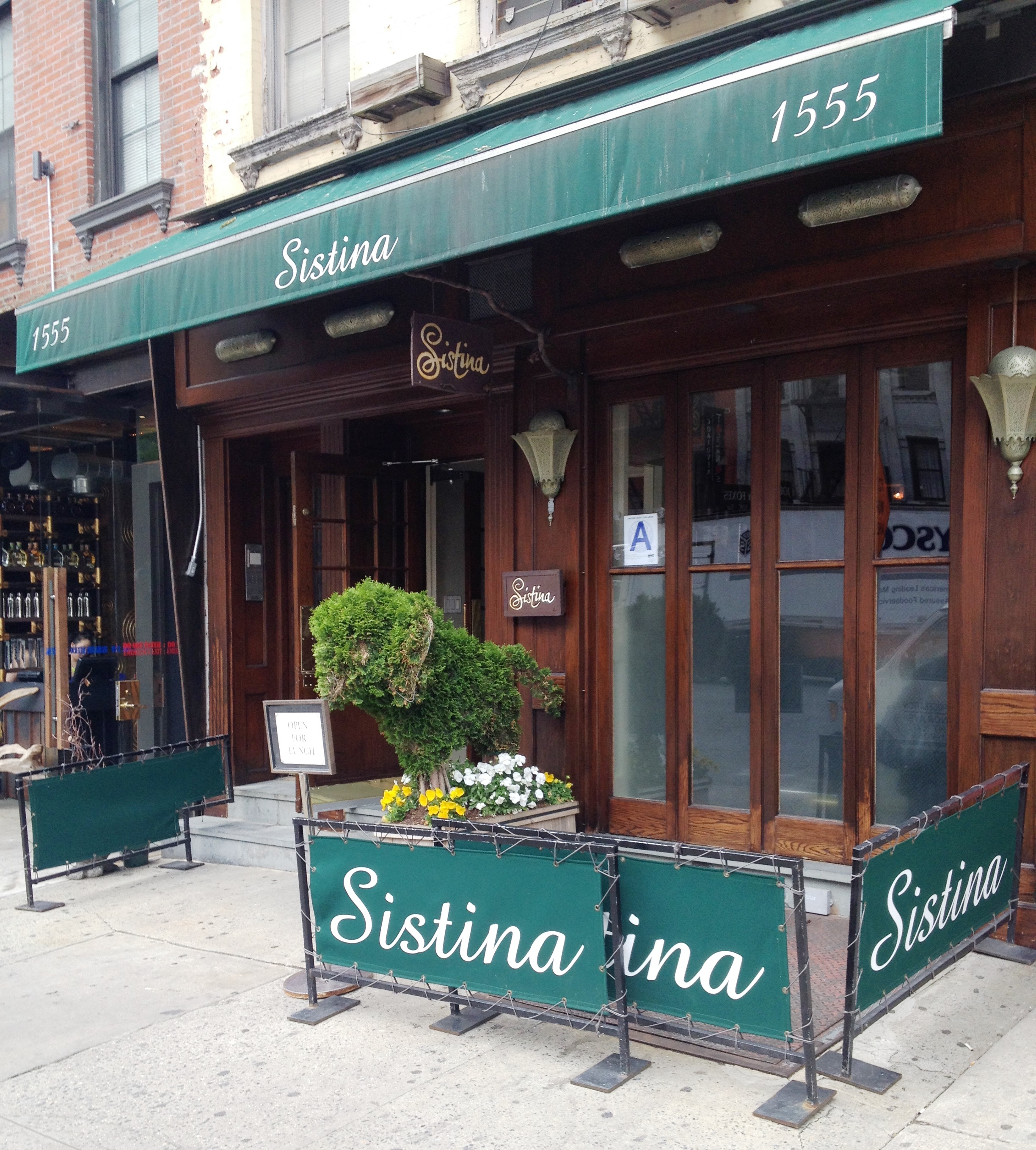
When given a choice of restaurant, Denis will almost always choose Italian cuisine, and it looks like Woody Allen may have the same preference. This past January, he opted out of attending the Golden Globes and instead took his family to a Broadway show and then on to Sistina Ristorante on the Upper East Side for dinner.

20140523_164808490_iOS

I don’t know what the Allens ate, but I can tell you that as Denis and I savored our 3-course Italian lunch, we had the poignant sensation of being back in Italy.

20140523_163620903_iOS

Host/owner/chef Giuseppe Bruno was most attentive, and helped us make our selections. By Day 3 of our visit to NY, following an intensive day of food-hopping, you can understand we did not have a large appetite, but we were after quality, not quantity.

20140523_164708243_iOS

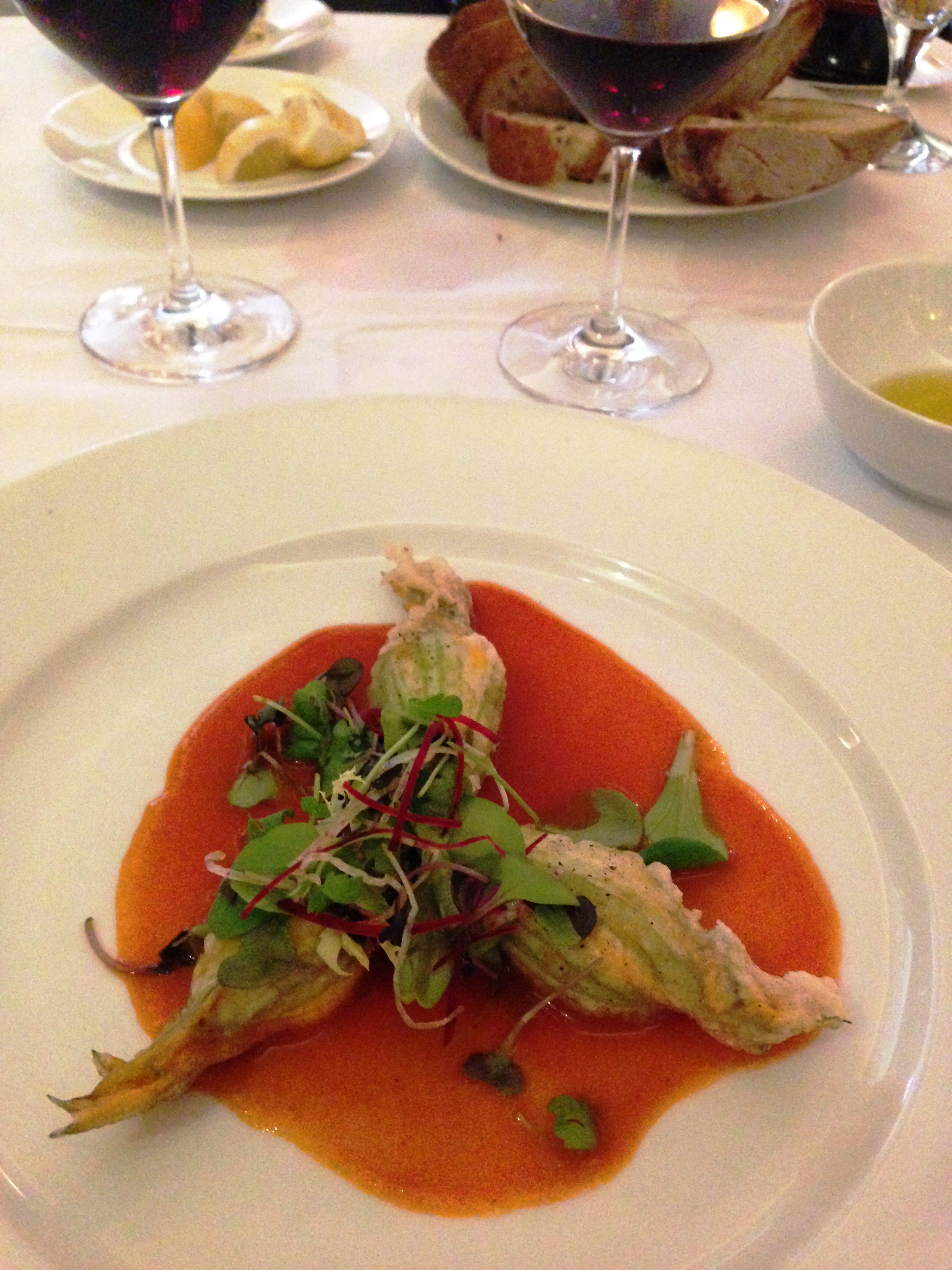
Zucchini flowers stuffed with sheep’s milk ricotta on a bed of hot tomato coulis

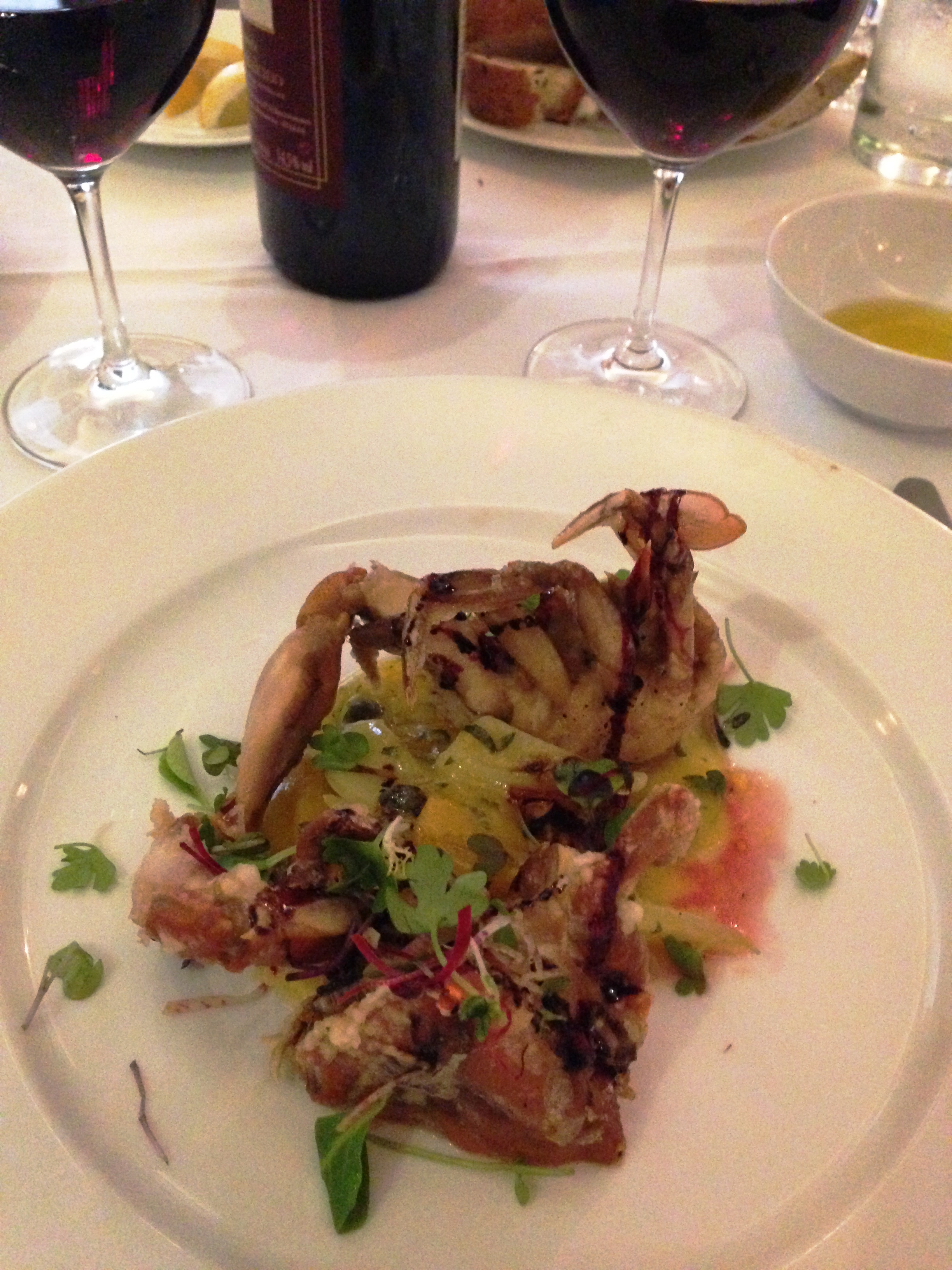
I began with utterly delicious zucchini flowers stuffed with sheep’s milk ricotta on a bed of hot tomato coulis, followed by a deep fried soft shelled crab flavored most refreshingly with blood-orange segments and braised fennel.

20140523_164640492_iOS

Insalata Caprese

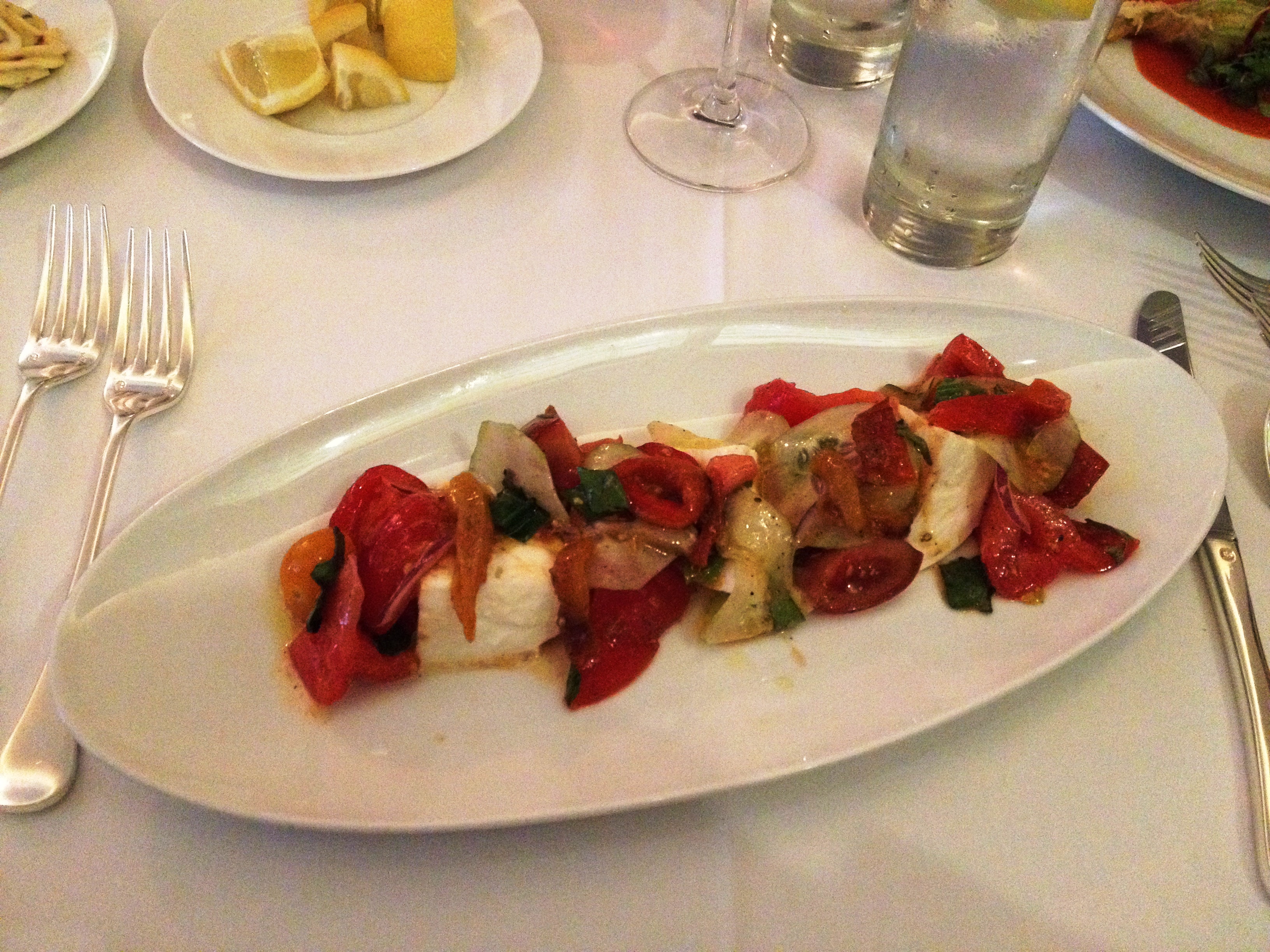
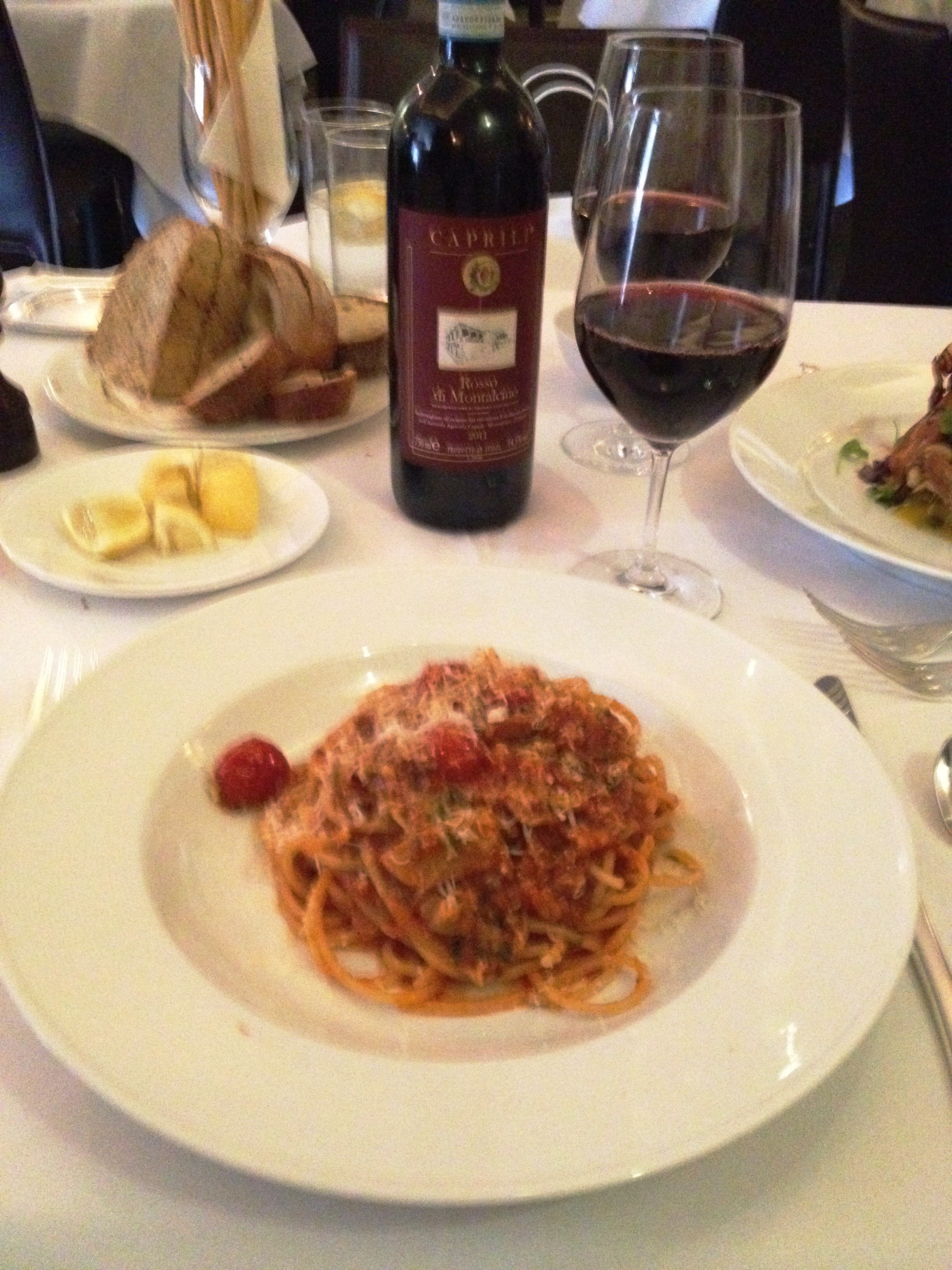
Denis had Chef Bruno’s own take on an Insalata Caprese, with chunks of Heirloom Tomatoes and Buffalo Mozzarella, paper thin slices of cucumber and finely chopped red pepper with fresh basil, followed by a extraordinarily flavorful Bucatini all’Amatriciana.

20140523_170418977_iOS

Bucatini All’Amatriciana

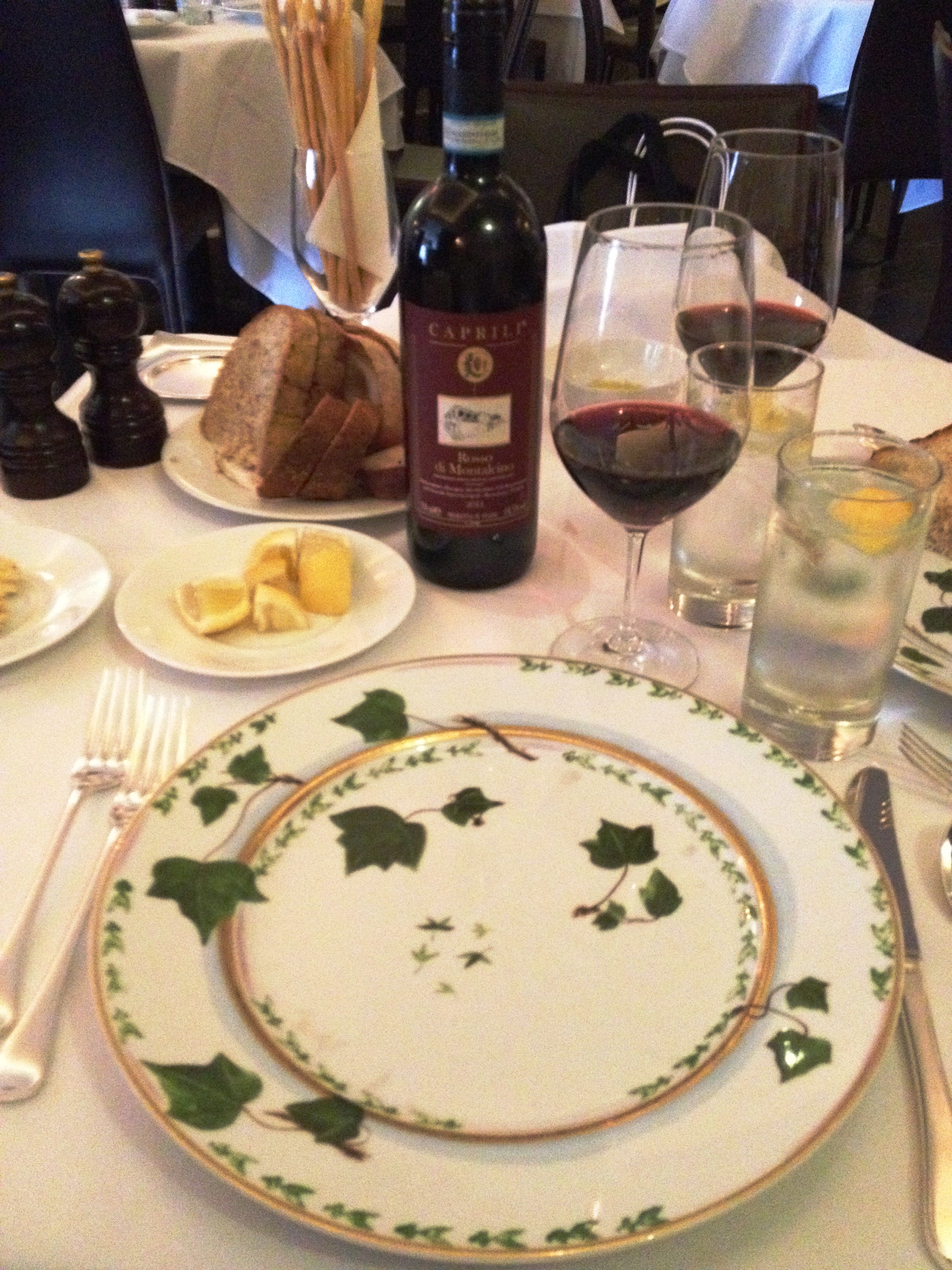
Our meal was very appropriately accompanied by a light, fruity Rosso di Montalcino, and it was absolutely no problem at all for the 2 of us to finish off the bottle in the middle of the day.

20140523_170422631_iOS

Soft shelled crab with blood-orange segments and braised fennel

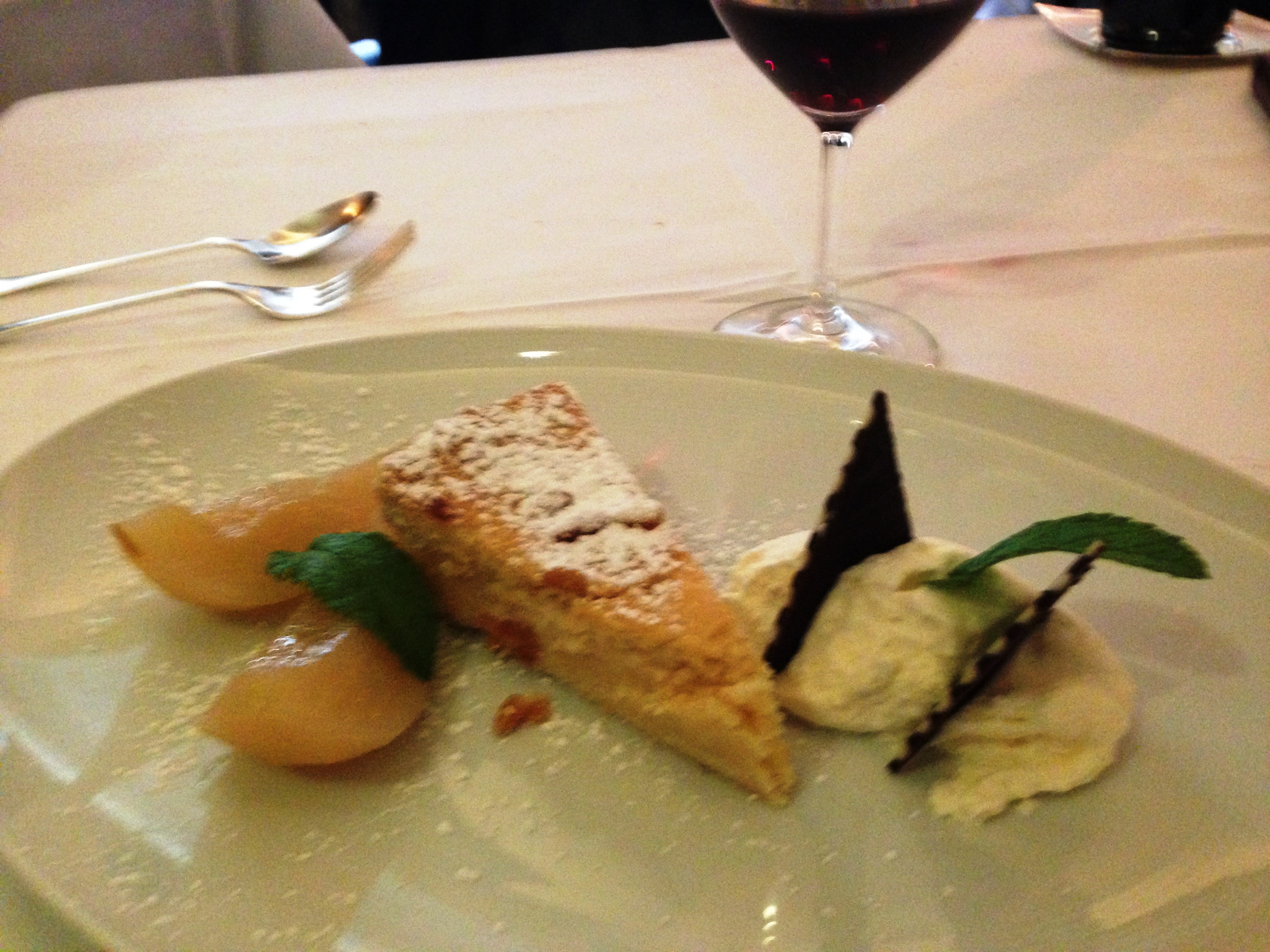
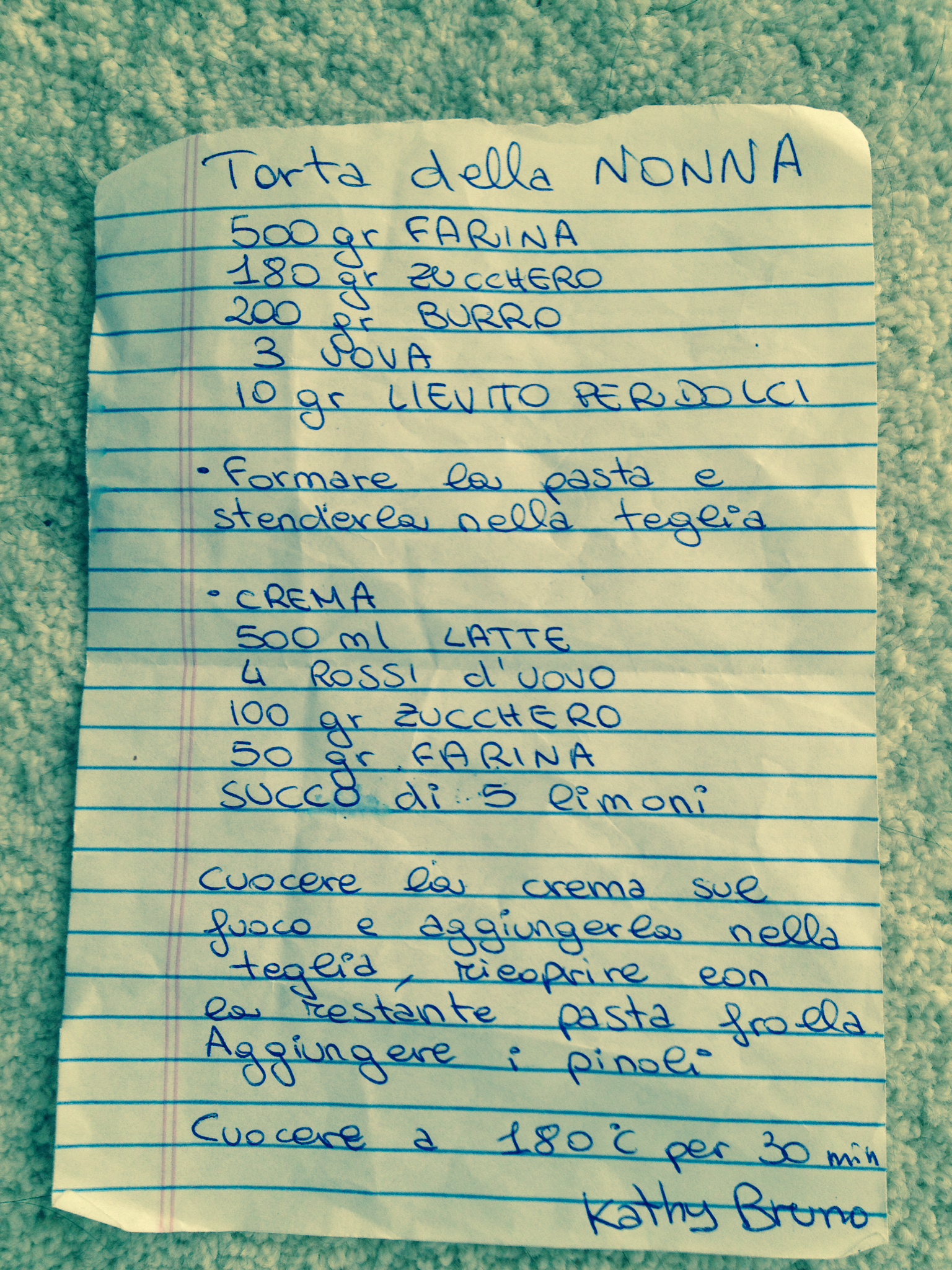
For dessert, we shared the Italian pastry chef’s Torta della Nonna, intensely flavored with lemon and pinoli .

20140523_173345235_iOS

Torta della Nonna

After I repeatedly begged Chef Bruno for the recipe, the pastry chef — an Italian woman in her early 30’s appeared at the bar wearing her hat and apron, and proceeded to write down her recipe from memory – in Italian no less as she doesn’t speak English.

Recipe

Speaking of authentic! We departed Sistina with every intention of returning to the restaurant where we found the service to be excellent and layers of flavor seem to characterize every dish.

CULINARY SPOTLIGHT on Woody Allen’s New York: Afternoon Tea or the perfect Pre-Theater dinner

20140522_203123929_iOS

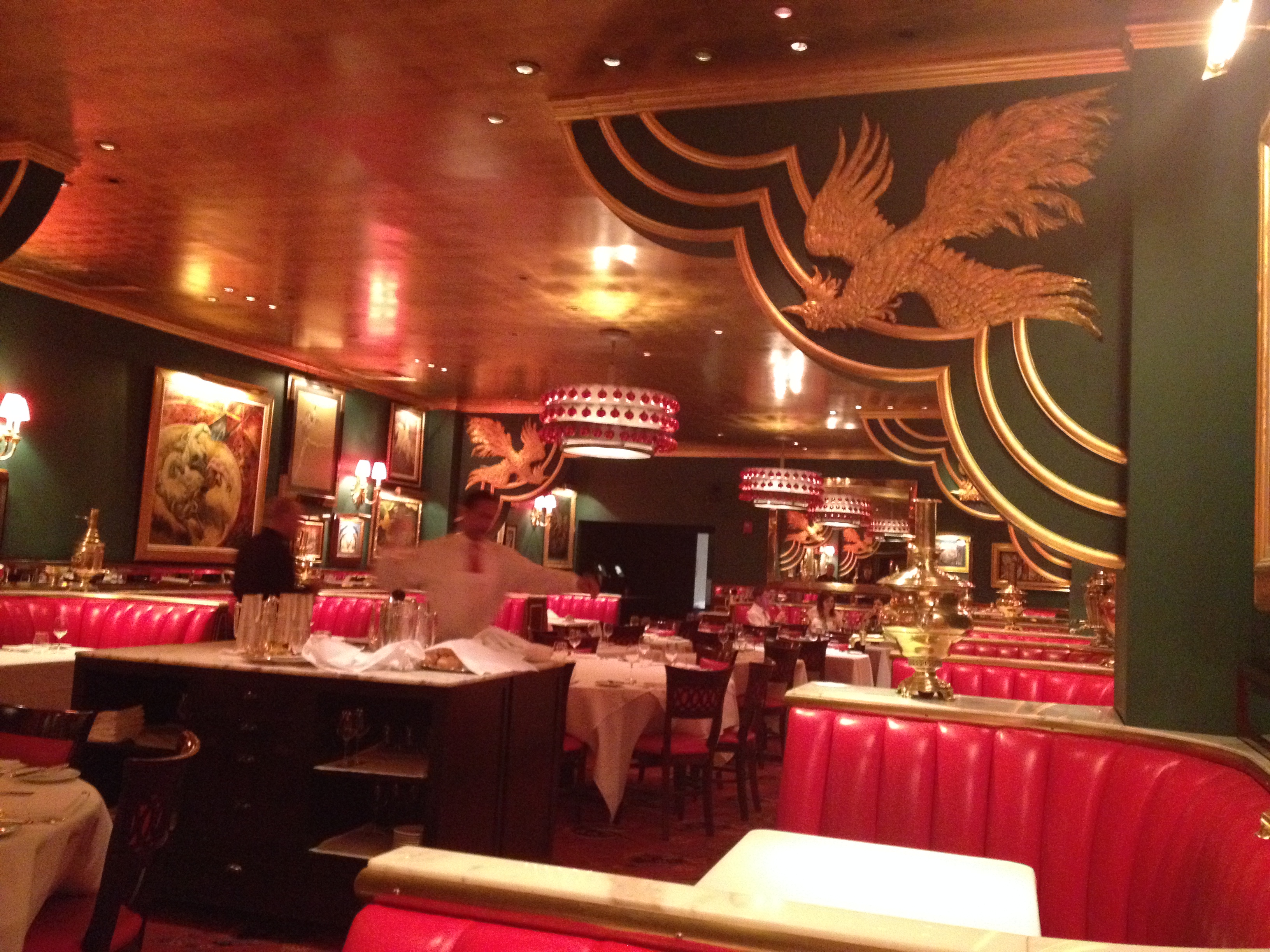
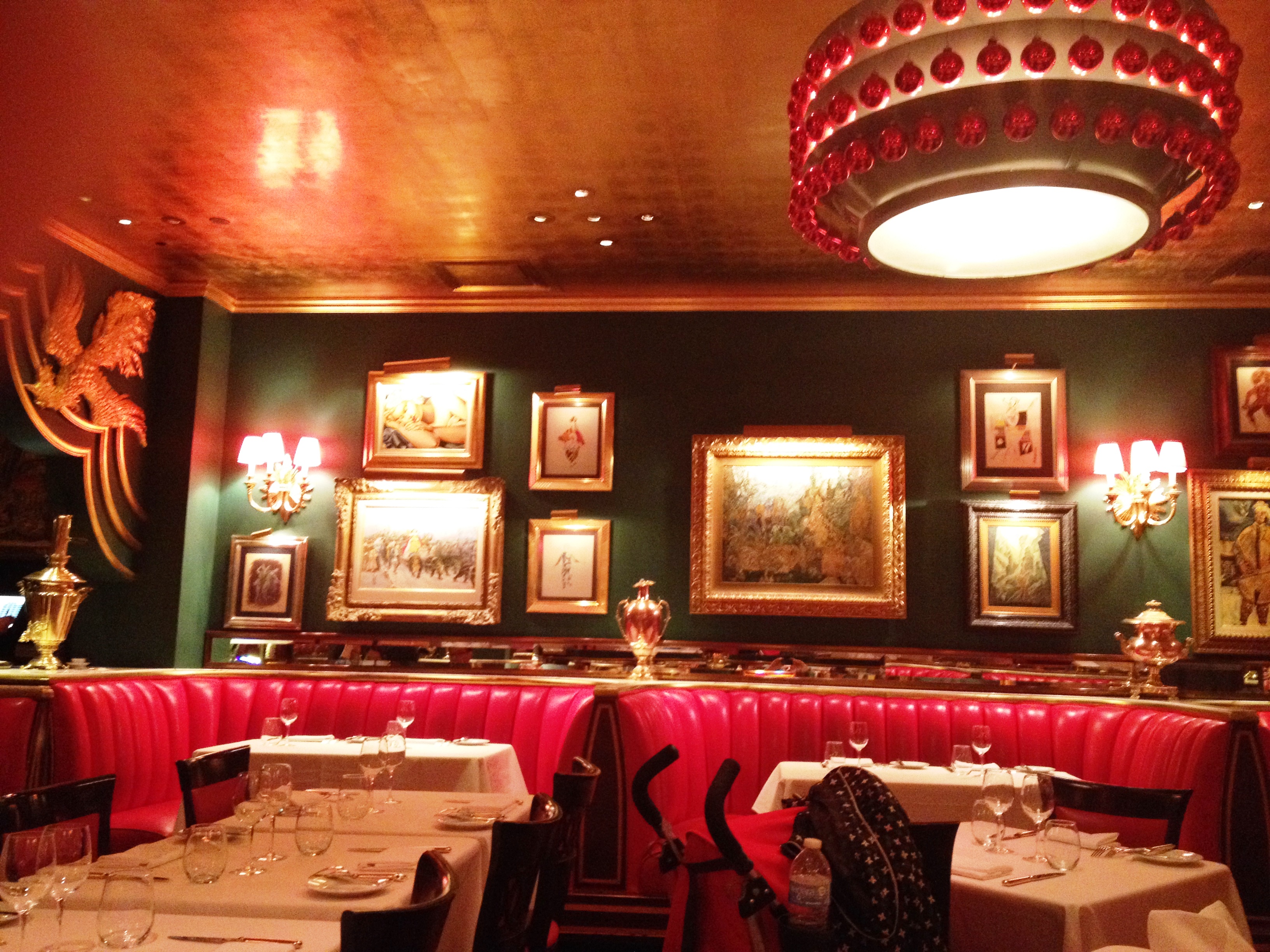
Founded in 1927 by members of the Russian Imperial Ballet, the Russian Tea Room has long been a haven for members of the entertainment industry and has hosted scenes not only from Woody Allen’s movie, Manhattan, but also from Nora Ephron’s film, When Harry Met Sally, as well as Dustin Hoffman’s unforgettable Tootsie.

20140522_203336582_iOS

It has been frequented by the likes of Ayn Rand and Madonna as well as by many members of the NY entertainment industry. Relatively recent renovations have resulted in a rich, elegant updated version of Old World Russian ambiance, but the food is as much continental as it is Russian.

20140522_204348703_iOS

While the Russian Tea Room serves 4 types of Afternoon Tea (Classic, Gluten-free, Vegetarian and Children’s), we went there for their 3-course pre-theater menu.

20140522_204250461_iOS

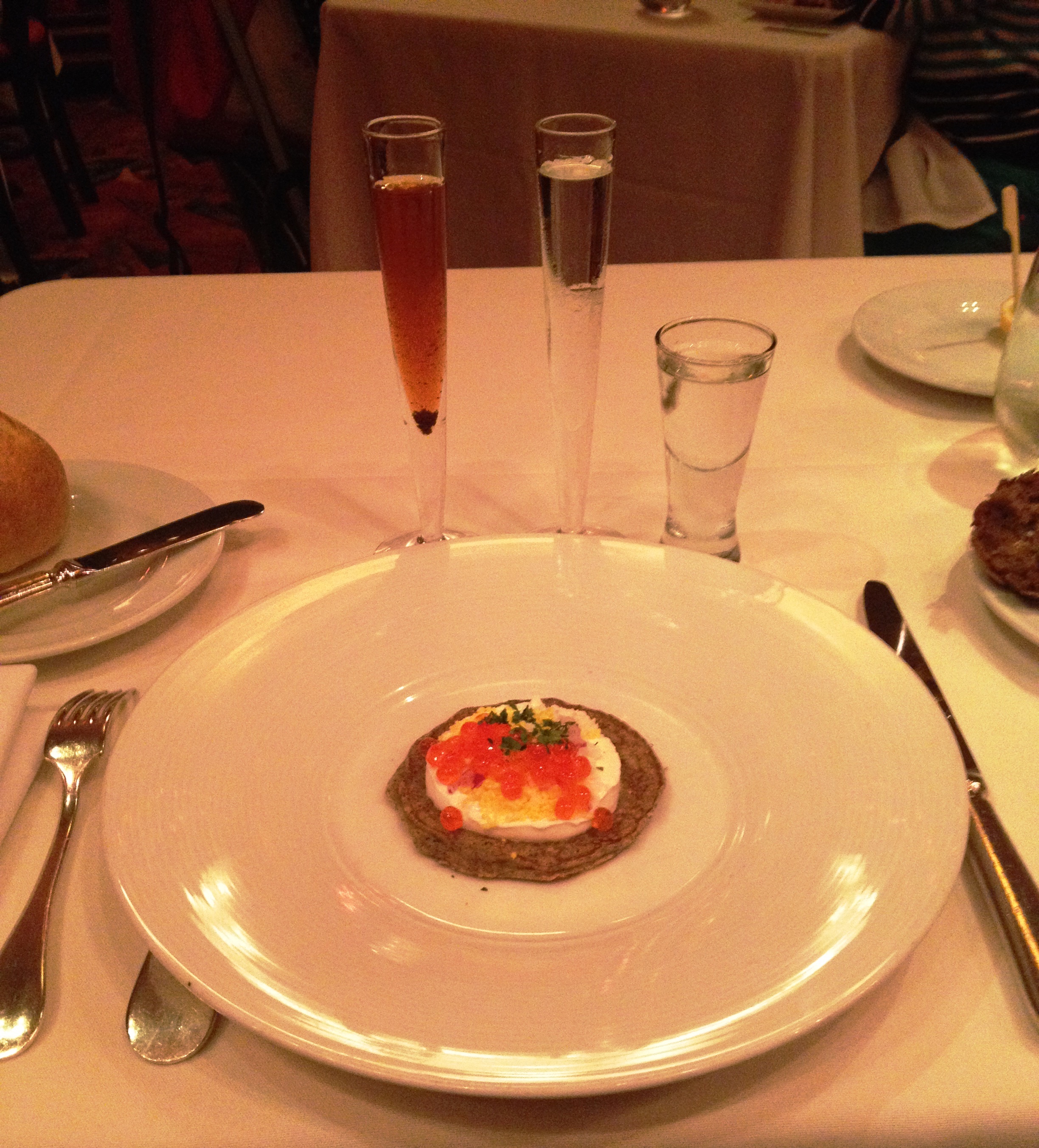
Denis and I both ordered a flight of Vodka and began with blini topped with sour cream and fish roe.

20140522_205637230_iOS

Blini topped with sour cream and trout, salmon and white fish roes

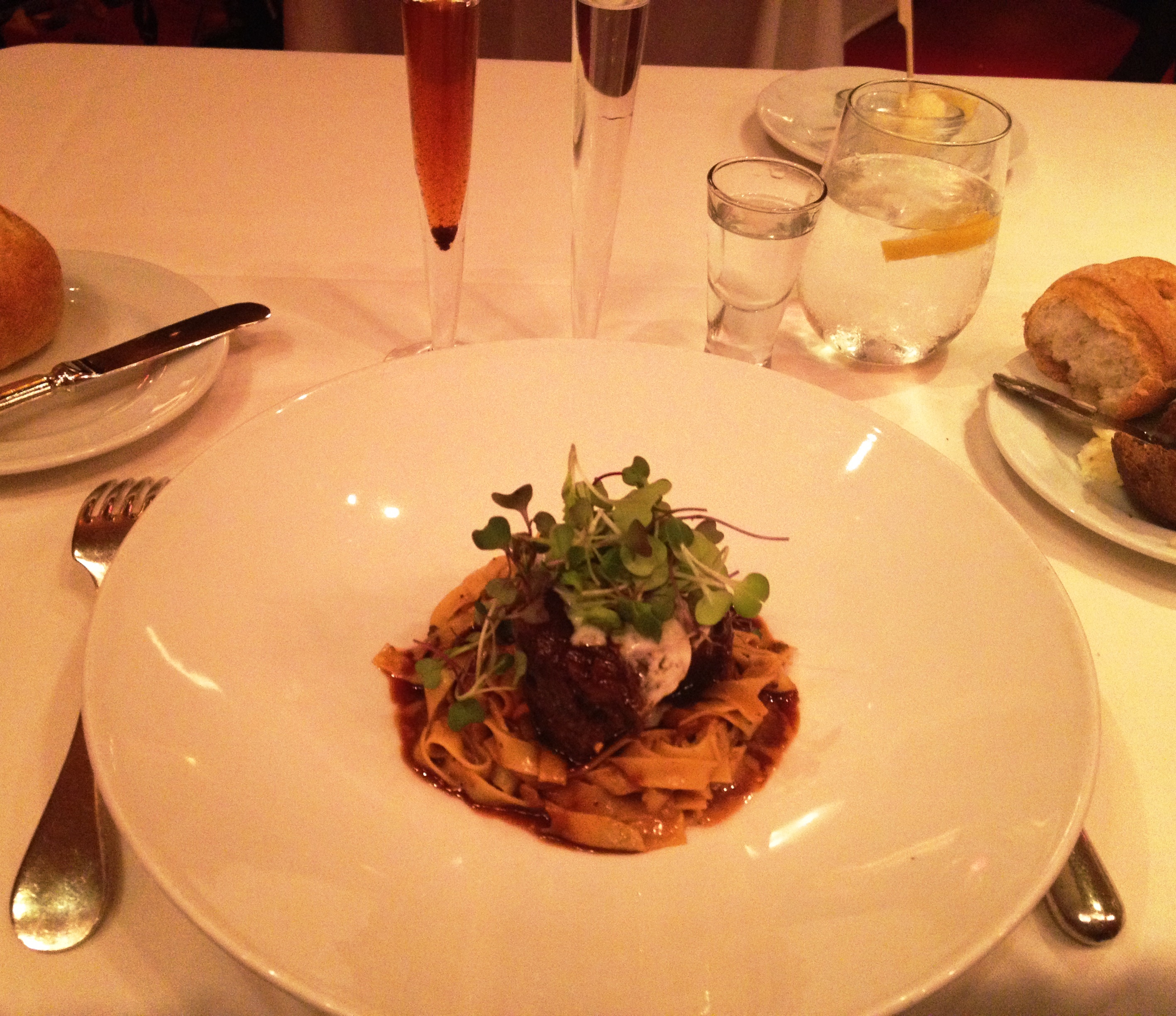
Denis continued with Boeuf Stroganoff and a Chocolate Pyramid (bittersweet chocolate with a raspberry filling) while I selected 2 more appetizers for our 3-course meal, Borscht and a goat cheese and wild mushroom Blinchik (Russian crepe).

20140522_211312810_iOS

Boeuf a la Stroganoff

I enjoyed all 3 of the Vodkas – Jewel of Russia, Stolichnaya, and Jewel of Russia Wild Berry – while Denis left the unflavored Jewel of Russia for me to finish … not a problem!

20140522_211423541_iOS

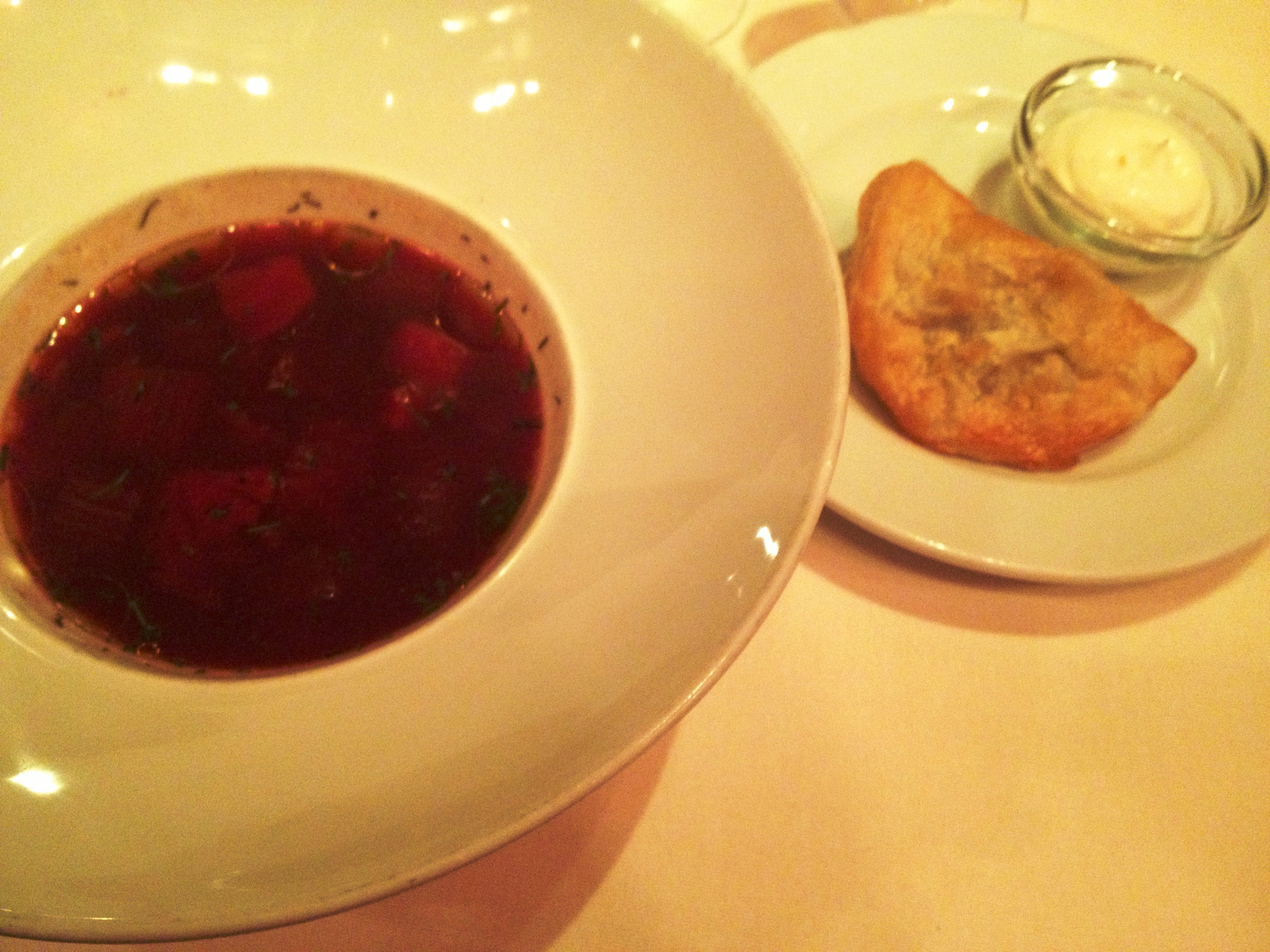
Red Borscht with Pierogi

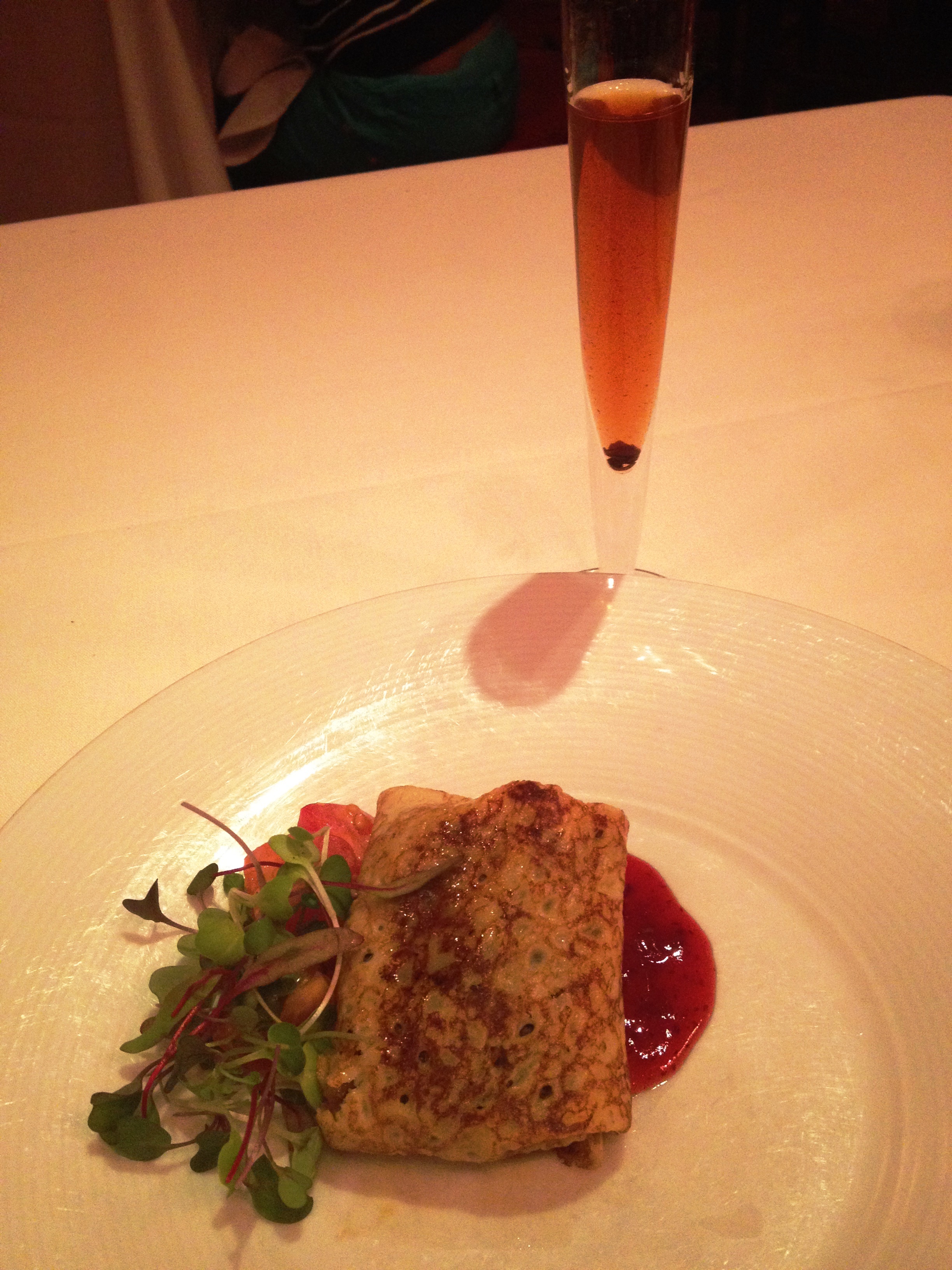
He preferred the Stroganoff he ate last summer in St. Petersburg to that of the Russian Tea Room, and I found the borscht there lacking a bit in flavor but I very much enjoyed the crepe, which paired perfectly with the somewhat sweet Jewel of Russia Wild Berry vodka.

20140522_213149073_iOS

Crepe filled with wild mushrooms, goat cheese, onions and lingonberries

Visit the Russian Tea Room more for a memorable than a gourmet experience.

CULINARY SPOTLIGHT on Woody Allen’s New York: Pizza or Dim Sum for lunch?

Decisions, decisions. When in doubt, restaurant hop, or as I like to call it “food-hop”! After all, who says you can’t have it all, or that life is too short? If you can’t decide between or among several great recommended places to eat when you are traveling, then don’t decide. Group them by neighborhood and go to them all! That’s how we spent our 2nd day living life in the footsteps of Woody Allen – we just ate a course at one restaurant and then moved on to another for the next course. And let me tell you, my taste buds were in a constant state of pleasure … la vita e bella!

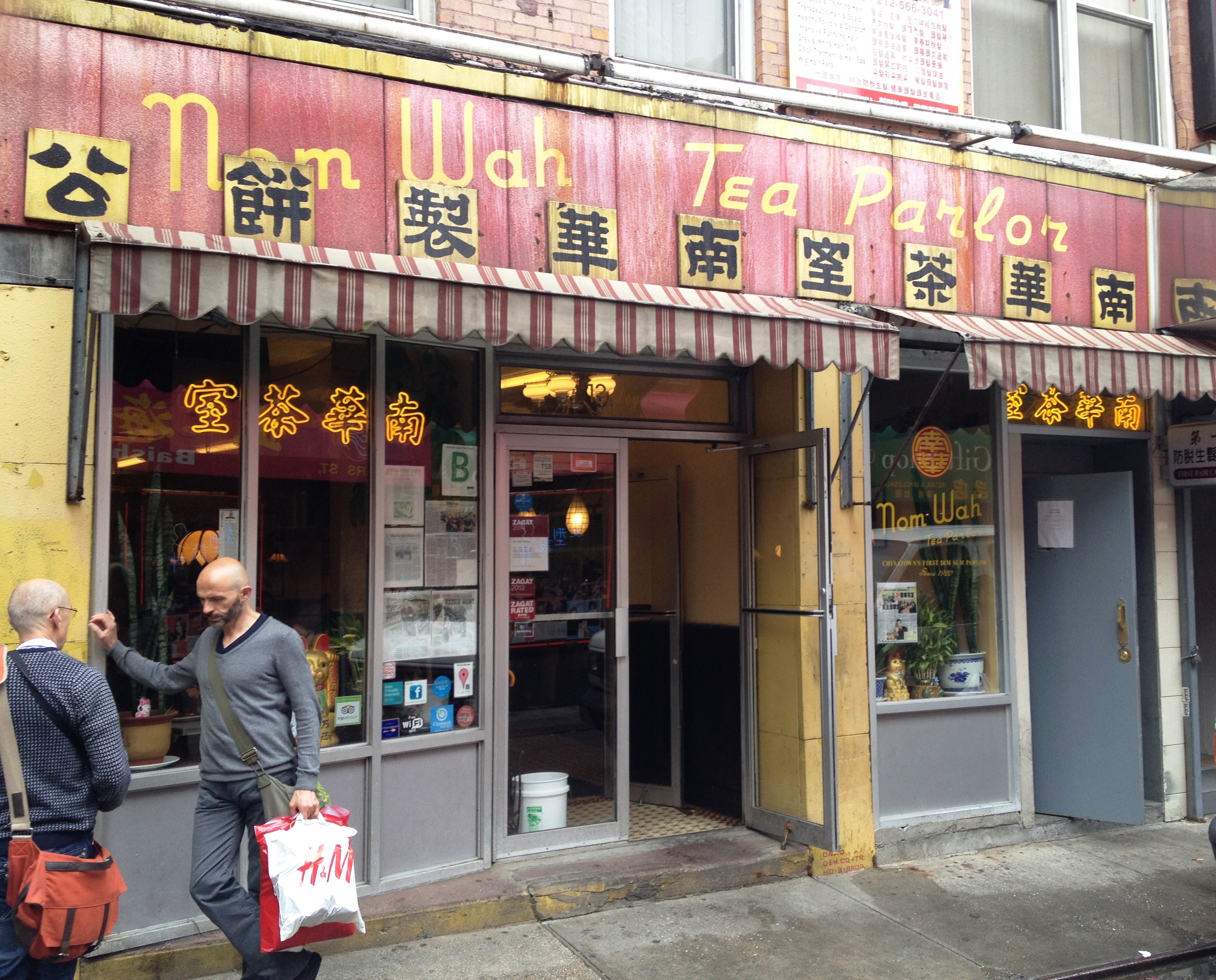
Nom Wah

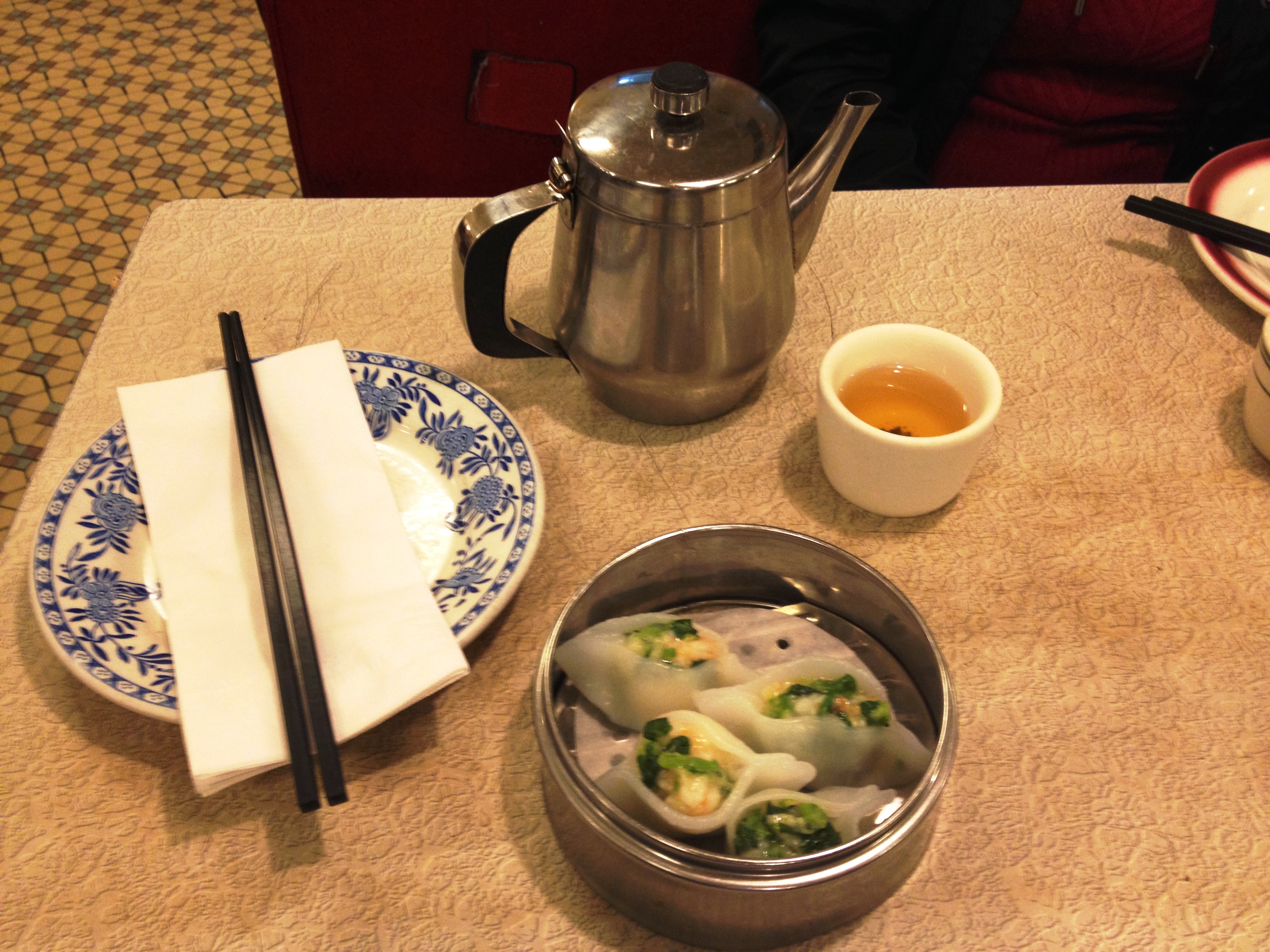
While we made 4 food hops that day from late morning to just about mid-afternoon, my 2 favorites were the Nom Wah Tea Parlor in Chinatown and John’s of Bleecker Street. I can still taste and see before me the succulent shrimp mai, as utterly appealing to the palette and to the eye as any I have eaten in San Francisco’s most elegant dim sum establishments or in Beijing or Shanghai for that matter.

Dim Sum

But the Nom Wah Tea Parlor is the first dim sum restaurant founded in NYC’s famous Chinatown and its longevity and extreme popularity with those speaking Mandarin and their offspring speaks for itself.

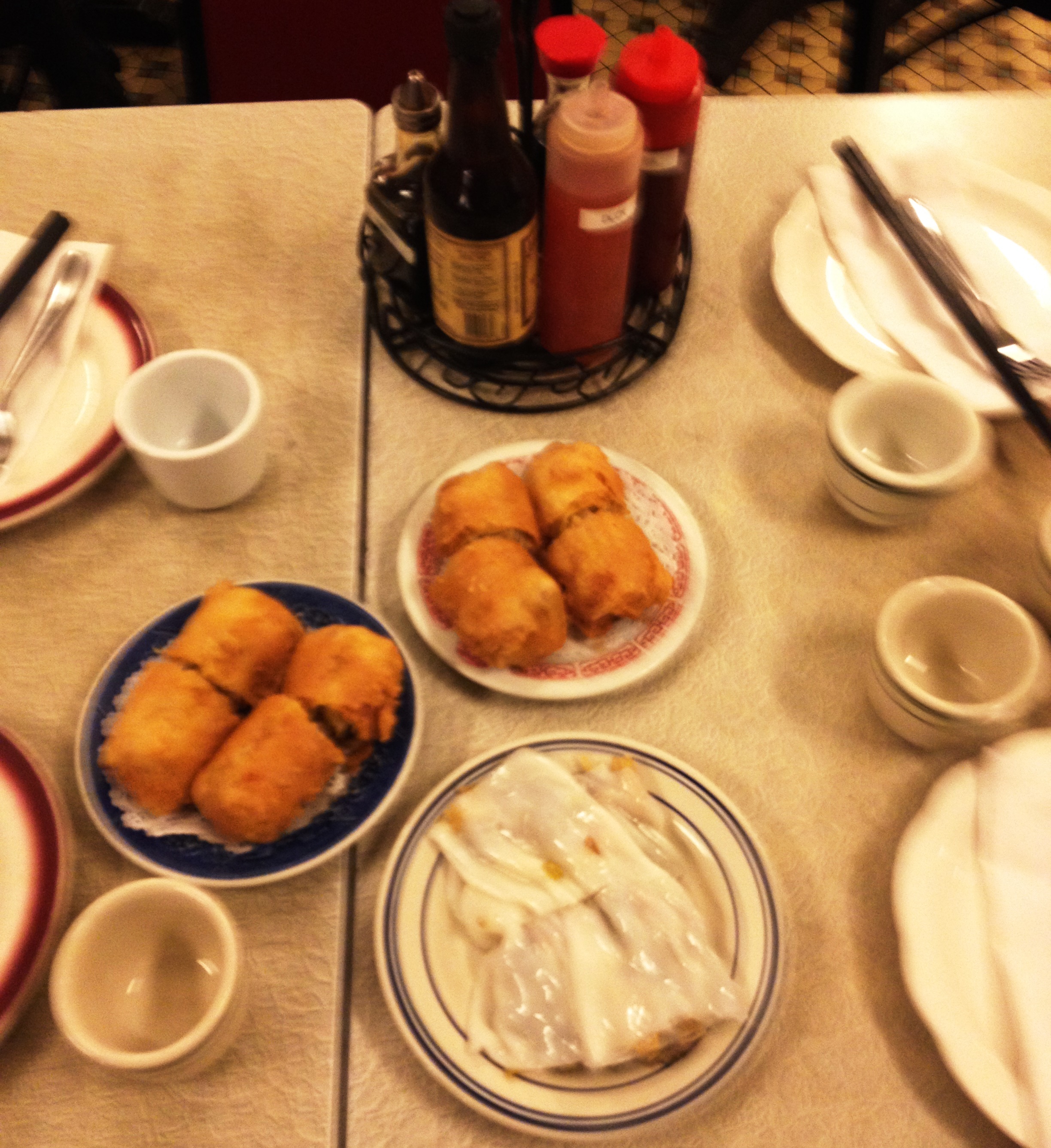
Dim Sum Two

Very easy on the budget, with a large menu that includes many other delectable choices, Nom Wah does a lively business. But you can call and reserve a table, and even order some appetizers to be waiting for you when you arrive!

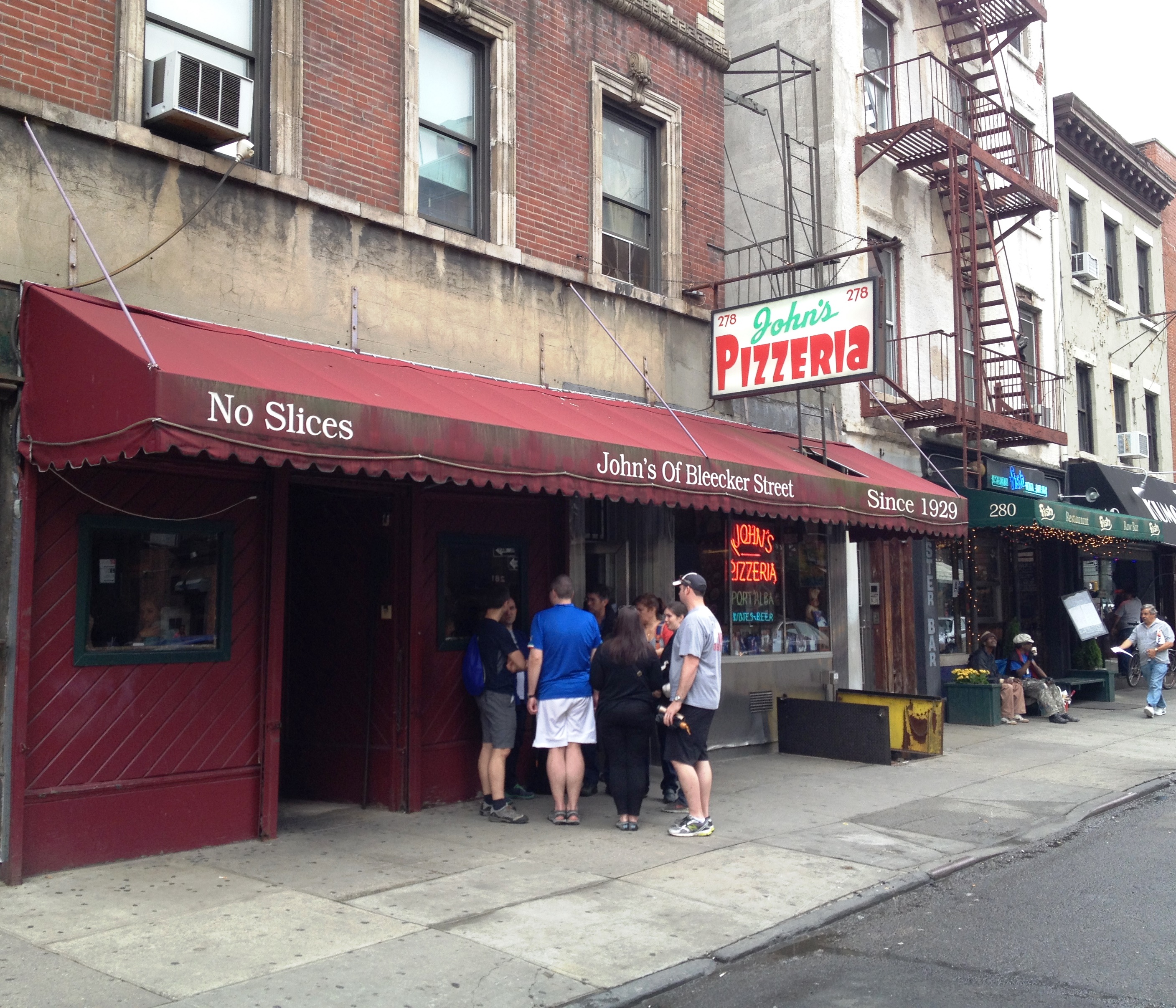
Johns

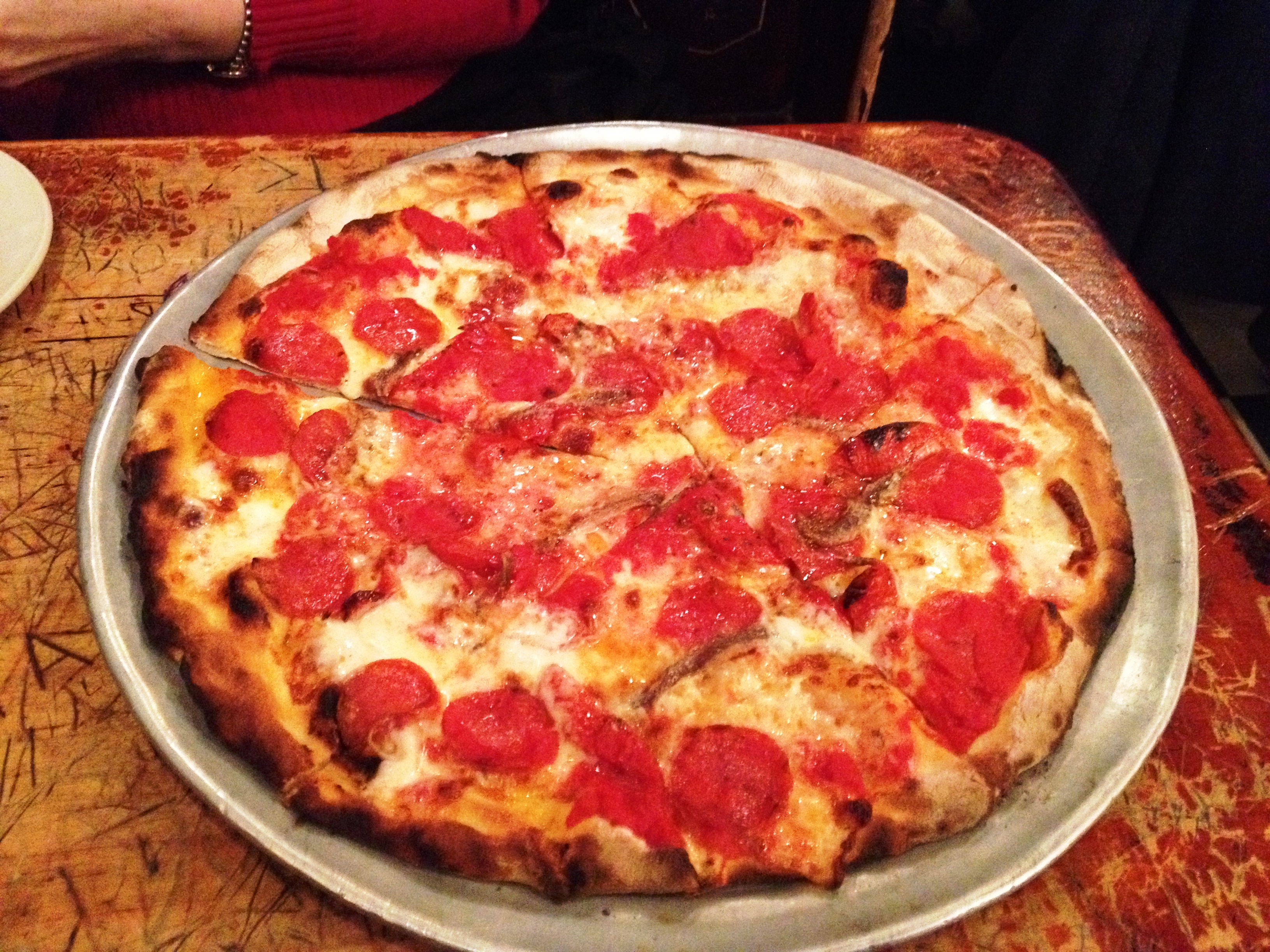
If I close my eyes, I can still taste and smell the fabulous flavors and aromas of the tomatoes roasted with garlic, anchovies and pepperoni, each of which added a layer of flavor to the coal-fired brick oven pizza that we devoured at John’s of Bleecker Street in the Village.

Johns Pizza

I can’t remember when I’ve enjoyed pizza more, but this place has been satisfying customers and bringing them back time and time again since 1929.

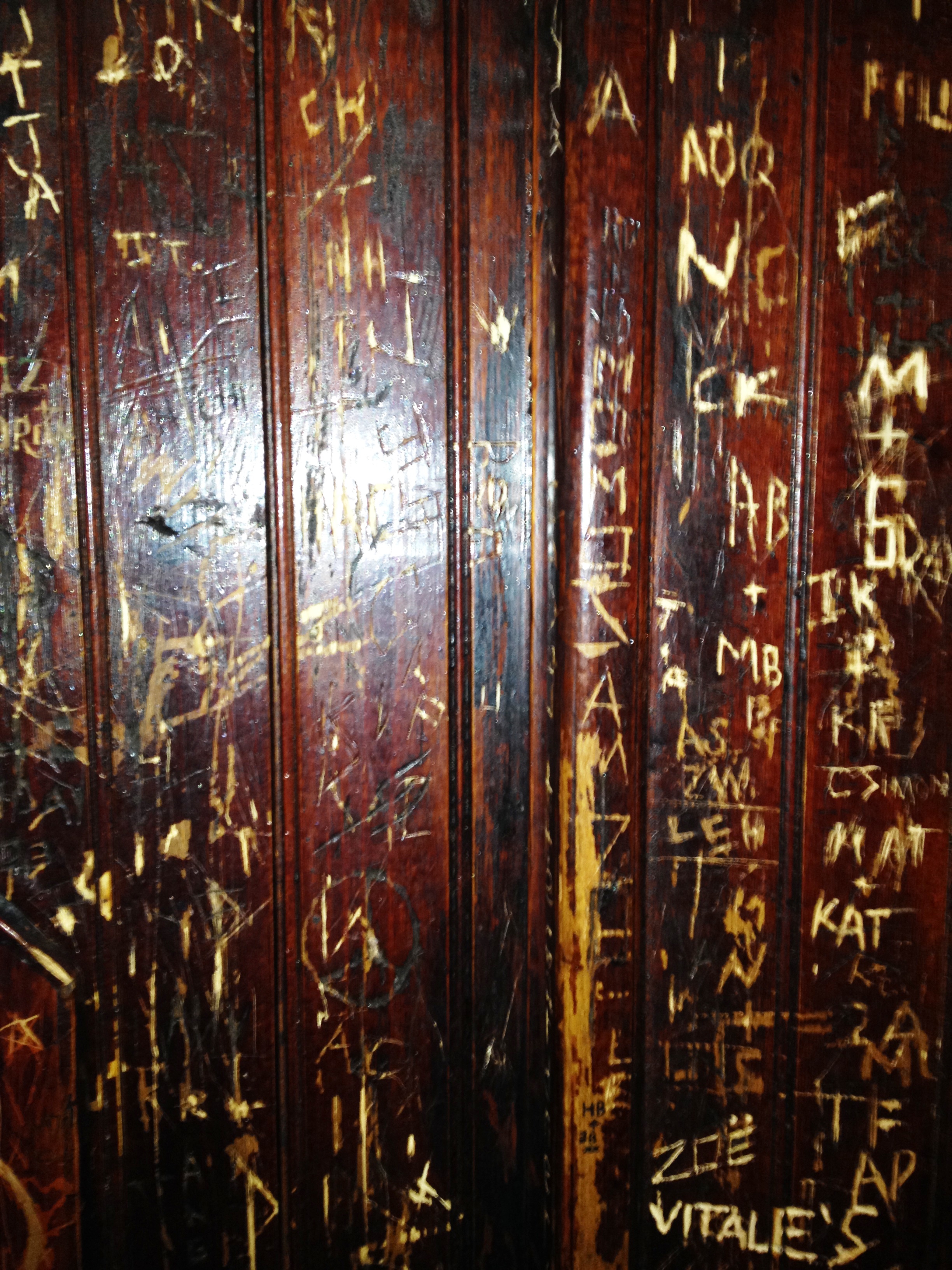
Johns Graffiti

Eat in amidst an array of enticing Italian aromas on one of the wooden booths, carved with the names of John’s pizza devotees over the decades, or take out your order. But do give John’s a try – it’s worth a trip to the Village just for their pizza!

And don’t forget to try “food-hopping” when you are traveling in order to savor all the flavors you can.

CUINARY SPOTLIGHT on Woody Allen’s New York: Where to Celebrate a Special Occasion


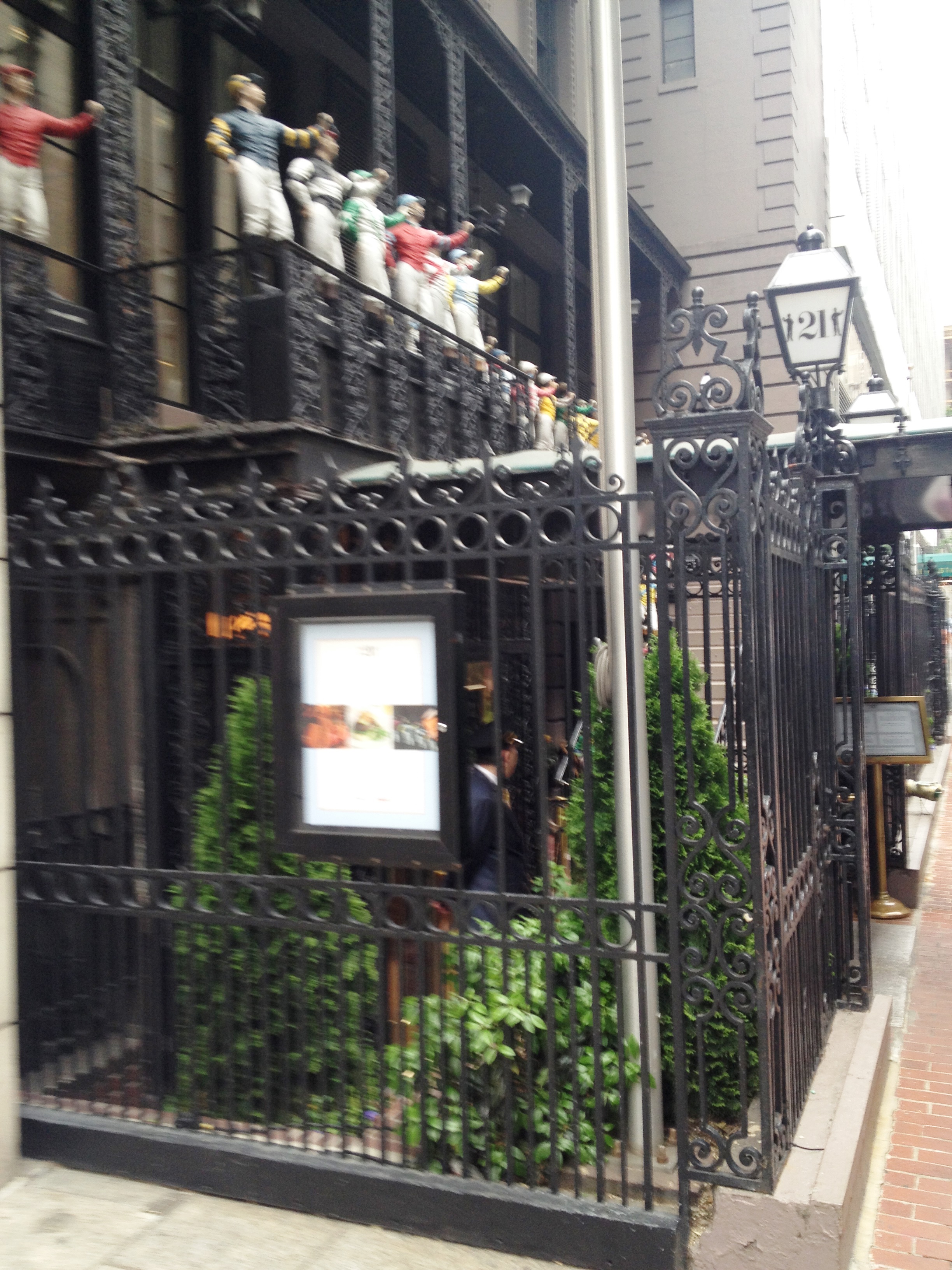
21 Club

For ambiance and unique décor, a big slice of NY 20th century history, elegant traditional cuisine, top-notch service and panache — head to the 21 CLUB, located almost opposite the MOMA in Midtown Manhattan.

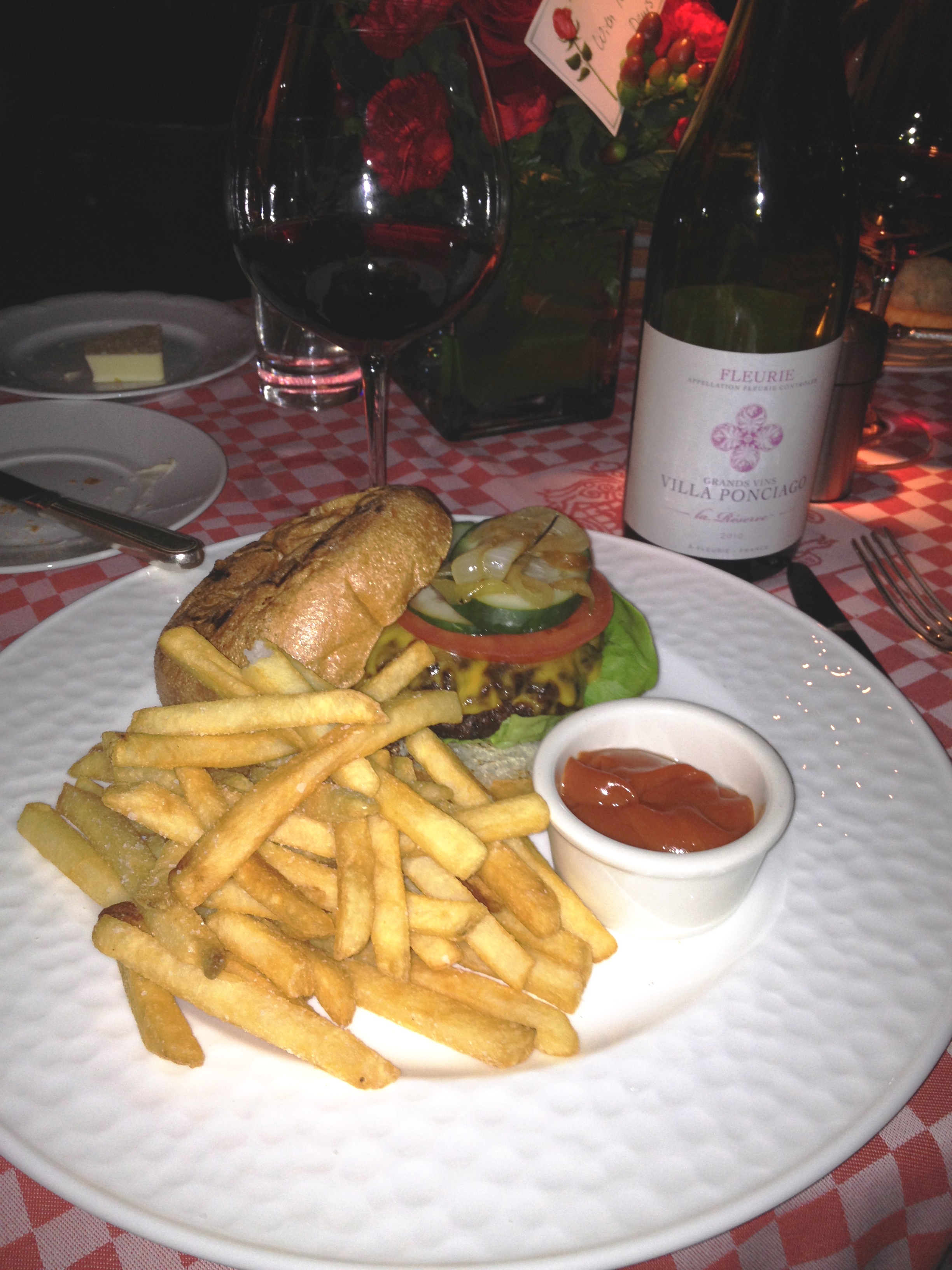
burger

Most memorable was the “21 Burger” made from a unique mixture of ground short ribs, top round, and sirloin and served with the 21 Club ketchup, which I would liken to a tangy pureed tomato chutney.

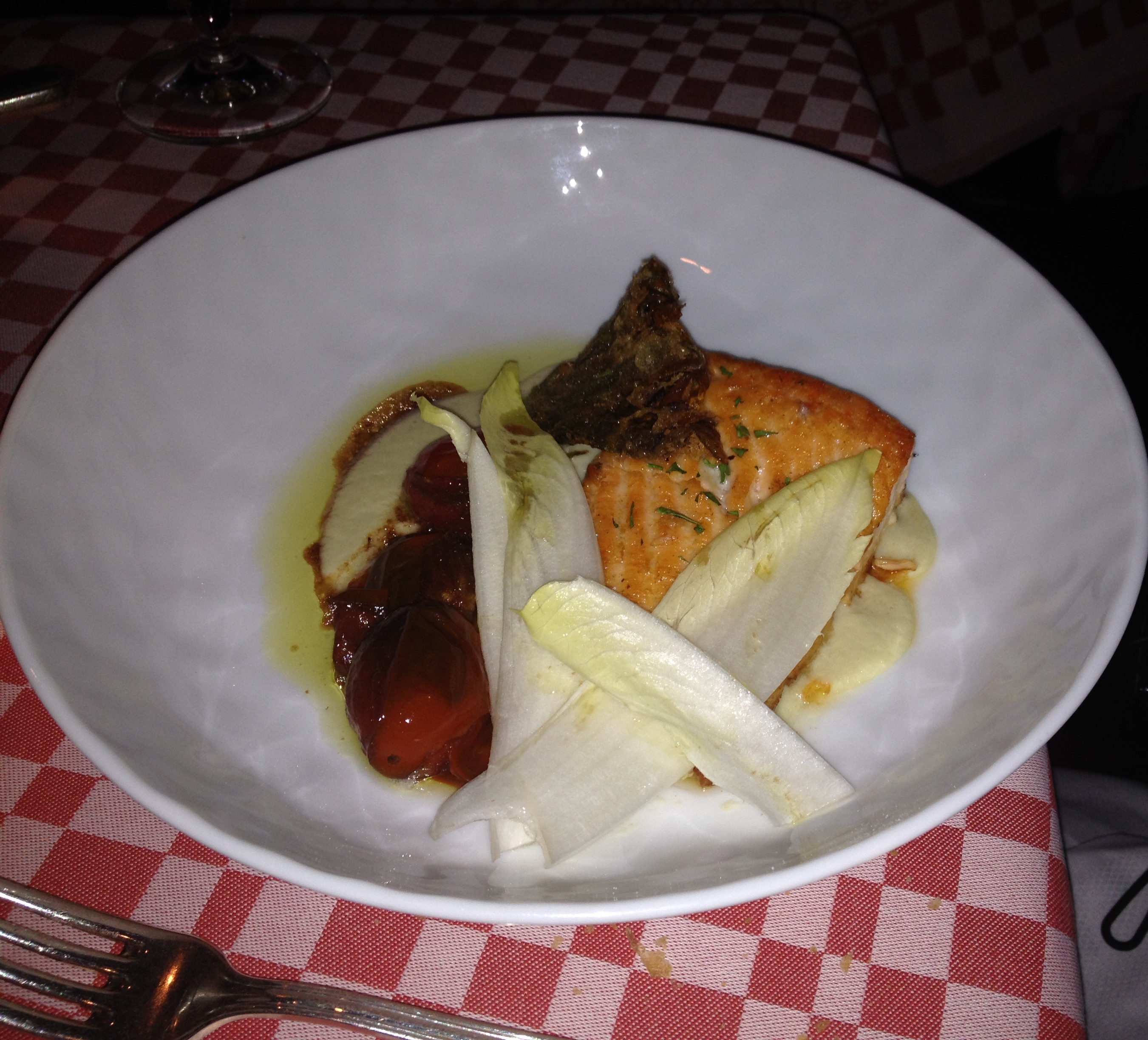
Salmon

Also superb was the Faroe Islands Scottish Salmon with braised endive, balsamic pickled heirloom tomatoes and tempura zucchini blossom, finished off with a subtle fennel tapenade – original and perfectly prepared.

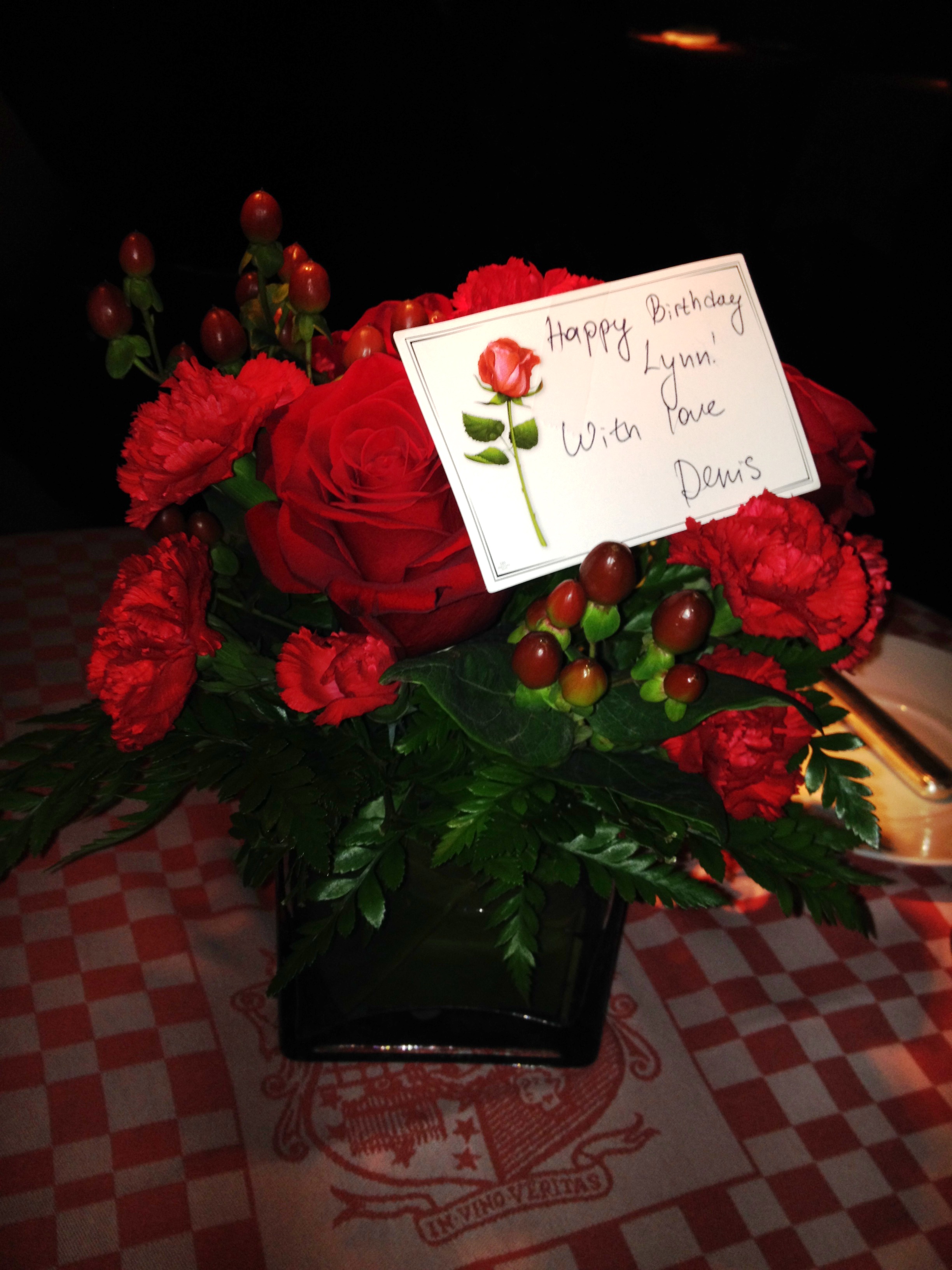
Roses

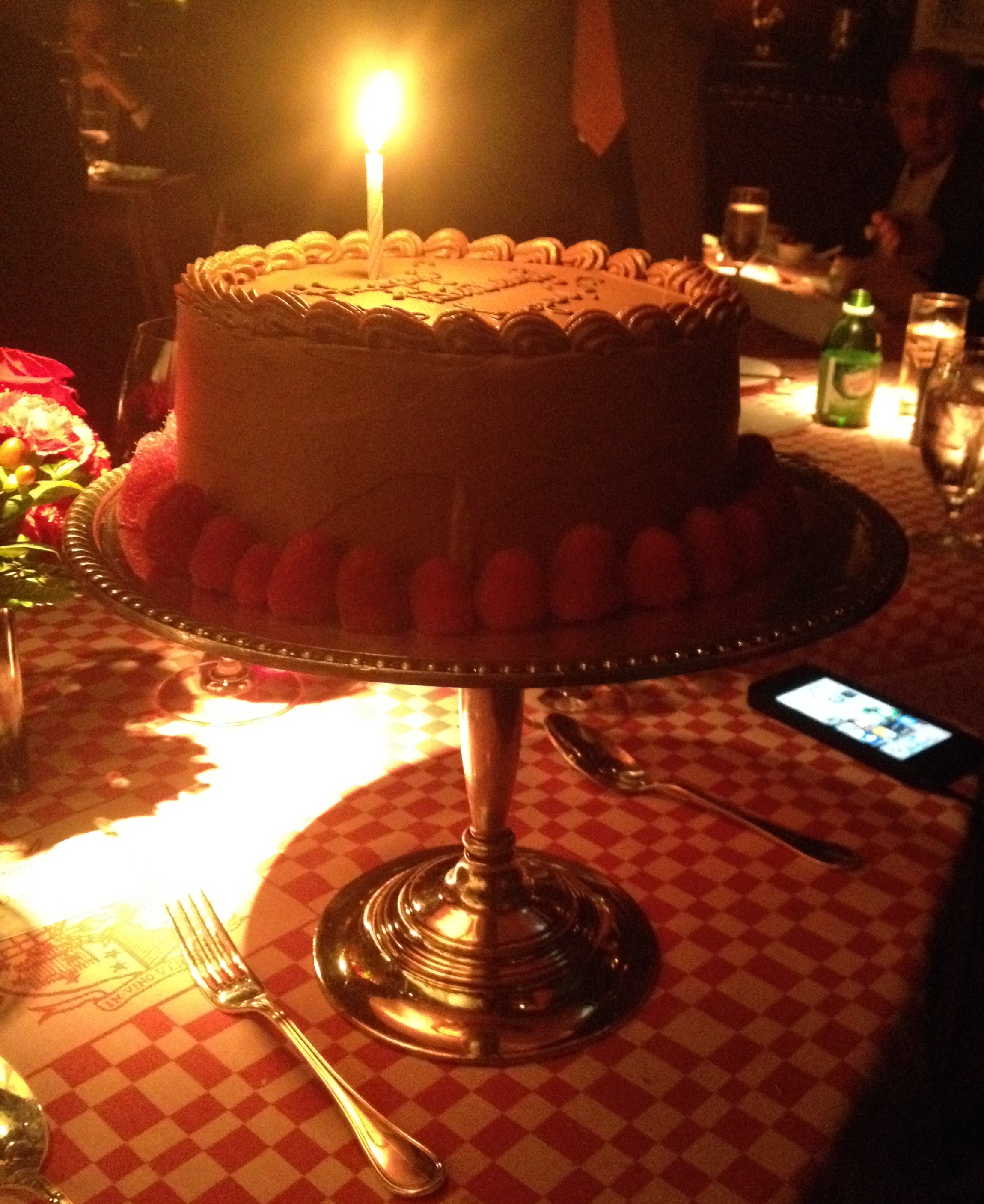
Although the 21 Club is most assuredly a restaurant for celebrating a special event, I was still surprised to see a chic bouquet of red roses at the table with a card from Denis as we sat down at a prime corner table, and surprised once again with a personalized chocolate cake made specially by the bakery chef at Denis’ request.

cake

If the 21 Club is good enough for President Kennedy’s Inaugural dinner celebration, it certainly was good enough for my belated (hence the “surprise”) birthday celebration. Denis, take me back for any and all celebrations in the future!

CULINARY SPOTLIGHT: Six Course Nepalese Dinner in Kathmandu

Imagine a palatial hotel recently restored to its 13th century glory, full of priceless antiques from bygone civilizations, with service and elegance to match in the heart of exotic Kathmandu. Now imagine the hotel’s signature restaurant where you leave your shoes as you enter, and walk into another century and another world. The bold red and black décor of the dining room is stunning and the ambiance offers a very old-world Nepalese dining experience, from the authentic low-rise, over-sized chairs, to the flickering candlelight and traditional Nepali music playing softly in the background. You would be at the extraordinarily unique Krishnarpan Restaurant in Dwarika’s Hotel at an elevation of 4,600 feet, in the shadow of Mt. Everest. Simply awesome.

So now that you have a sense of the dramatic backdrop, do I have you salivating yet? The food prepared at Krishnarpan in the traditional Nepalese manner was delicious, all of it. I need to emphasize that the portions were not those of a tasting menu, which presented a daunting challenge in the face of most gracious waitresses who so very much wanted to please and were concerned, when we did not finish each and everything, that it was not to our liking. While Nepali cuisine bears many similarities to that of India, such as the essential inclusion of rice and dal (lentils) with dinner, in general, Nepali food is not as spicy and fiery as Indian food so often is.

The menu du jour was printed in both Nepalese and English on hand-made menus with our names personalized according to our passports. Pampering and personal touches are the hallmark of the Dwarika and they do it well. Here is the English version of our extraordinarily memorable meal …

image

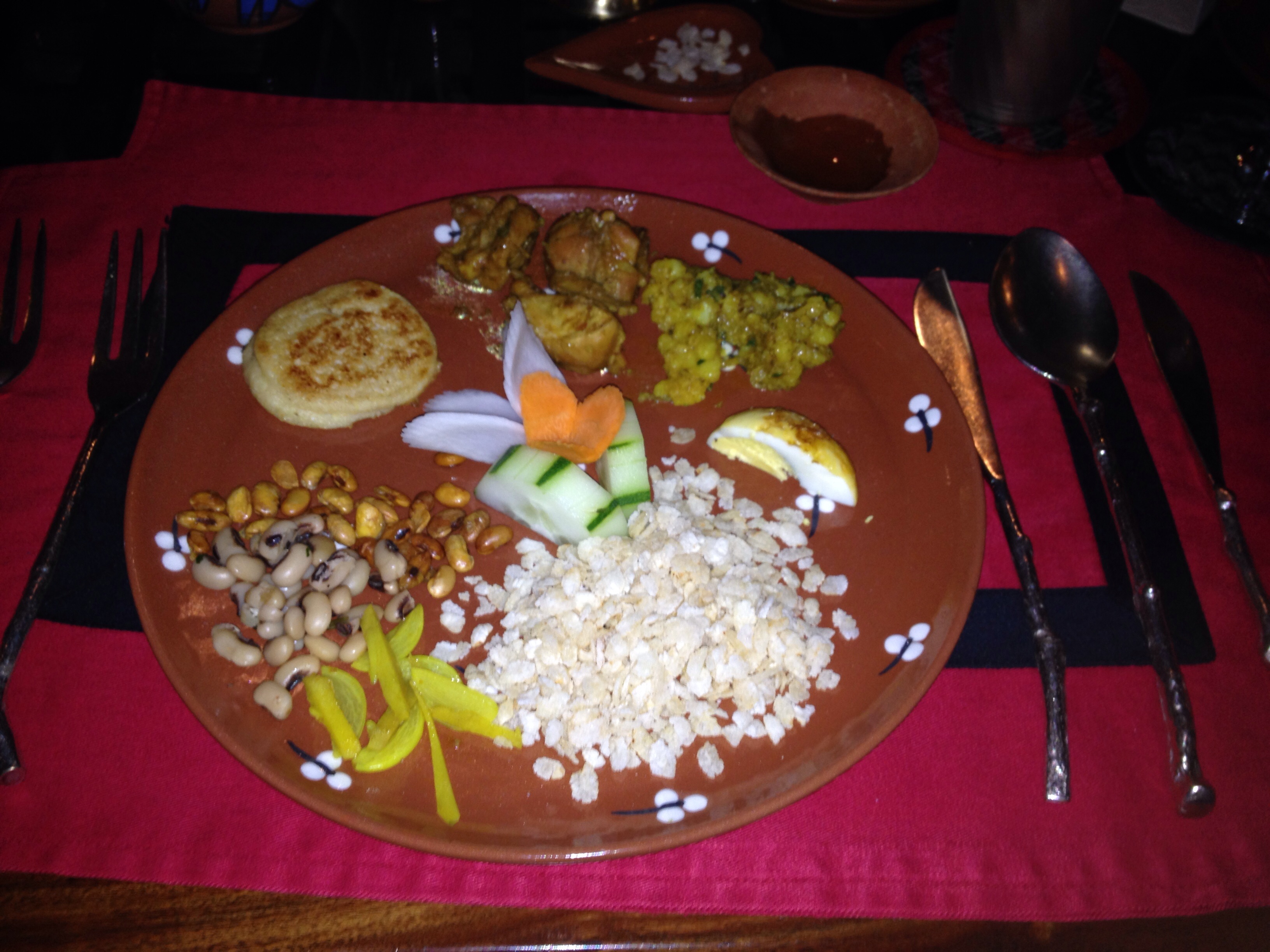
First Course: Assortment of Hors D’Oeuvres served during religious ceremonies

image

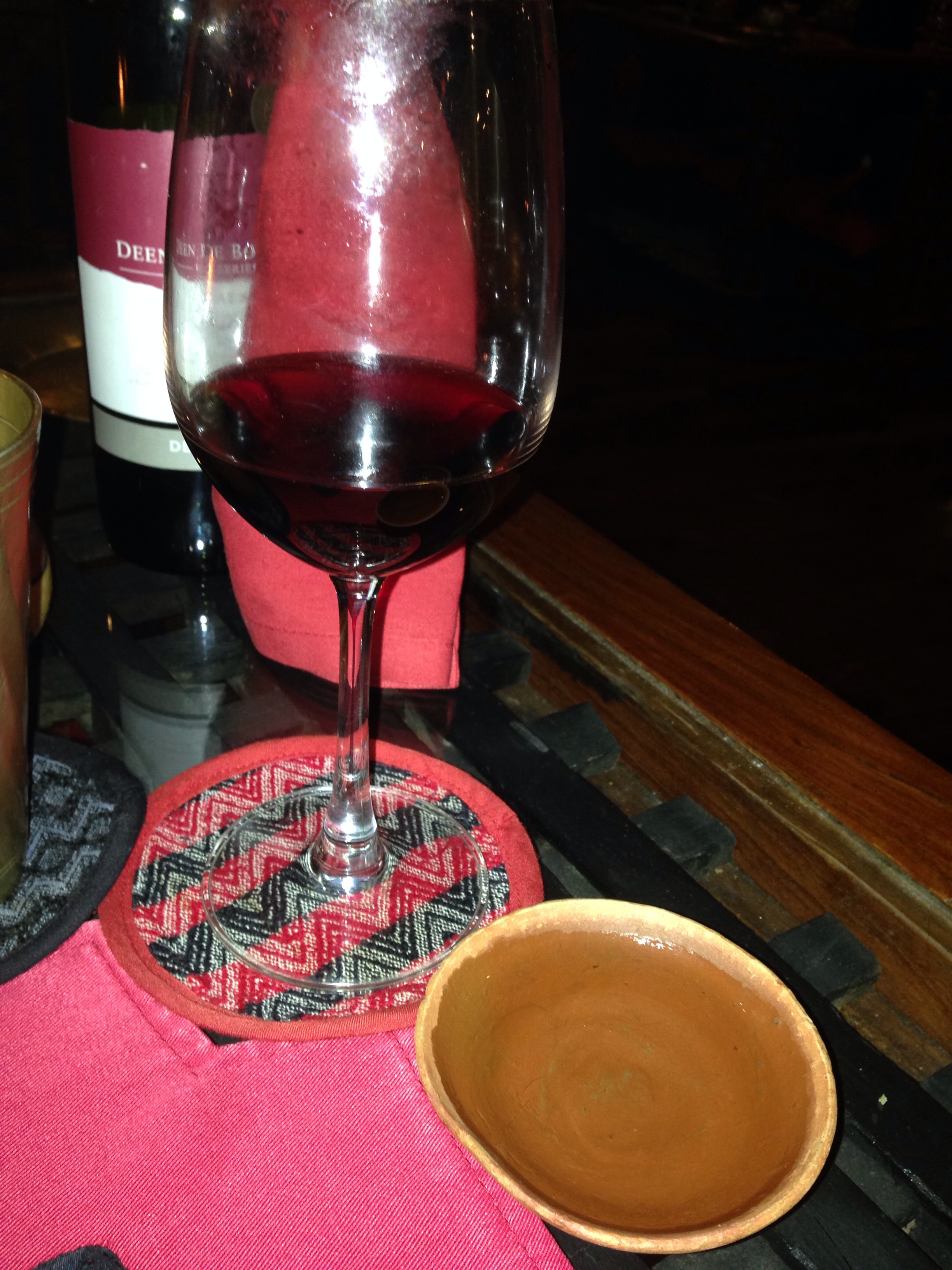
A very fortified Rice Wine is a traditional offering with the meal, and we ordered a spicy Shiraz as well

image

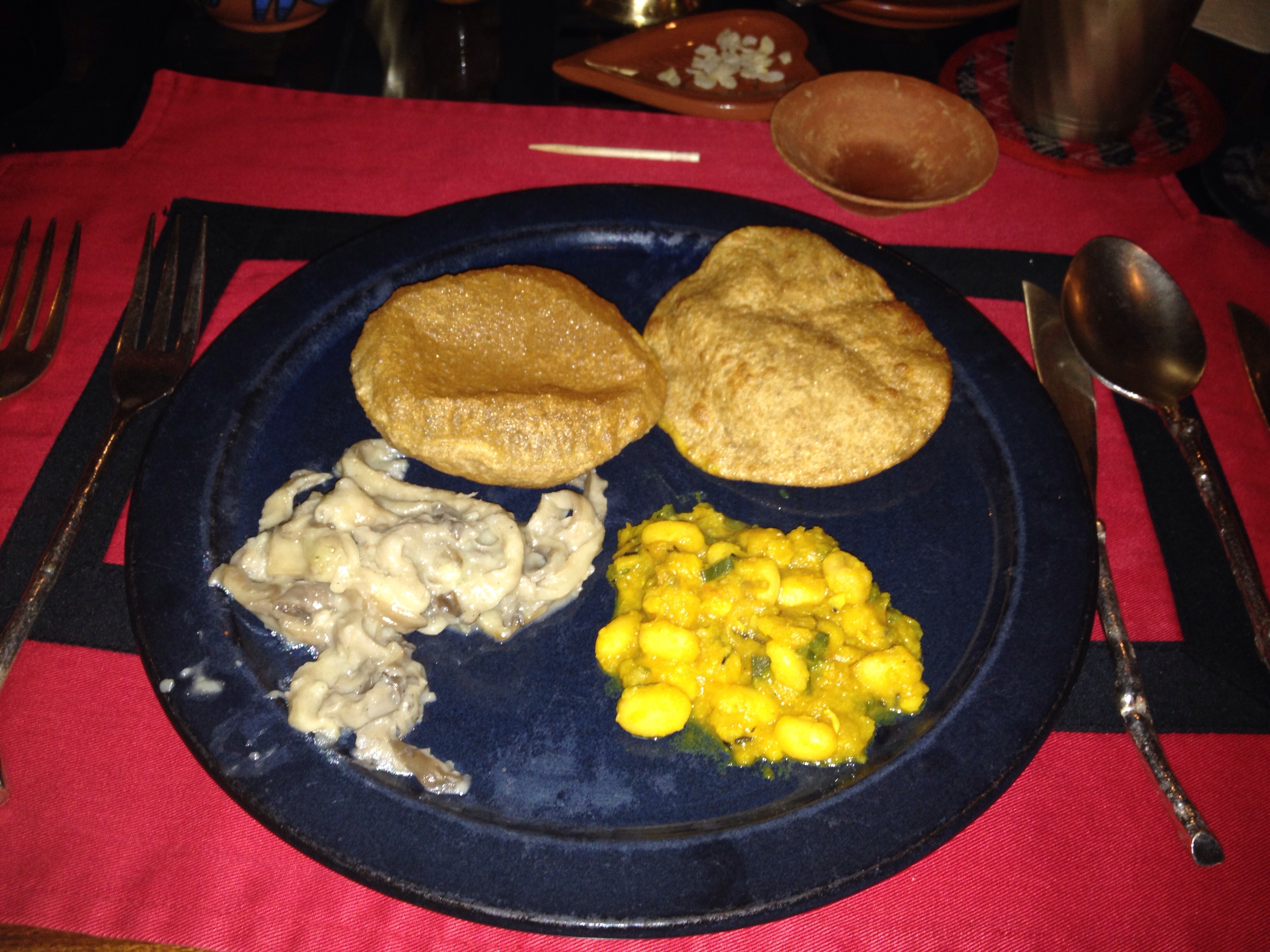
Second Course: Roasted Mushrooms marinated with Fresh Cream, Deep Fried Soft Fine Flour Bread, Organic Kidney Beans Curry

image

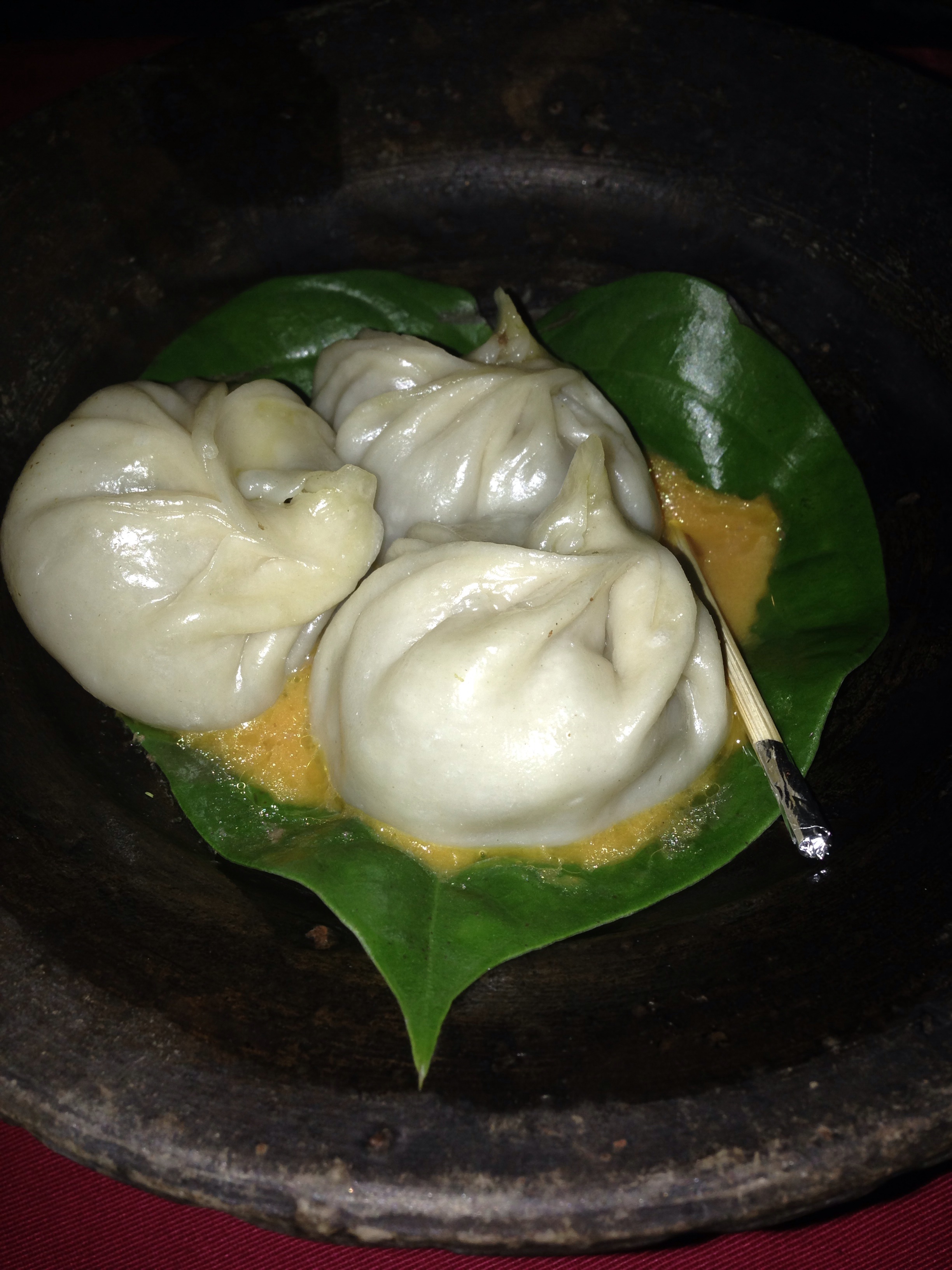
Third Course: Traditional Nepali minced Wild Boar Dumplings served with home-made Chutney

image

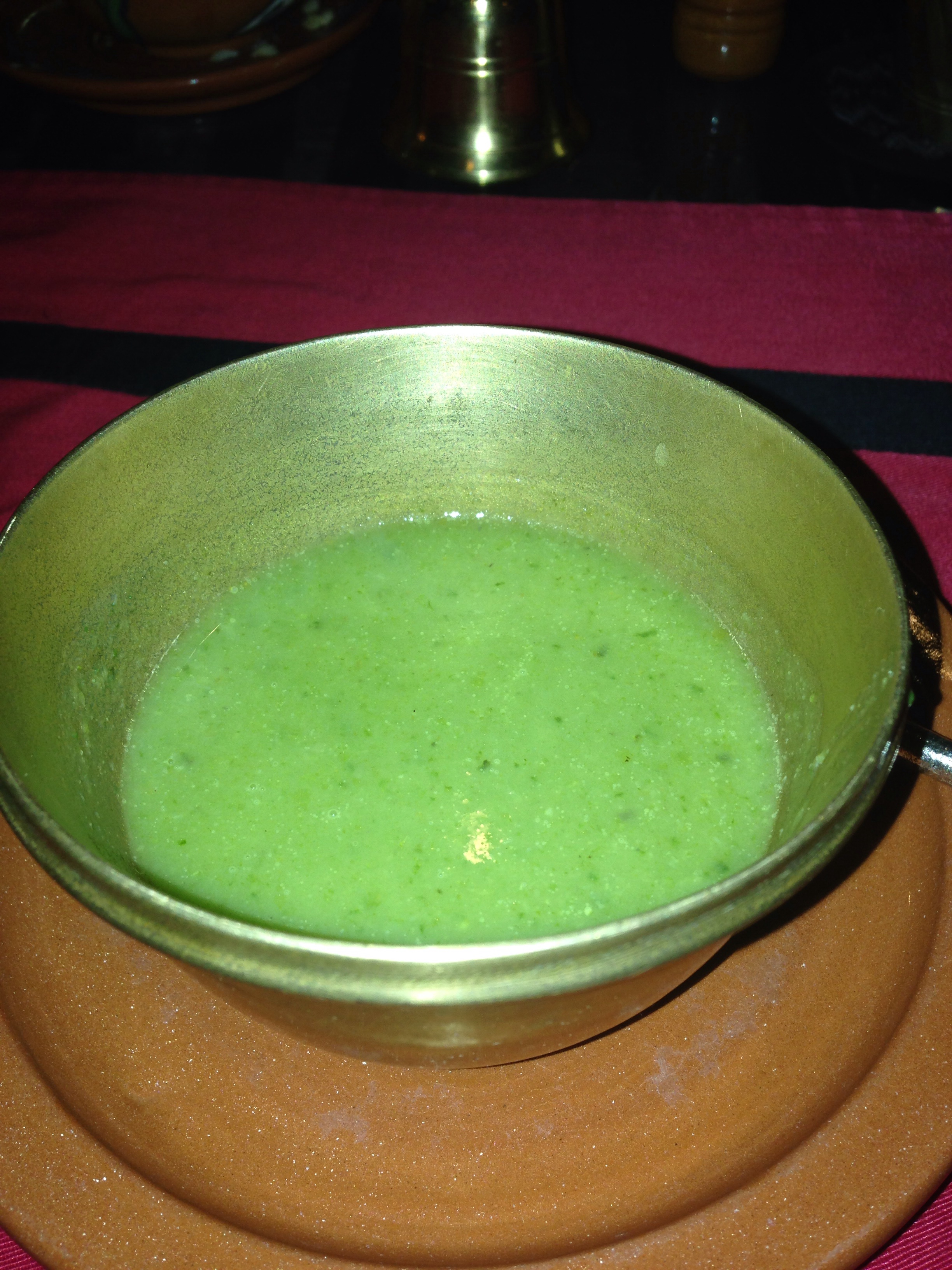
Fourth Course: Mixed Vegetable Soup with Nepali Spices

image

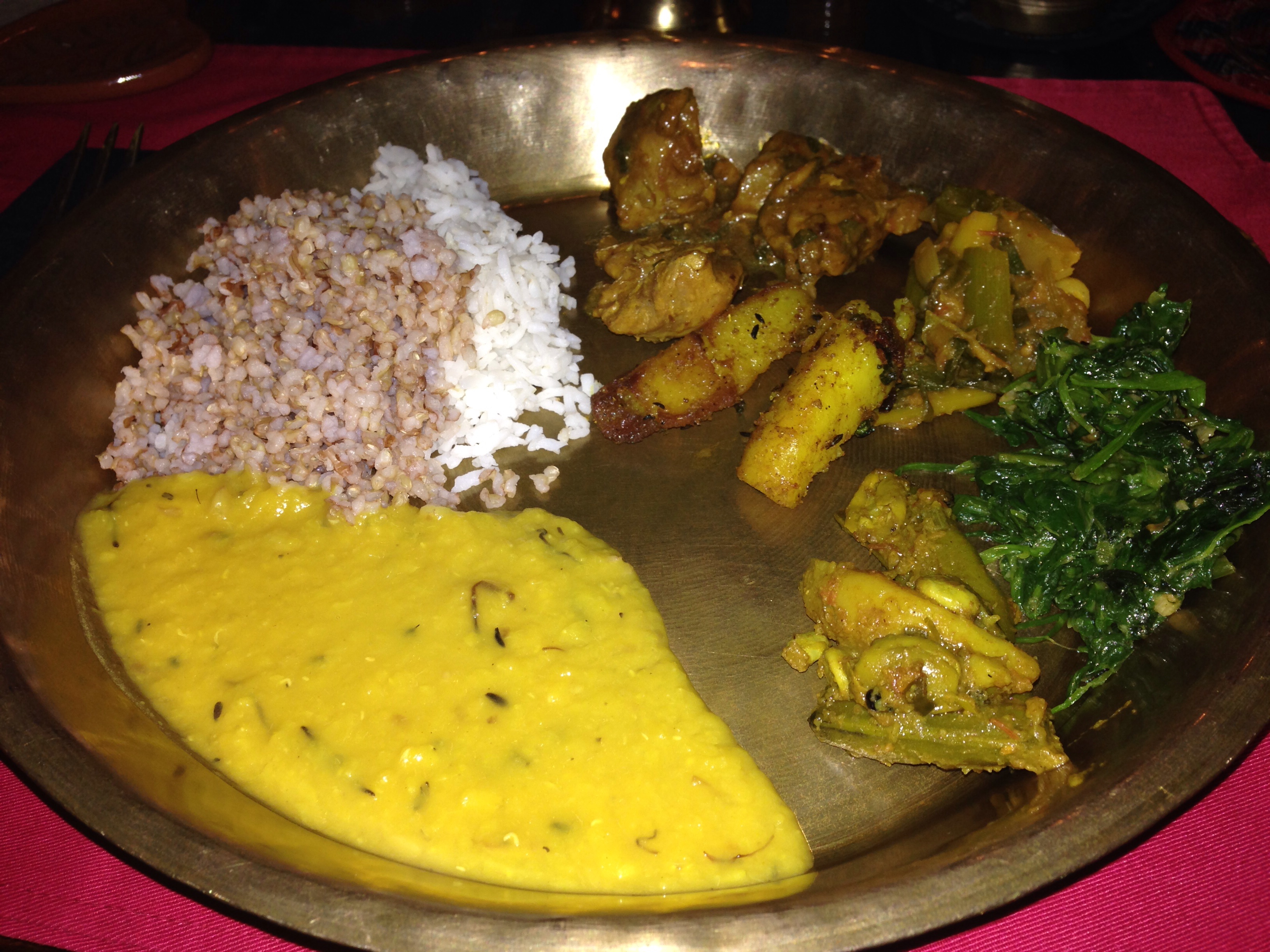
Fifth Course: Steamed Organic Rice, Organic Lentils flash fried with Himalayan Herbs, Sauteed Organic Spinach with Nepali Spices, Radish and Garlic Gravy, Bitter-Gourd Pickle, Homemade Hug-Plum Pickle

image

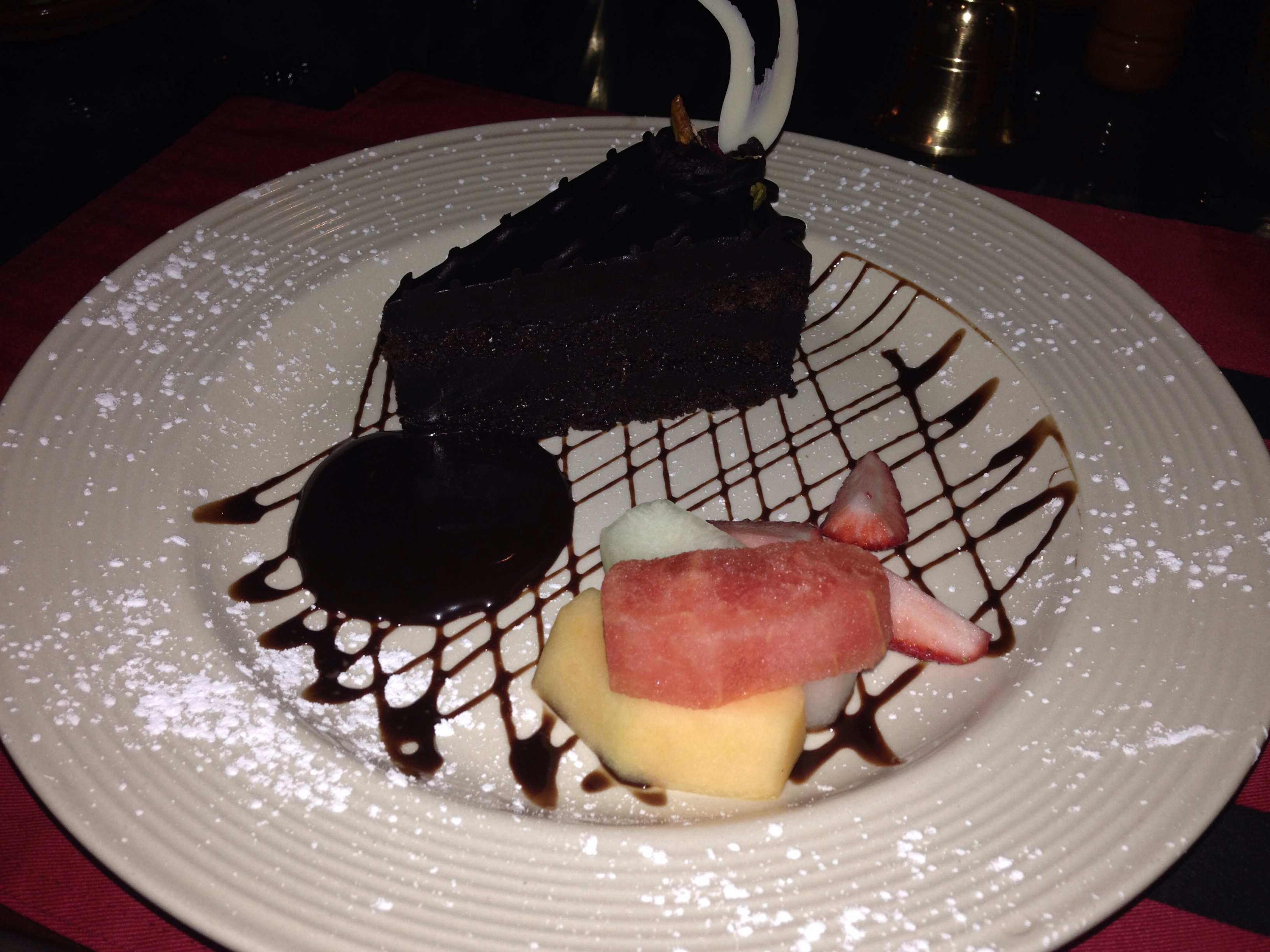
Sixth Course: Dark Chocolate Cake with Dark Chocolate Sauce

The entire meal is served harmoniously, one course flows after another, so that you have enough time to appreciate the course you have just eaten before the next one arrives. The produce is all organic, and most comes from the Dwarika’s own garden. Dinner concludes with coffee and tea, including fresh mint tea with mint from their garden. We chose mint and ginger tea which was sublime. Dessert, it should be noted, according to the menu was supposed to be Fresh Yoghurt flavored with Cinnamon sweetened with Honey, Nepali Pumpkin Pudding, Cut Fresh Fruit - but we opted for the divine chocolate cake we had had the night before when we all of a sudden got a craving for chocolate and called room service for our chocolate fix (actually, I negotiated this change from the fixed menu prior to confirming our reservation at the Krishnarpan but this is all hush-hush).

Aside from the chocolate cake, our favorites from this 6 course menu were the second, third and fourth courses. The organic kidney bean curry was light with layers of flavor, the bread was also extremely light and full of flavor, the wild boar dumplings rivaled any we had eaten in China’s best restaurants, and the soup, comprised primarily of pureed green vegetables with the hint of sweetness from the corn was memorable.

But “memorable” describes the whole evening. When in Kathmandu, make sure to have dinner at Krishnarpan, and come with a hearty appetite!

CULINARY SPOTLIGHT: A Traditional Southern Indian Breakfast

image

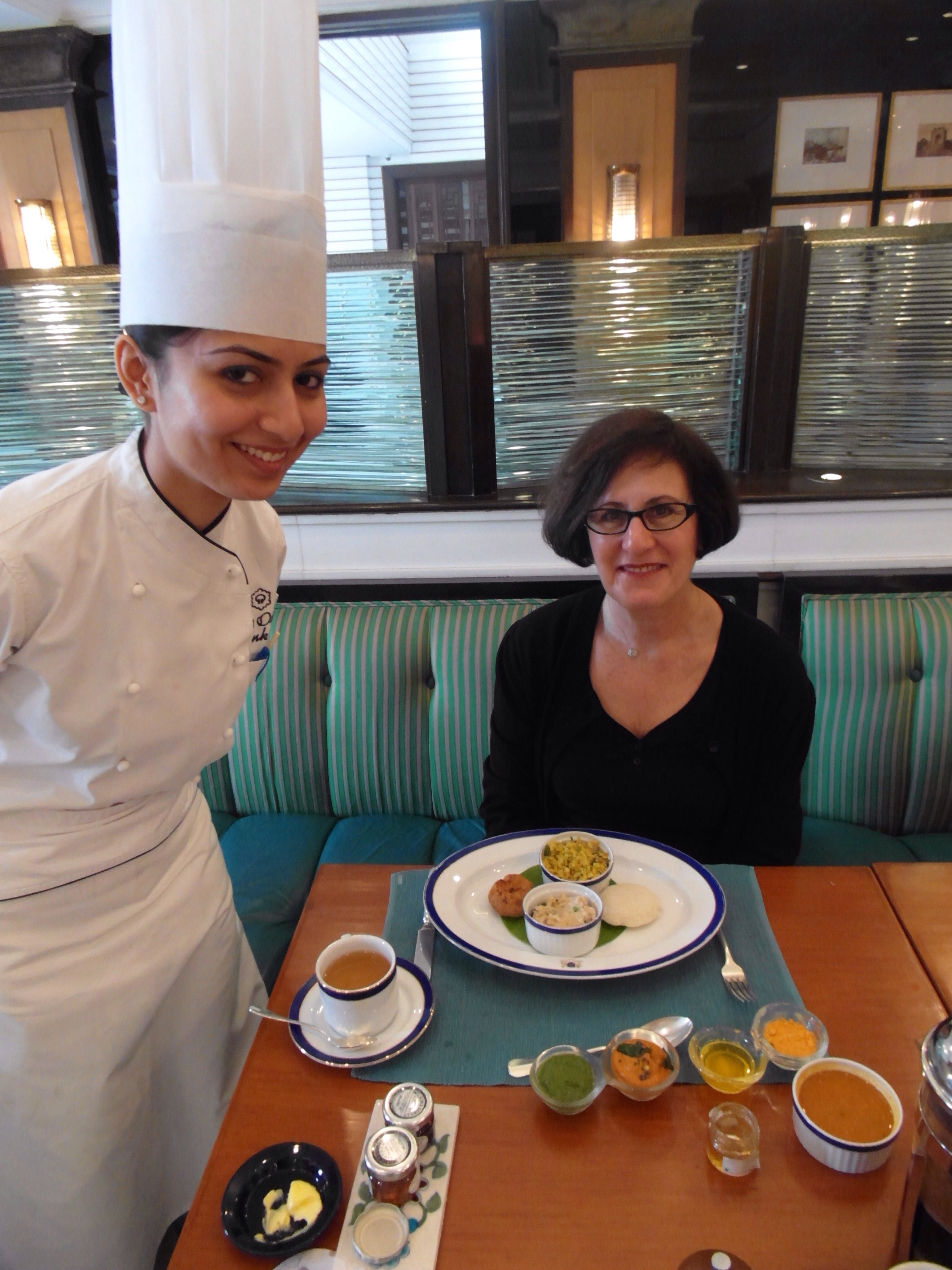
Chef Ankita and her breakfast for Lynn - Oberoi Amarvilas, Agra, Uttar Pradesh, India

“What can I do, Madam, to make you happy?” asked the young and very charming female chef our first night at the Oberoi Amarvilas (“Eternal Villas”) in Agra. I had told our waiter a moment ago that I had not enjoyed the chicken curry he had recommended. Before I could say much of anything, dessert was going to be complimentary and she was going to prepare a special “Indian breakfast” just for me. Hmm … I’m a bit fussy about my breakfast, and as I was pondering the next morning whether I should just play it safe and take a traditional “western” breakfast from the buffet, there she was with her charming smile telling me that my specially prepared breakfast would be brought to me shortly.
The food was delivered by the waiter with a flourish, but Ankita Sood, the Chef, was not far behind. She told me she had prepared a traditional “Southern Indian” vegetarian breakfast and began to explain each item. When I realized that I would never remember all those strange-sounding names, I asked her if she would email them to me – which she did right after departing from the table. But first, the charming Ankita posed with me for a photo along with the food she had so expertly and caringly prepared.

image

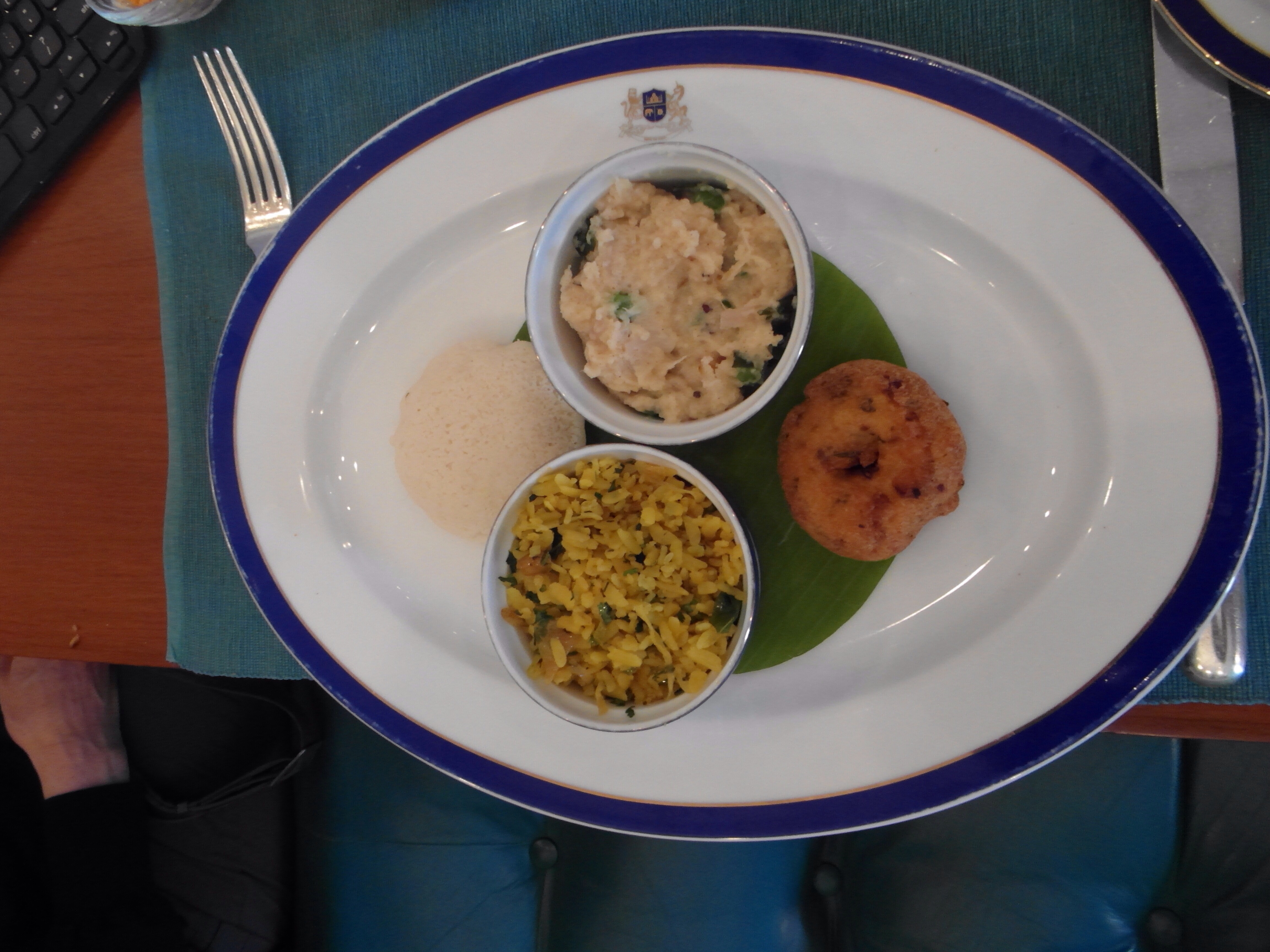
Vada, Poha, Idli and Upma

In the photo above of the platter with 4 items, a going clockwise from 3 o’clock is “Vada” (a deep fried dumpling of rice and lentils), “Poha” (flattened rice with peanuts and curry leaf), Idli” (steamed rice dumpling), and “Upma” (semolina and vegetable pudding). While I enjoyed each one of these unique dishes, my favorite was the Poha followed by the Vada, the Upma – which reminded me a bit of oatmeal -, and the Idli, which clearly needed some condiments to spice it up. The accoutrements included “Sambhar”, a lentil stew with vegetables, “Gunpowder”, a condiment made with broiled spices and lentils served with clarified butter, and some rather spicy chutneys. I loved the Sambhar and used it to flavor the Idli and the Upma. The Gunpowder was aptly named – a bit too fiery for me first thing in the morning, and the chutneys I enjoyed in moderation with the Vada.

When I had finished my South Indian tasting breakfast, I reflected upon the experience. The bad taste from the chicken curry the night before was erased, magically replaced by the visual, aromatic and culinary appeal of what can only be described as the most unusual and interesting breakfast I have ever eaten. Would I eat it again? With pleasure!

CULINARY SPOTLIGHT: Peacocks, Fenugreek and Blue Pottery

image

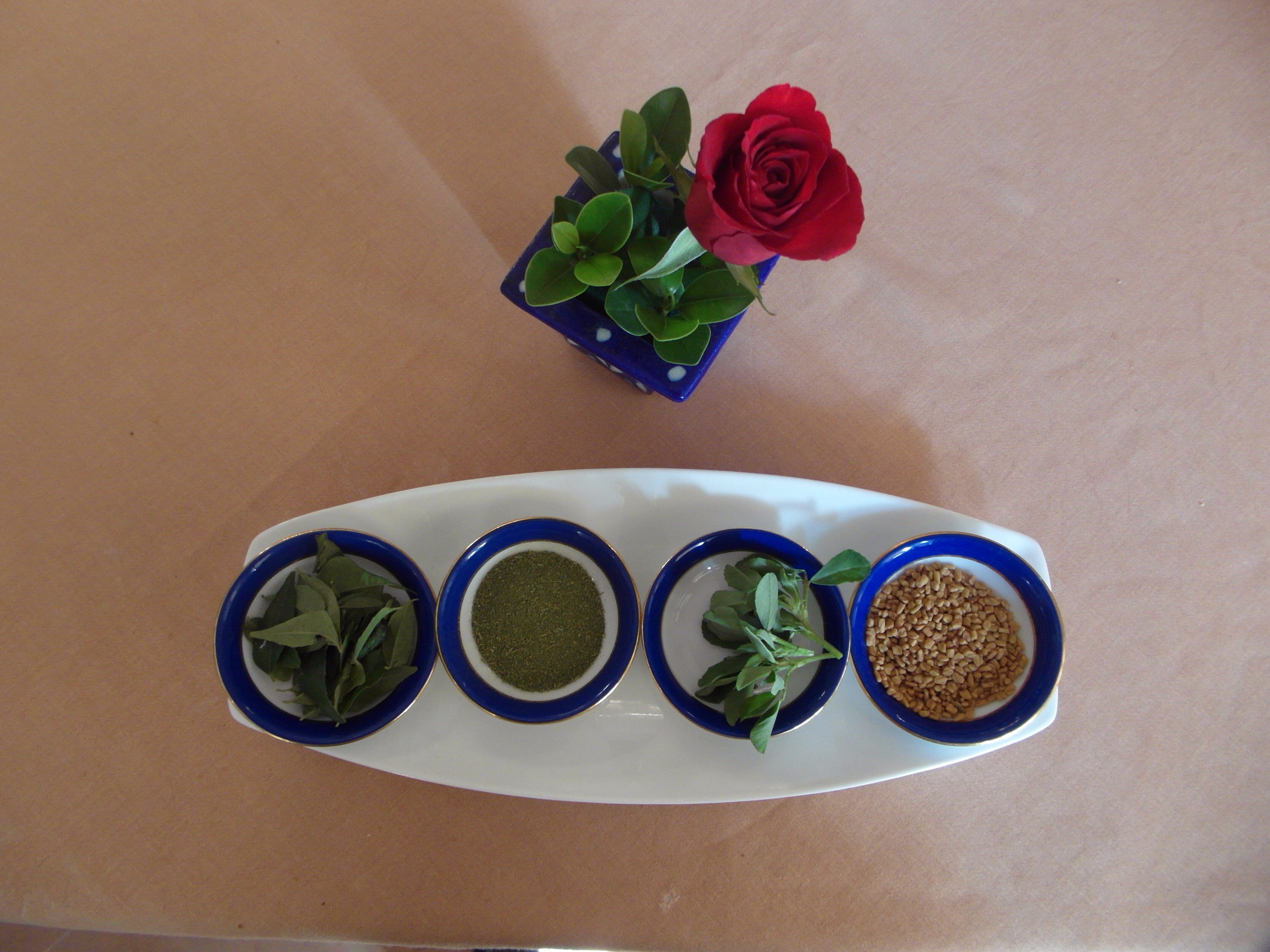
Fresh coriander, ground fresh fenugreek, fresh fenugreek and fenugreek seeds

In exotic Jaipur, I am having breakfast after a short but wondrous visit and am feeling adventurous. After all, we have surveyed the city from 2000+ feet above it in a sunrise hot air balloon ride, entered the courtyard of the magnificent Amber Palace dating from 1592 on top of an elephant just as royalty used to do in the days of kings and maharajahs, and encountered peacocks who appeared magically in the garden outside our hotel room just after I verbalized my desire to see some.

So to accompany the elegant “western-style” breakfast of scrambled eggs with smoked salmon which I ordered, I go up to the “Indian” side of the buffet table and take a generous serving of vermicelli. When I take my first bite of the vermicelli, there is a divine explosion of flavor in my mouth. I can taste the onions, garlic, tomatoes and chilies, but there is something else I don’t associate with vermicelli and can’t identify. I ask the chef when he comes by what the little flavorful seeds are that add such a punch to the dish. “Coriander seeds” is his reply, and then we chat a bit about Indian food, including “fenugreek” which I say interests me. He asks me to wait a brief moment.

To my delight, he returns with a tasting of fresh coriander (“cilantro”), ground fenugreek leaves, fresh fenugreek, and fenugreek seeds (see the photo above). But that is just the beginning … When I finish my tasting, he asks me to wait again for a moment, and then returns with the herbs and seeds, each in a sealed package along with the famous “blue pottery of Jaipur” which I had previously admired.

I have learned in Jaipur — be careful what you wish for, or it may become yours. Luckily, I only wished to “see” the peacocks, not to bring them home.

Nice, France ~ Alluring breezes, views, meals and comfort at Plage Beau Rivage

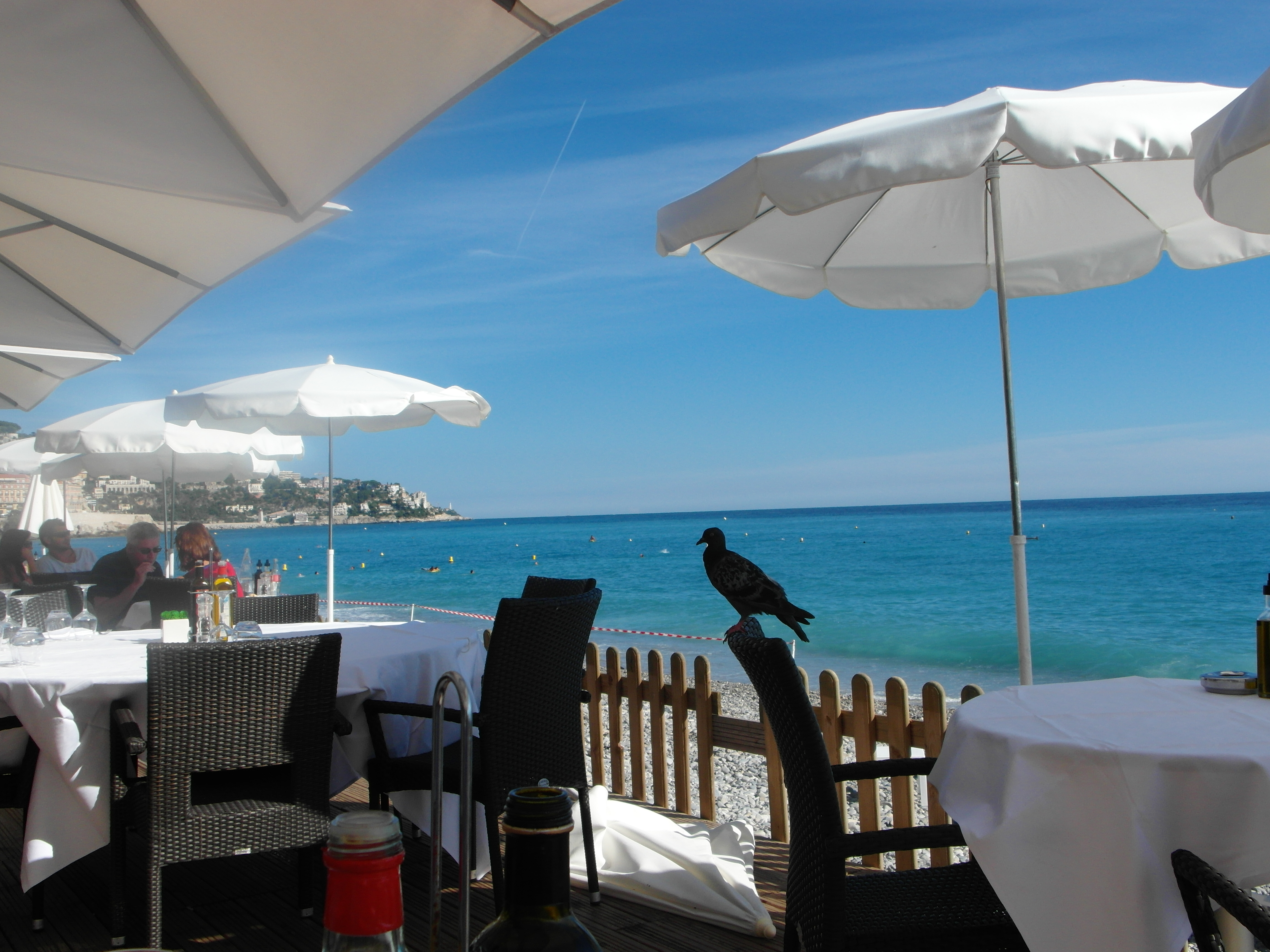
The azur blue sky was back in its full glory today, but this time there was a stronger wind creating bigger waves on the beach and a more refreshing breeze ashore.

SAM_1860

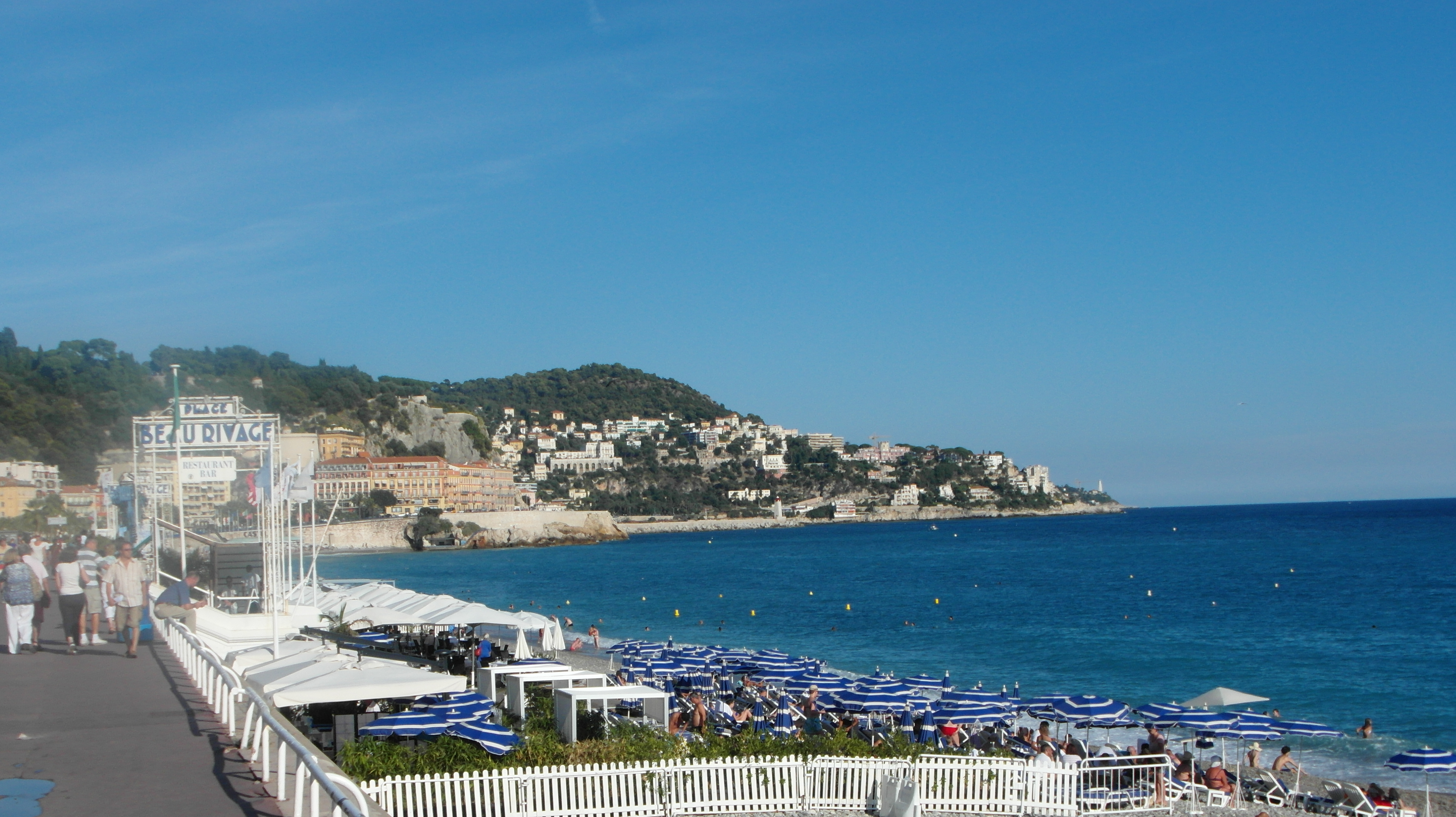
Plage Beau Rivage in Nice

My plans to try another topless beach along the Nice shore were derailed by our love of everything that Plage Beau Rivage offers, its comfort, its gastronomic food, its service, its views, etc… Watch the video at the top of this posting to get a feel for this wonderful place.

SAM_1801

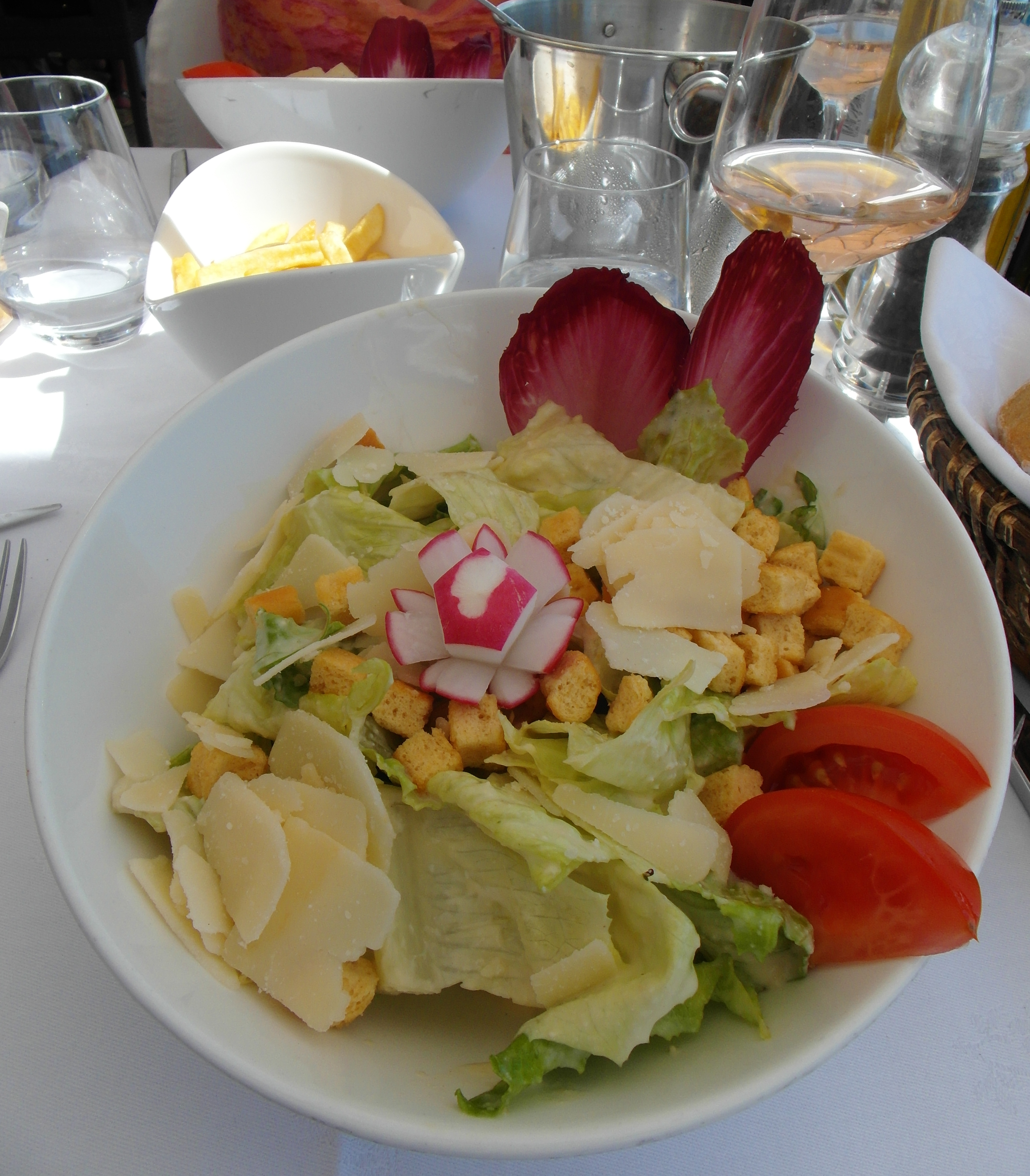
“The unavoidable plain (sic) Cesar Salad” at Plage Beau Rivage in Nice

We spent the whole afternoon enjoying another leisurely luncheon. The Cesar Salad we started with was the best I have had in a very long time.

SAM_1809

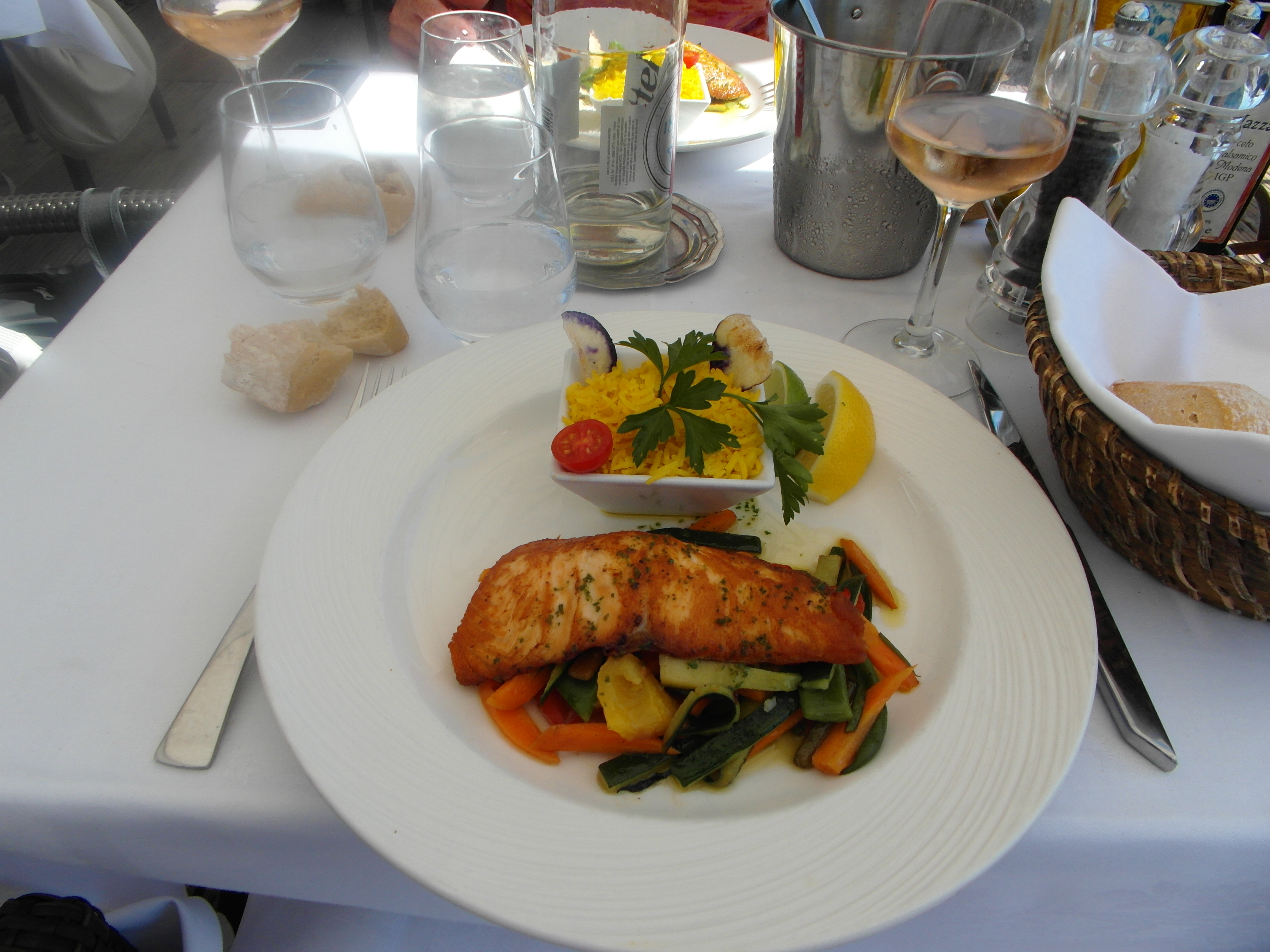
It was followed by a tender Saumon Roti au Four et son Pistou de Shiso Rouge, Riz Parfume aux Epices Douces (oven roasted salmon with red shiso pesto, rice flavored with mild spices). And finally, since we had loved so much the speculos ice cream we had been served on our previous visit, we splurged with the same moelleux au chocolat et sa creme glacee au speculos (chocolate melting cake with speculoos ice cream) but asked for a double portion of the ice cream!

SAM_1843

We had another “cracker day” (an Irish expression I picked up from the Northern Ireland couple we befriended at Plage Beau Rivage) at the beach!

Luncheon inspired by Tender is the Night

Hotel_du_Cap-Eden-Roc_173382

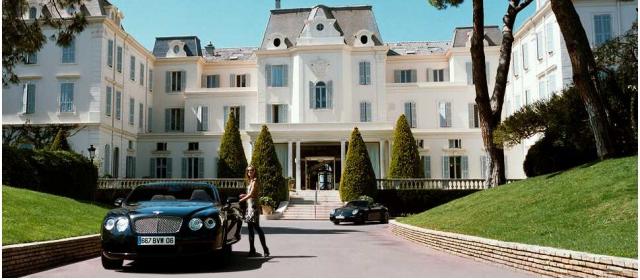
Hotel du Cap-Eden-Roc in Cap d’Antibes

F. Scott Fitzgerald was my favorite author in high school. His novels, as well as his short stories, took me to romantic places and introduced me to fascinating characters. I lived vicariously through Fitzgerald and knew that I absolutely wanted to visit the hotel described in the first line of my favorite Fitzgerald novel, Tender is the Night. In fact, I even planned on naming my first daughter after the main character in that novel, the alluring but complex Nicole Diver. Years later when our first daughter was born, I had to give up on the “Nicole” fantasy because we already had a close relative with that name. But I remained faithful to my first dream to make a pilgrimage to the hotel where the story unfolds …“On the pleasant shore of the French Riviera, about halfway between Marseilles and the Italian border, stands a large, proud, rose-colored hotel.”

edenroc-resto-vue

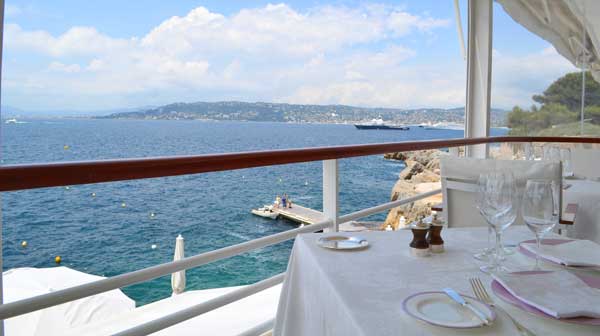
View from restaurant of the Hotel du Cap-Eden-Roc in Cap d’Antibes

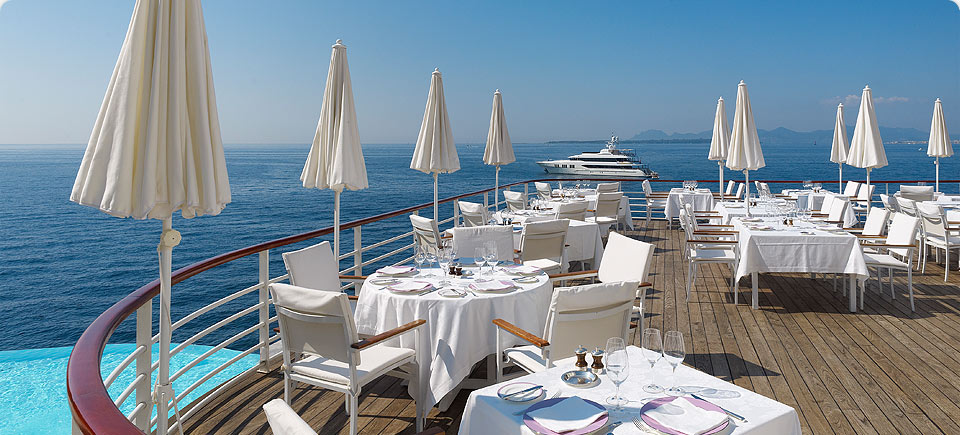
The Hotel du Cap-Eden-Roc that inspired Fitzgerald’s “Hotel des Étrangers“ isn’t “rose-colored” any more, but it still is a magnet for the rich, famous and powerful – and by “rich”, I mean “Rich!” So once again, we decided to sample the good life with a luncheon at the hotel’s restaurant, the Eden-Roc, which the hotel’s splendid brochure describes as “”famed for its gastronomic cuisine”. Ambiance the Eden-Roc has in spades. The restaurant is sublimely elegant. The blue and white décor, with a touch of purple and pink, is the perfect backdrop for the Mediterranean sea which is really the star player in the view as it is visible for as far as the eye can see. Peppered with fabulous 200+ foot yachts along with a variety of other smaller sailing vessels and enhanced with a backdrop of the curvilinear coastline of Cannes and the Maritime Alpes rising in the background, the view is quite simply spectacular. The service is also first-class – a small army of servers were at our beck and call, sensing our needs before we even realized we had them, whisking away a plate or refilling a glass or offering to carry a platter from the buffet table to our table, and the sommelier impressed us with his expertise, selecting the perfect wines to accompany both our food and dessert. Awesome indeed, just like the view.

As over-the-top as the quality of the décor, service and view were, I regret to say that the food – the actual cuisine – was lacking in comparison. Don’t get me wrong — our meal was delicious and highly satisfying, but given the other three components of the meal, and the over-the-top price for each item on the extensive à la carte menu, we ended our meal concluding that the Chef wasn’t quite up to snuff and that we had paid princely for the name and the view. Still, the meal was exquisitely memorable and I’d like to share what we ate.

photo 427

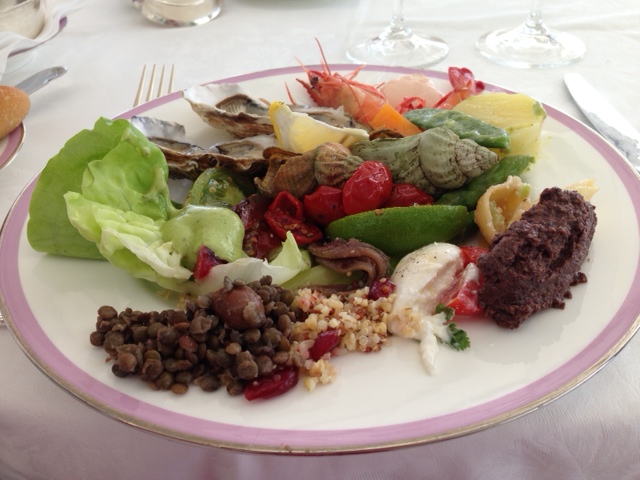
Platter from the Buffet Eden-Roc

We began with the restaurant’s formidable Buffet Eden-Roc comprised of mainly traditional classics prepared from the finest of the finest ingredients and presented on the buffet table to please the eye as much as to please the palette. Among the many selections was a superb gazpacho, a very thinly sliced prosciutto and an unctuous buratta cheese laced with olive oil and herbs — a nod to the Italian neighbors -, gigantesque shrimp, fresh local oysters, the largest escargots I’ve ever seen and the first time I’ve seen them cooked in their shells (but I found them a bit rubbery and tasteless), an impressive selection of cured sausages and meats, a variety of salads from lentil to pasta to quinoa, an assortment of cold steamed vegetables from asparagus to French haricots, heirloom tomato salad and bowls of assorted greens, tapenades, sauce bowls of mayonnaise in pink (flavored with tomato), green (flavored with herbs) and traditional white, assorted Niçoise accompaniments such as black olives and sun dried tomatoes, and more to be sure. After filling our platters and consuming them with a delightfully refreshing Cotes de Provence 2012 Chateau de Selle Domaine Ott Rosé, you might think we would be satiated … but you would be wrong.

SAM_1373

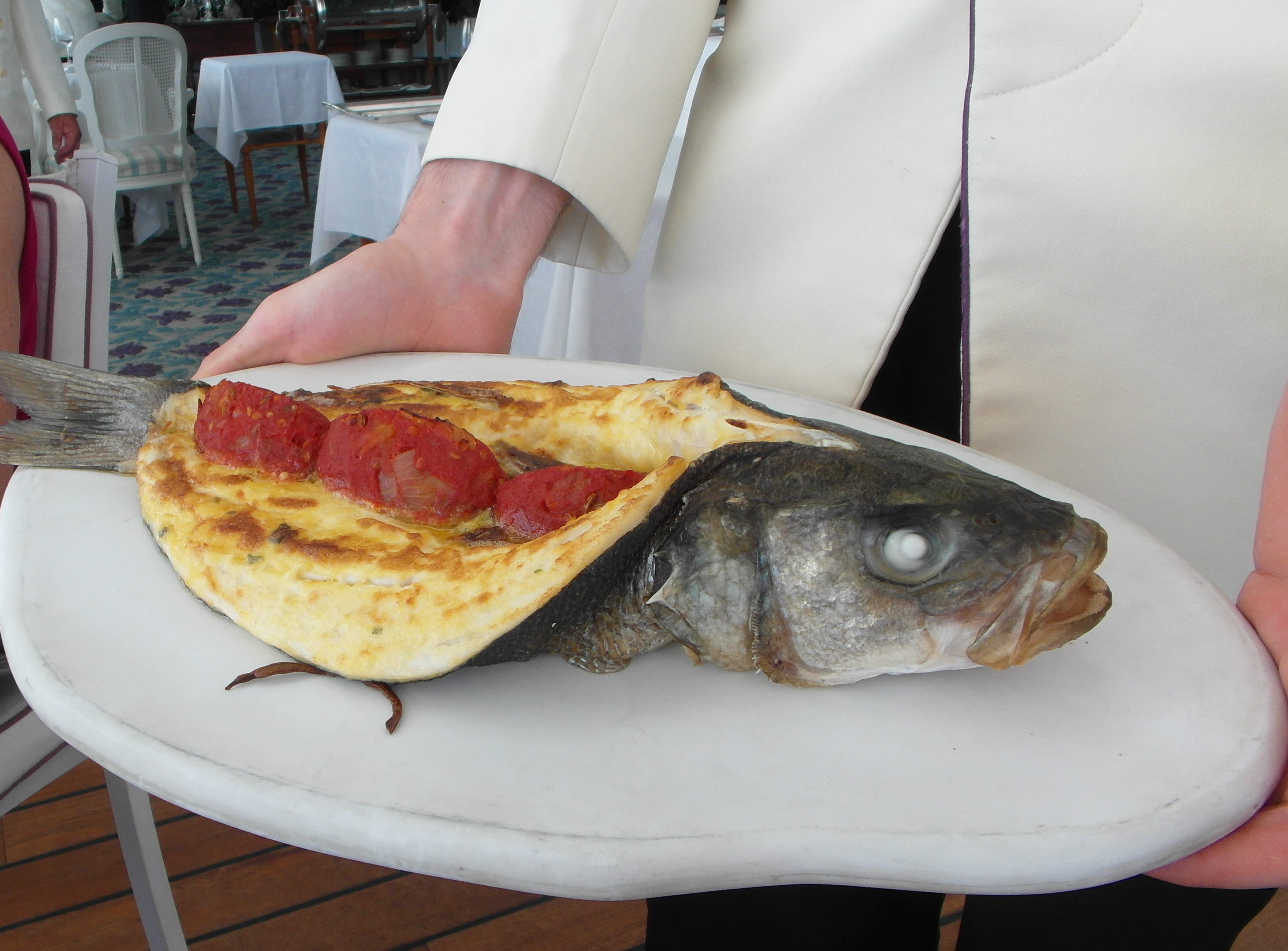
Sea bream grilled “en portefeuille” with mousseline and tomates a la provencale

We moved on to the chef’s specialty of Sea Bream grilled “en portefeuille” (literally “in wallet”), an elegant way to signify that the fish is de-boned and grilled open face with an airy light mousseline and tomatoes à la Provencale.

SAM_1374

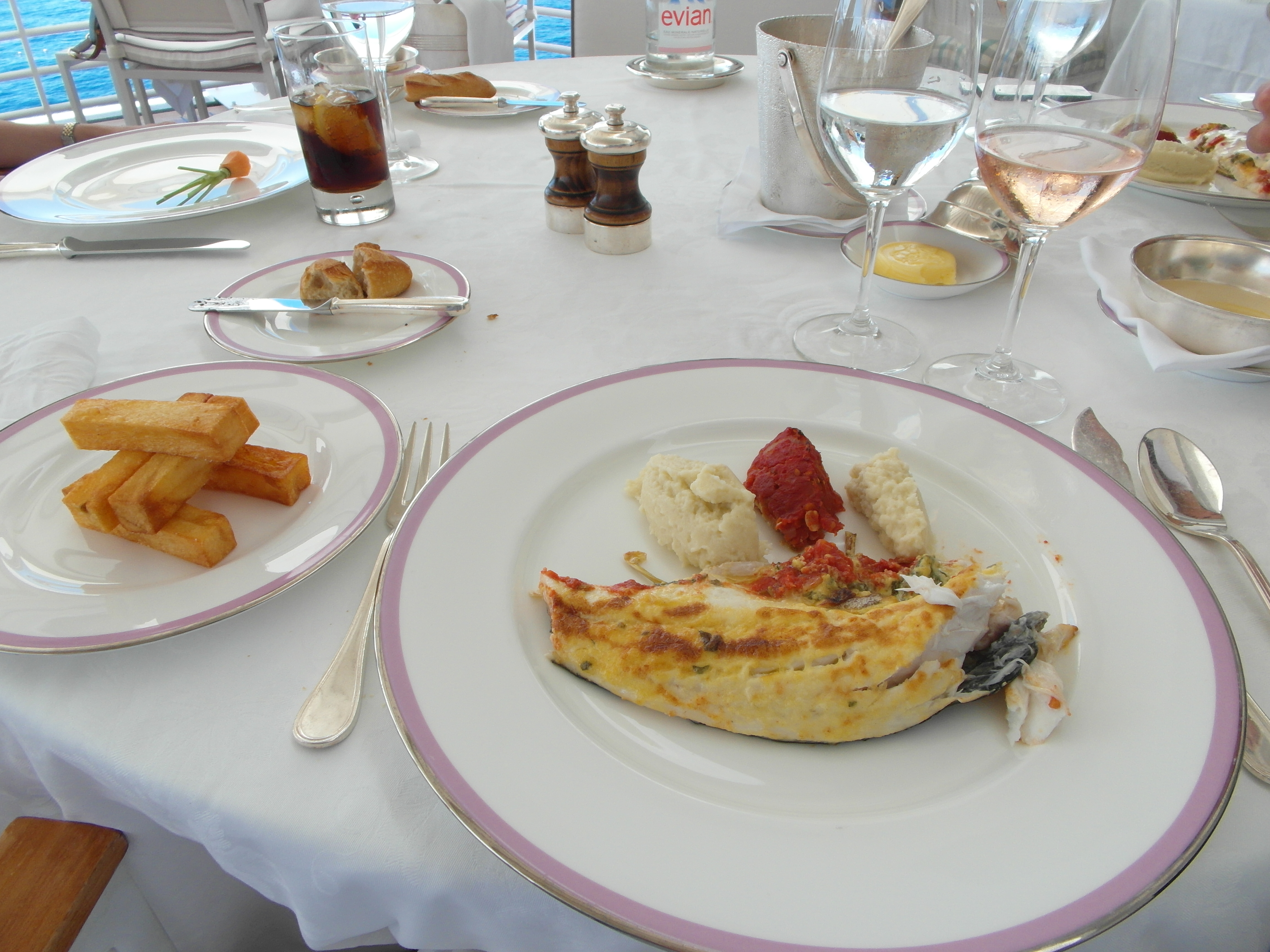
Sea bream with pommes Pont-Neuf

The fish was served with potato purée but that was not enough for Denis. Monsieur also ordered the Eden-Roc’s Pommes Pont-Neuf, aka thick rectangle blocks of crispy flash-fried potatoes that melt in your mouth. The superbly tender and delicious sea bream simply disappeared off our plates … and all that rested was a bit of purée.

photo 429

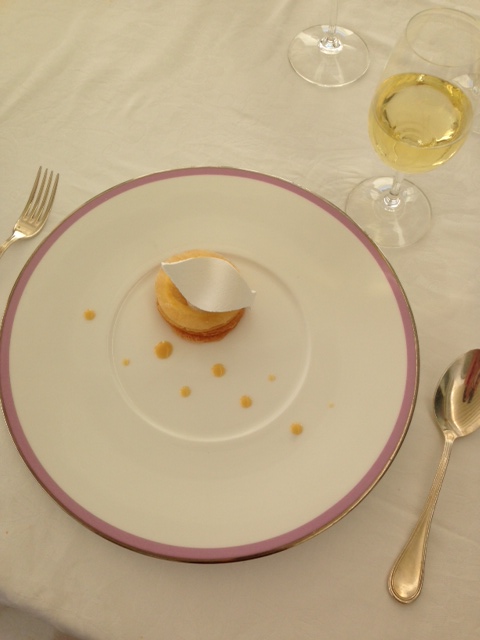
Dessert Le Citron accompanied by Moscato d’Asti

photo 426

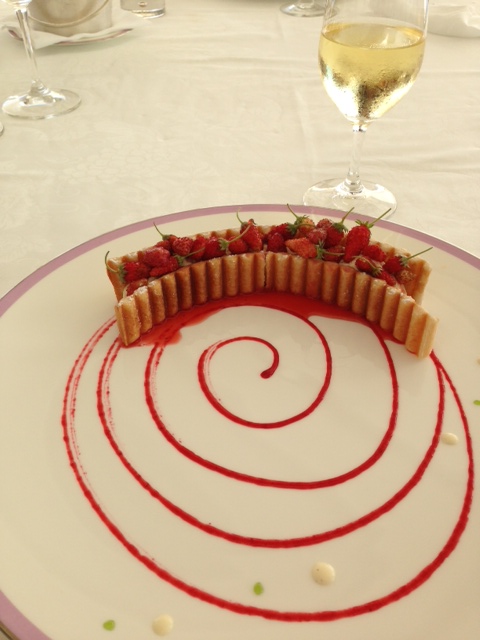
Dessert Millefeuille with “fraises des bois”

The dessert trolley arrived with a magnificent spread of classic French patisserie, but we decided to venture away from the “known” which we love and instead to sample the pastry chef’s creativity. We ordered Le citron, described as “lemon crunchy, tangy and iced ‘cloud’ grown in Menton”, and a Millefeuille, “revisited wild strawberries millefeuille with mascarpone cream”. When we inquired about a digestif the sommelier brilliantly suggested an Italian Moscato d’Asti Bricco Squaglia La Spinetta 2011 which he described as “fresh, light, with little acidity, and lightly sparkling”. It was a superb choice but the creative “unknown” pastries were lacking in flavor and the mignardises were unexciting. The Moscato saved the day for the dessert course.

The philosophy of the Eden-Roc Restaurant is utterly on point …
“De tous les sens, il n’y en a de plus délicieux, ni de plus nécessaire à la vie que celui du gout.” (“Of all the senses, there is not one more delicious, or more necessary to life than the one of taste.”) To truly abide by that philosophy, the Chef and his team must improve their mastery of the art of French cooking so that the flavors and textures create a feeling of heavenly satisfaction in the mouth, and perhaps they should offer the traditional amuse-bouches, as is the tendency of great French restaurants,’ to awaken and excite the palate before the “meal” is served. Not too surprisingly, Michelin gives the Eden-Roc Restaurant its top rating for service and ambience — five knives and forks in “red” for ultimate “ambiance” … but no star for the cuisine.

Still, we had a glorious meal and afternoon, and experienced another masterful and memorable French luncheon. Plus, I’ve finally achieved one of my youthful dreams … I visited the Hotel that inspired Tender is the Night and I walked in the footsteps of F. Scott Fitzgerald.

Le Chantecler, Essence of a 2** Michelin Luncheon

SAM_1054

The sun is beginning to set here in Nice, and since lunch we have visited the Musée Matisse in the magnificent Nice neighborhood of Cimiez … yet I can still feel the pleasure of our three and a half hour luncheon, I can remember the flavors and the marvelous sensations of enjoying the food and wine. Let me bring you back to relive today’s memorable gastronomique luncheon with me.

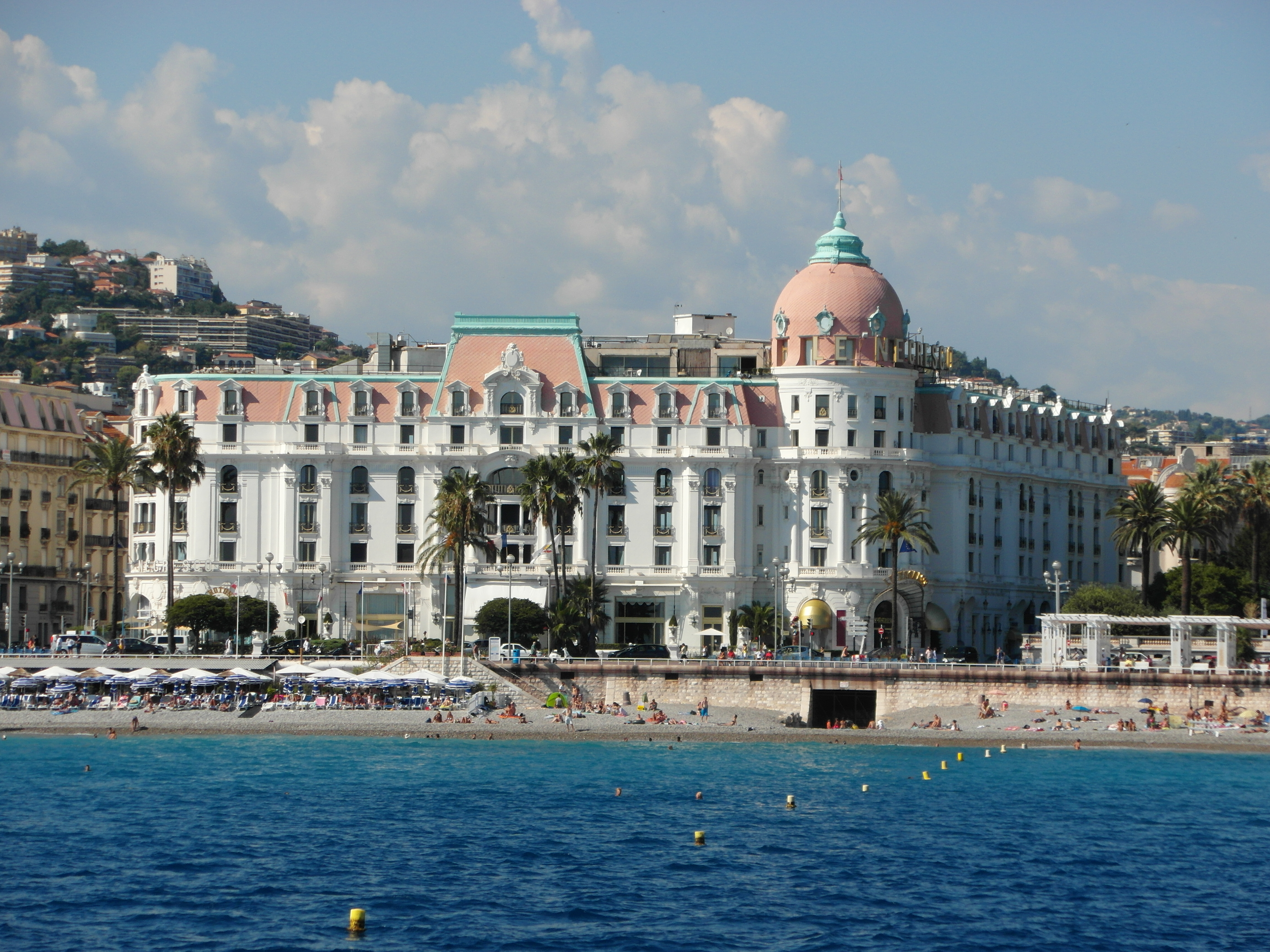
Just off the Promenade des Anglais on the Baie des Anges (“Bay of Angels”) in the heart of Nice, is the palatial Hotel Negresco, listed by the French government as a National Historic Building and a member of the Leading Hotels of the World. As we enter the hotel, we are greeted by a doorman dressed in the uniform of an 18th century elite bourgeois household servant who inquires after our needs and takes us to the Chantecler Restaurant. The “feast” has begun.

SAM_1088

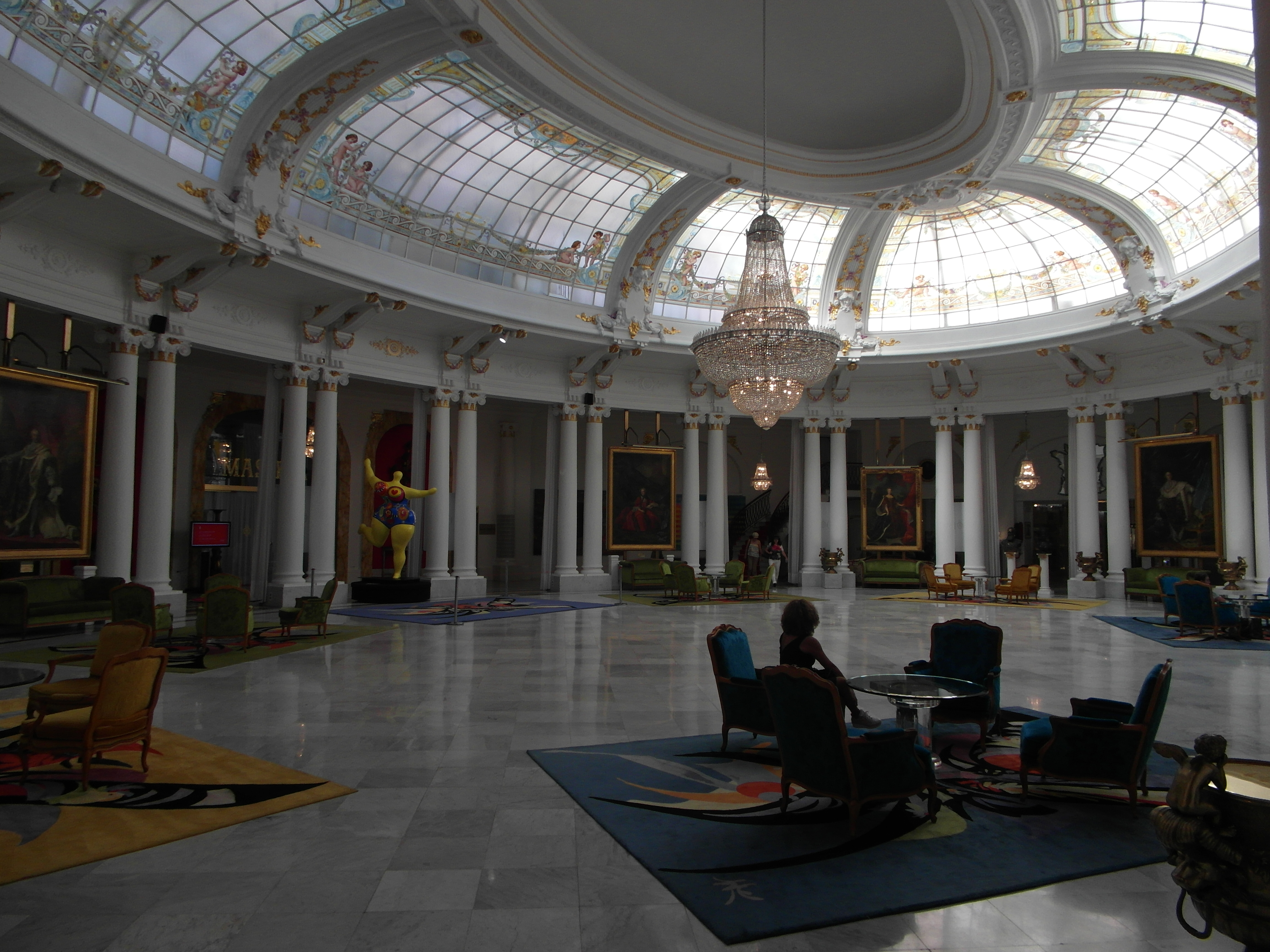
Our eyes take in the glamorous opulence of the architecture and décor of the hotel with its multitude of Mediterranean colors against a stark white setting and we are suitably impressed by the Gobelin tapestries and the impressive collection of paintings and sculpture.

As we enter the restaurant, the visual feast continues. Our eyes roam from roccoco furniture in vivid shades of pink, lime, lemon, and cerulean blue to the custom-made Limoges table settings in these same colors to Baccarat Chandeliers to striking pink tablecloths which speak to the restaurant’s joie de vivre, and finally to the magnificent view of the Mediterranean from the huge glass doors at the entry. A visual treat no less impressive than that of the food to come … and the stage is set.

While the à la carte section of the menu is impressive, we decide to order Le Menu Plaisir, a set menu with wine pairings which appeals to us. By definition we are expecting a “pleasurable” meal, but the meal in all essence exceeds our expectations. After we place our order, the staff is delightfully attentive, and we find our water poured, we make our selections from the basket of freshly baked breads accompanied by a monogrammed butter, and we are toasting each other with our light Tariquet Cotes de Gascogne white wine ready for our gastronomical experience to begin.

photo 26

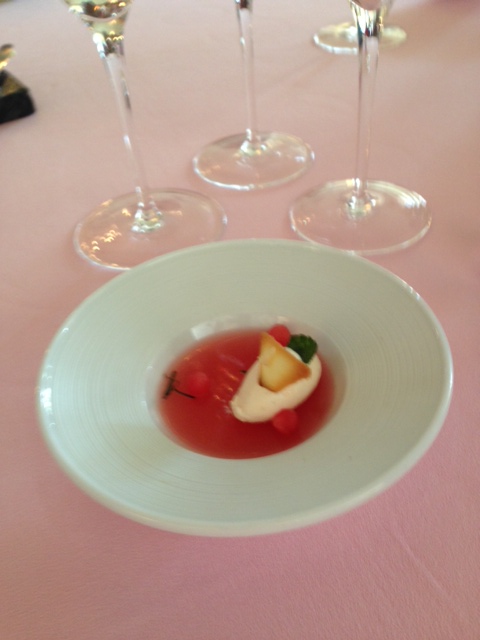
As is the custom of restaurants of this standing, the Chef sends out an amuse-bouche (“palate-teaser”) to welcome his guests and enhance the excitement for the meal to come. Jean-Denis Rieubland, the chef of the Chantecler, exerts his originality with a Mise-en-Bouche of Blanc-manger (“Blancmange”) of smoked salmon in watermelon aspic laced with balsamic vinegar. While a “blancmange” is typically a sweet dish, this one is a very light, almost ethereal savory dish that truly serves to arouse our interest in the meal.

photo 12
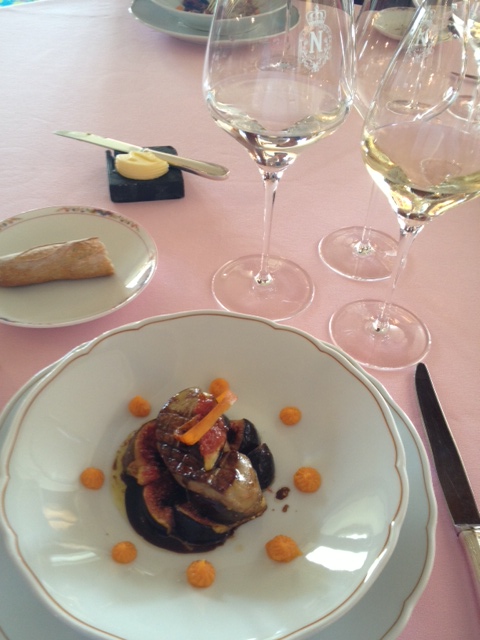
Pan fried duck foie gras with figs, sweet potato mousseline and balsamic sauce come next. While this dish may sound a bit rich and heavy for summer fare by the beach, it was surprisingly light. Of course, Chef Rieubland sets the portions at their ideal size so as to satisfy rather than satiate. The sweet figs enhanced by the touch of balsamic vinegar marries perfectly with the salty foie gras to produce a mouthful of exquisite satisfaction that is further enhanced by the light airy texture of the mousseline.

photo 14

photo 15

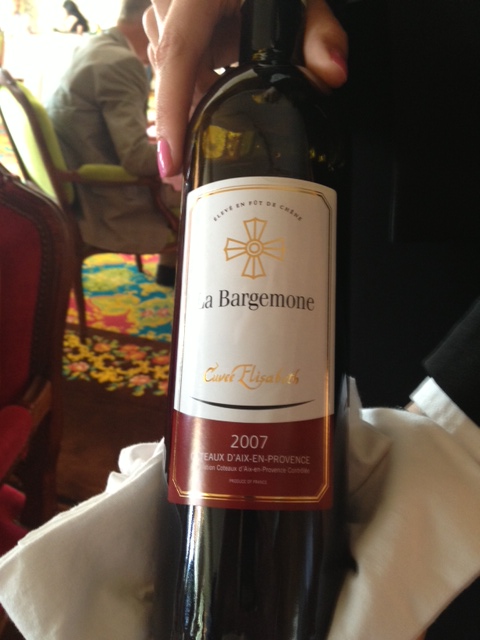
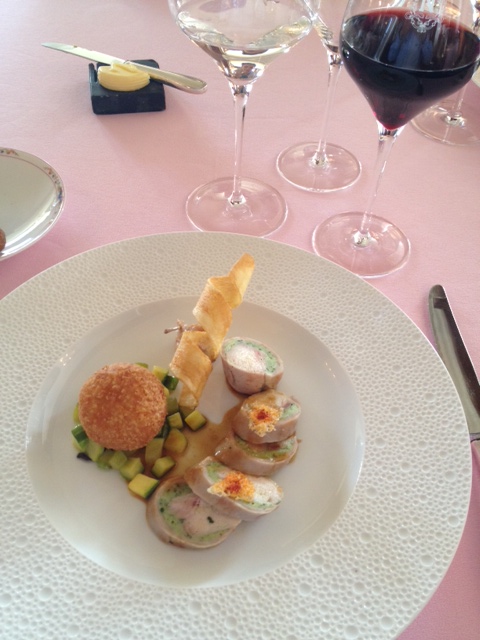
Prior to the main course of roasted rabbit with fresh herbs, rice and parmesan cromesquis, and local zucchini with black olives, our sommelier comes to offer us a Coteux d’Aix-en-Provence red wine, the 2007 La Bargemone. The Bargemone vineyard was founded by The Templar Knights in the 13th century. Full-bodied with light spice and loaded with rich, intense cherry fruit, this wine complements perfectly our Provence-inspired food with its divine mixture of French and Italian inspirations. Plus the blend of flavors and textures in this course, with the additional crunch of a playful home-made potato chip ribbon, leaves our taste buds and our stomachs completely satisfied.

photo 16

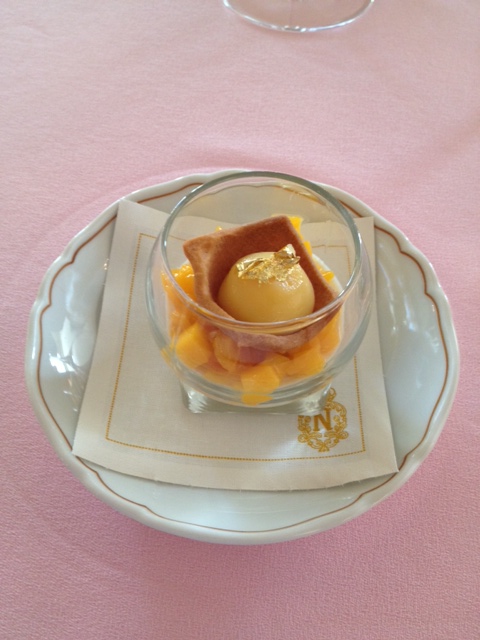
An unexpected treat arrives next – a “pre-dessert” of panna cotta with fresh mango. Light and refreshing, this little entremets kindles our desire for the sweetness of dessert.

phot 17

phot 4
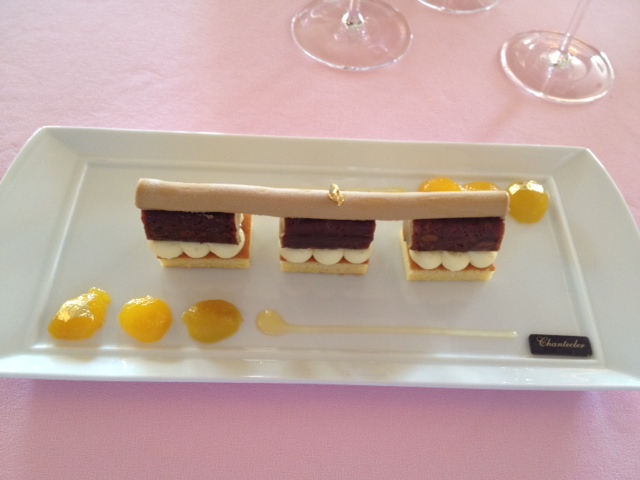
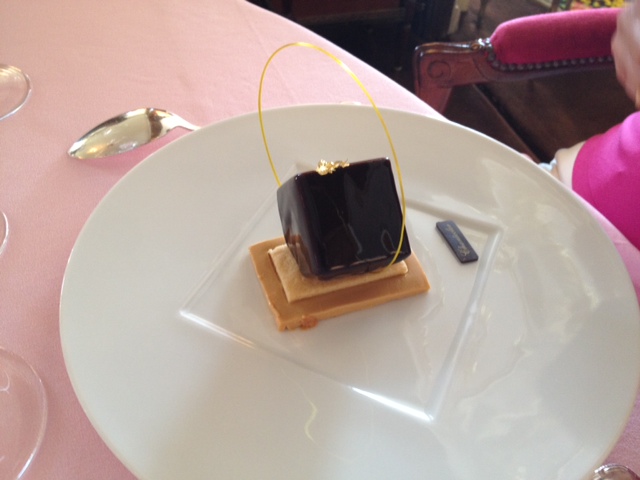
We shared two desserts, each of which reminds me of a piece of modern art — constructed forms of shape, color and flavor that arranged together provide an ultimate form of pleasure. The first original creation is a “harmony of mirabelle (yellow plum) and licorice, vanilla cream and Genova cake”, and the second is a “Bretagne shortbread and Manjari chocolate cube with crème brulée and caramel”. To describe them as “original” would be an understatement. Clearly the pastry chef is an artist in his own right whose creations are edible works of art.

photo 21

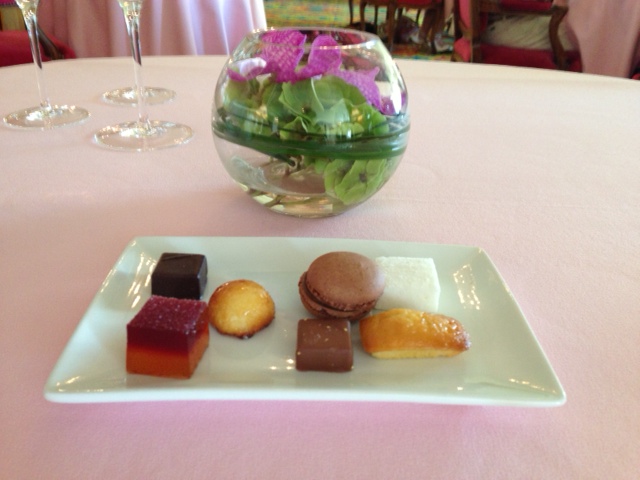
Our meal concludes with the pastry chef’s mignardises and coffees.

Long after our feast is over, the memory and the pleasures linger on.

Art & Gastronomy … The finale of Renoir’s life and the debut of Escoffier’s

SAM_0805

Musee Renoir and his home for the last 12 years of his life in Cagnes sur Mer

Both Renoir and Escoffier practiced their art from an early age throughout the sunset of their years. Both worked passionately at their craft with an intense joie de vivre, were innovators in their professions, gained recognition at a relatively young age and fame before their death, and both had intimate connections to the region of Nice.

Born in Limoges to a working-class family, Renoir received his early training as a painter while drawing and painting on fine china in a porcelain factory, and critical acclaim at the age of 33 when 6 of his paintings were hung in the first Impressionist exhibition in 1874. Sadly, he developed the crippling illness of rheumatoid arthritis in his early 50’s, and finally in 1907, he moved to the warmer climate of the Cote d’Azure which was most suitable for his illness.

SAM_0813

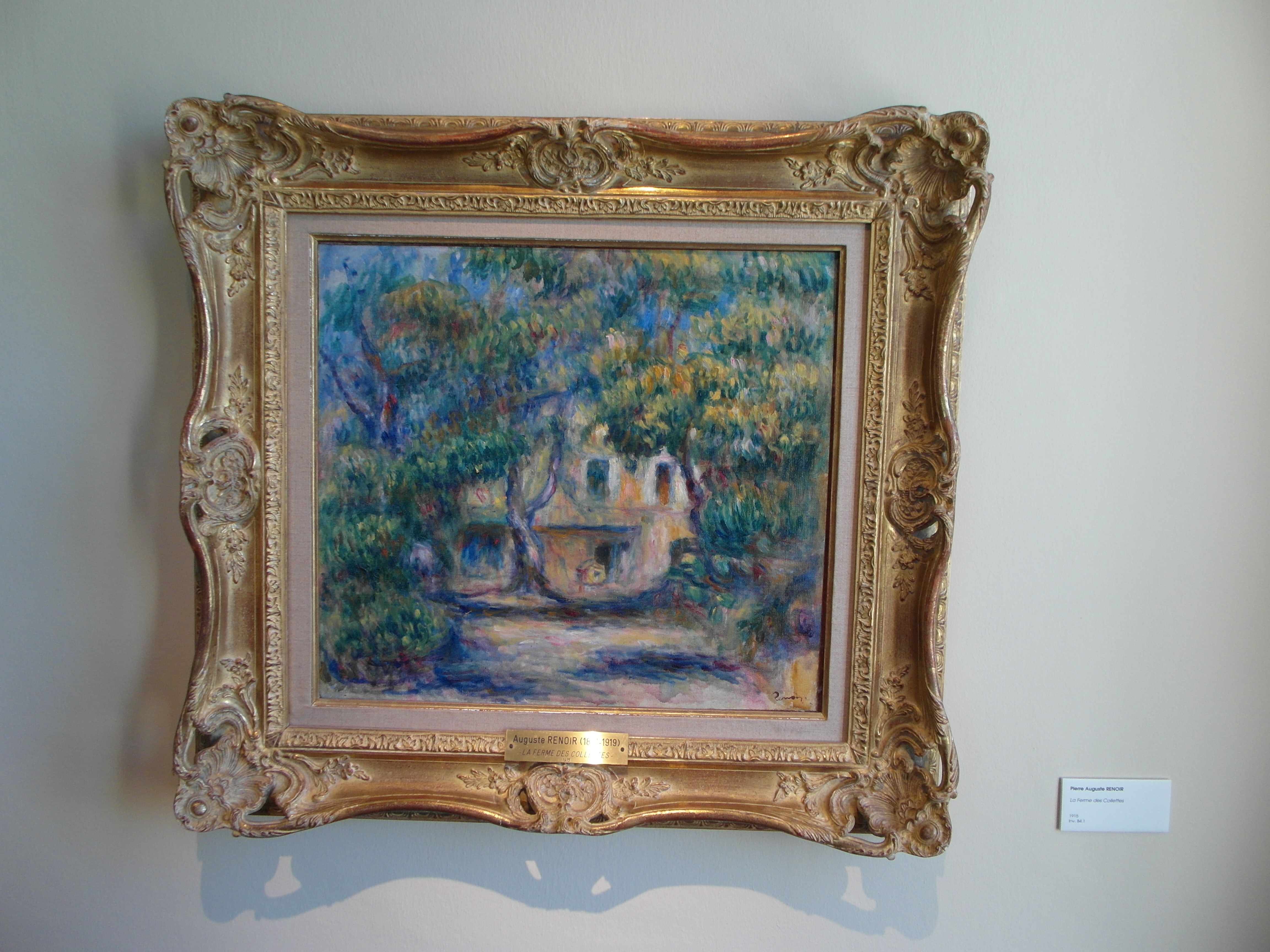
Renoir’s painting of his beloved Les Collettes

He purchased Les Collettes. a farm on the edge of the charming village of Cagnes-sur-Mer with an utterly magnificent view of the Mediterranean and the glorious sunshine made famous by his colleagues such as Van Gogh, Cezanne, Matisse, and Chagall. It has been said Les Collettes was to Renoir what Giverny was to Monet.

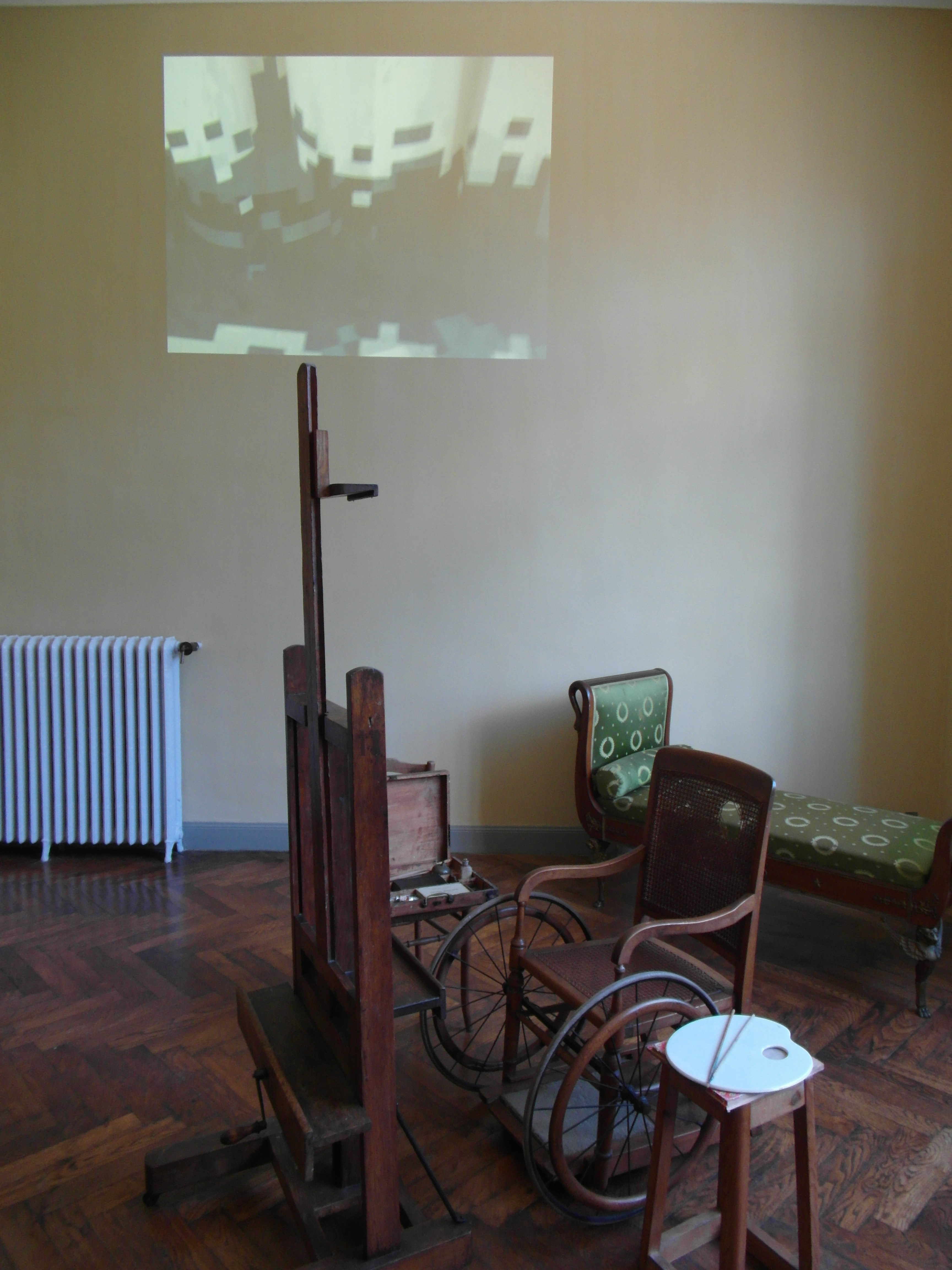
For the next 12 years, despite crippling, unbearable pain from his arthritis which relegated him to a wheelchair and necessitated his painting with a brush tied to his hand at the end of his life, Renoir practiced his art with vigor and innovation, adapting his style of painting to his failing eyesight as well as to his failing mobility. This period of Renoir’s work is characterized by looser, more fluid brushwork to dissolve outlines and detail, and hence more impressionistic and at times slightly abstract work.

SAM_0812

Renoir’s atelier with his wheelchair

Seeing the custom made wheelchair and the apparatus constructed to enable Renoir to move up and down in order to work on large canvases was very revealing. So was his continued focus on painting voluptuous women. Although Renoir mourned the death of his beloved wife, Aline Victorine Charigot, who had served as a model for his renowned Le Dejeuner des Canotiers (“Luncheon of the Boating Party”), he never lost his love of the female body. His lifelong devotion to his work rewarded him with the honor of seeing his paintings hanging alongside those of the old masters in the Louvres in 1919. He passed away shortly thereafter.

SAM_0811

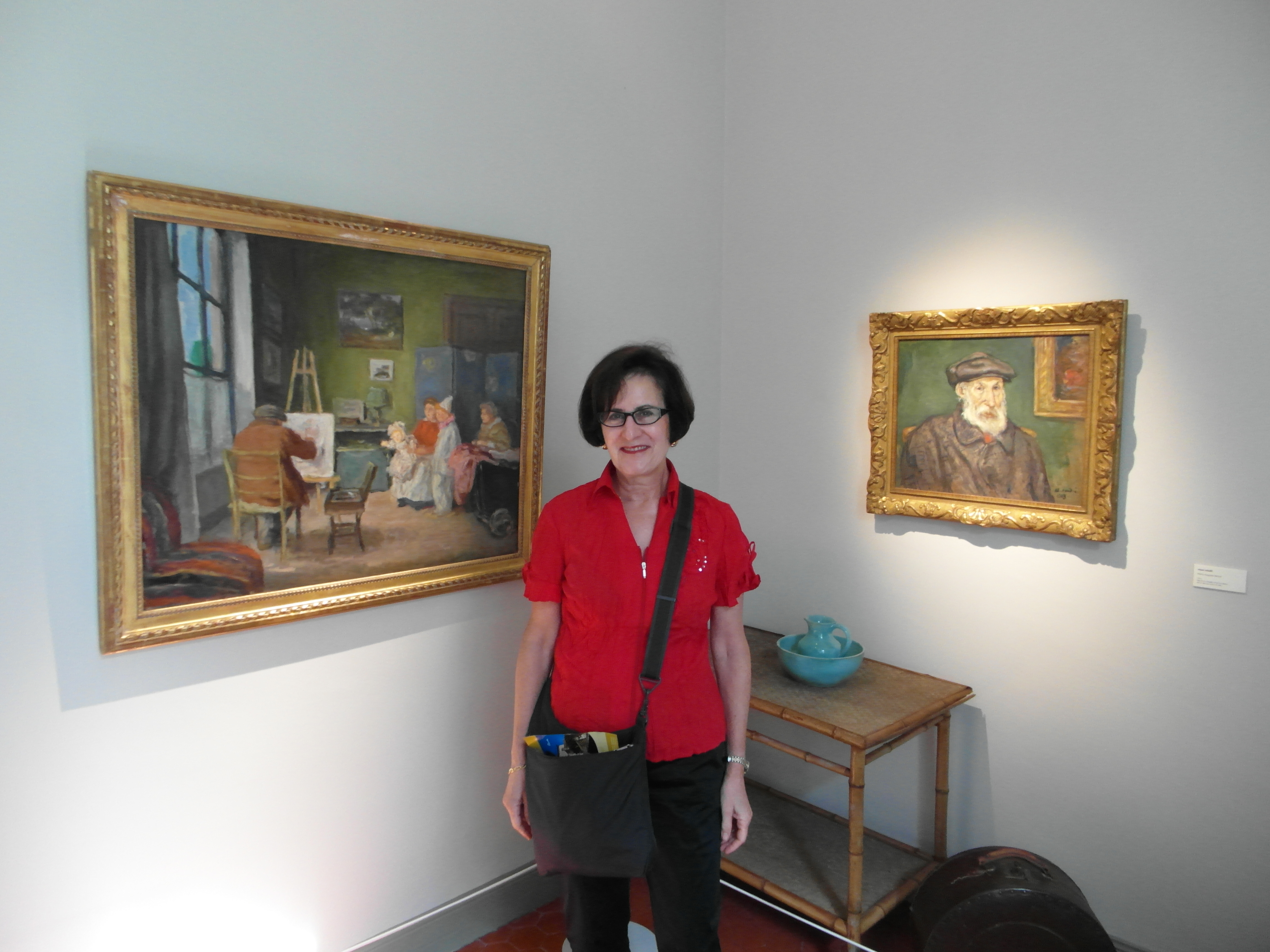
Some of my favorite paintings of Renoir at Les Collettes

Les Collettes has been transformed into the Musée Renoir. While unfortunately it houses few of Renoir’s most famous works, it provides the backdrop for understanding the personality behind the man who produced several thousand works of art over this lifetime and whose work is beloved world-wide.

SAM_0835

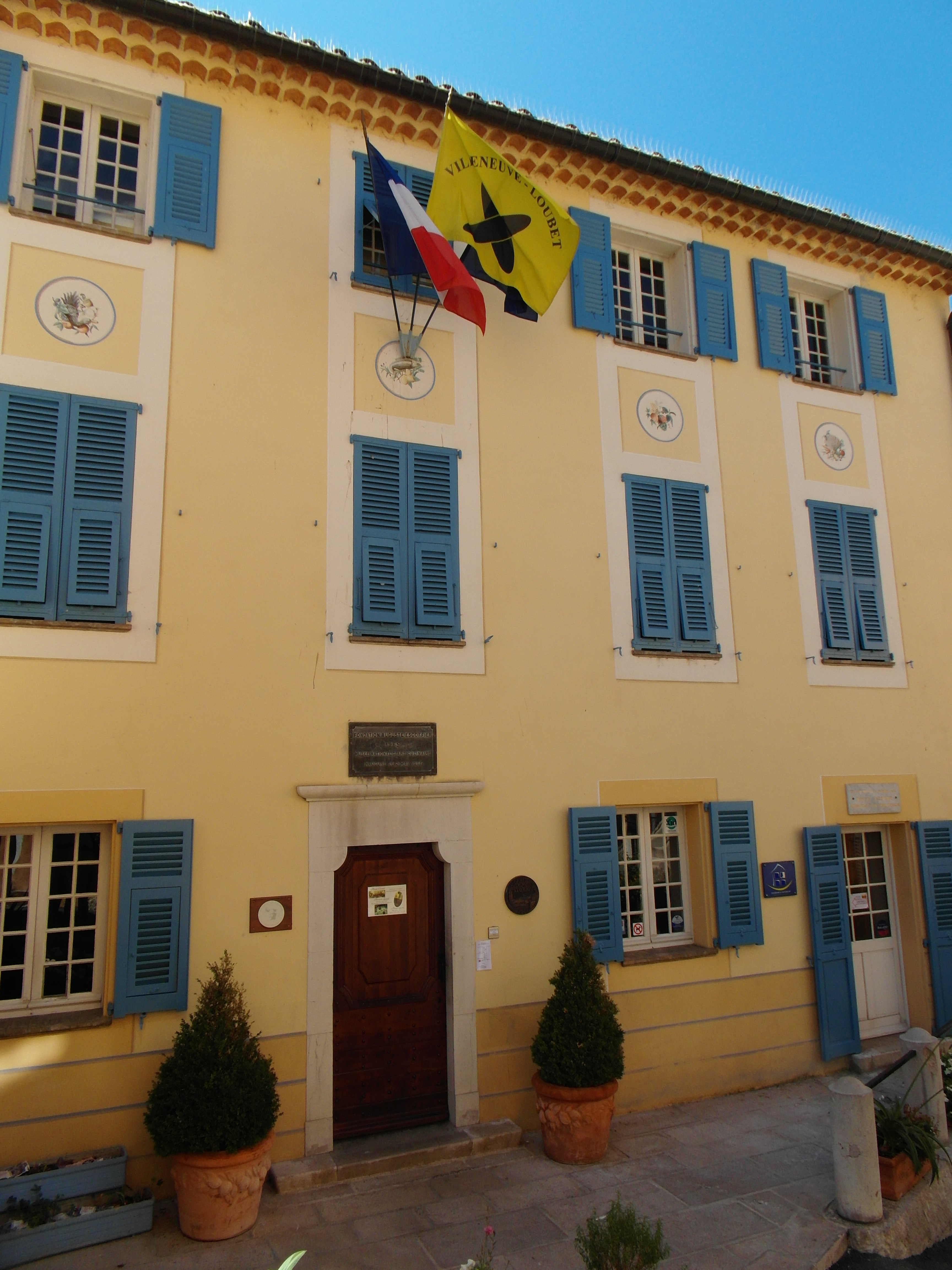
Musee National de l’Art Culinaire Auguste Escoffier in Villeneuve-Loubet

From the home of one grand master, we moved onto the village of Villeneuve-Loubet to visit the childhood home of another, Auguste Escoffier, a prolific culinary author and the founder of French haute cuisine who helped put the classic techniques and recipes of French cuisine on the world map. Escoffier’s childhood home has been transformed into the Musée Escoffier which we decided to visit after having lunch.

SAM_0840

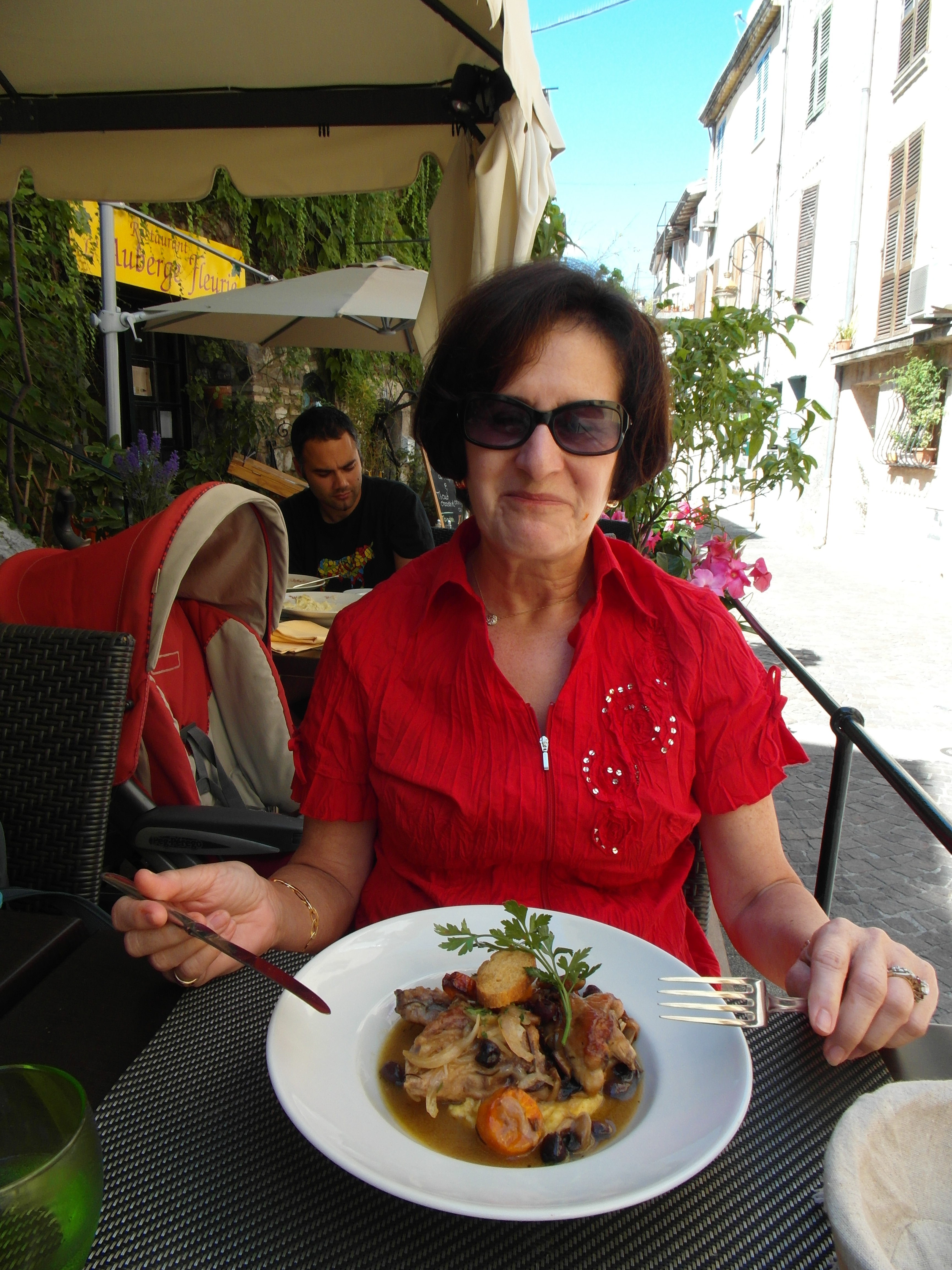
Me enjoying the Fricassee de Lapin

Just down the street was a charming restaurant, L’Auberge Fleurie, which attracted our attention with its menu du jour. We sat outside on the terasse and ordered a Salade du Marché as an entrée prior to the “menu” which offered a Fricassée de Lapin (“rabbit stew”) and a Chocolat Fondant (cake) à l’Orange. We expected simple food in this old town which seemed to still be in the 20th century, and were frankly delighted well beyond our expectations with the taste, quality and presentation of the food. We were still savoring the meal long after it was over, so we weren’t too surprised to learn at ­­the museum later that the chef of this petit restaurant had been trained at the Ritz-Escoffier School of French Gastronomy. How à propos !

SAM_0852

Escoffier trained and inspired many world famous chefs

Auguste Escoffier, considered to be the first celebrity chef of the 20th century, elevated the work of a “cook” to that of a “profession” by introducing organized discipline and specific techniques to modern kitchen management. Born in 1846, Escoffier spent the first 18 years of his life in this charmingly refurbished home decorated in old Provençal style which the Fondation Escoffier now manages as the Musée National de l’Art Culinaire Auguste Escoffier. It was here in this home that his love for cooking developed as he watched his grandmother cook over the fire in the family fireplace.

SAM_0845

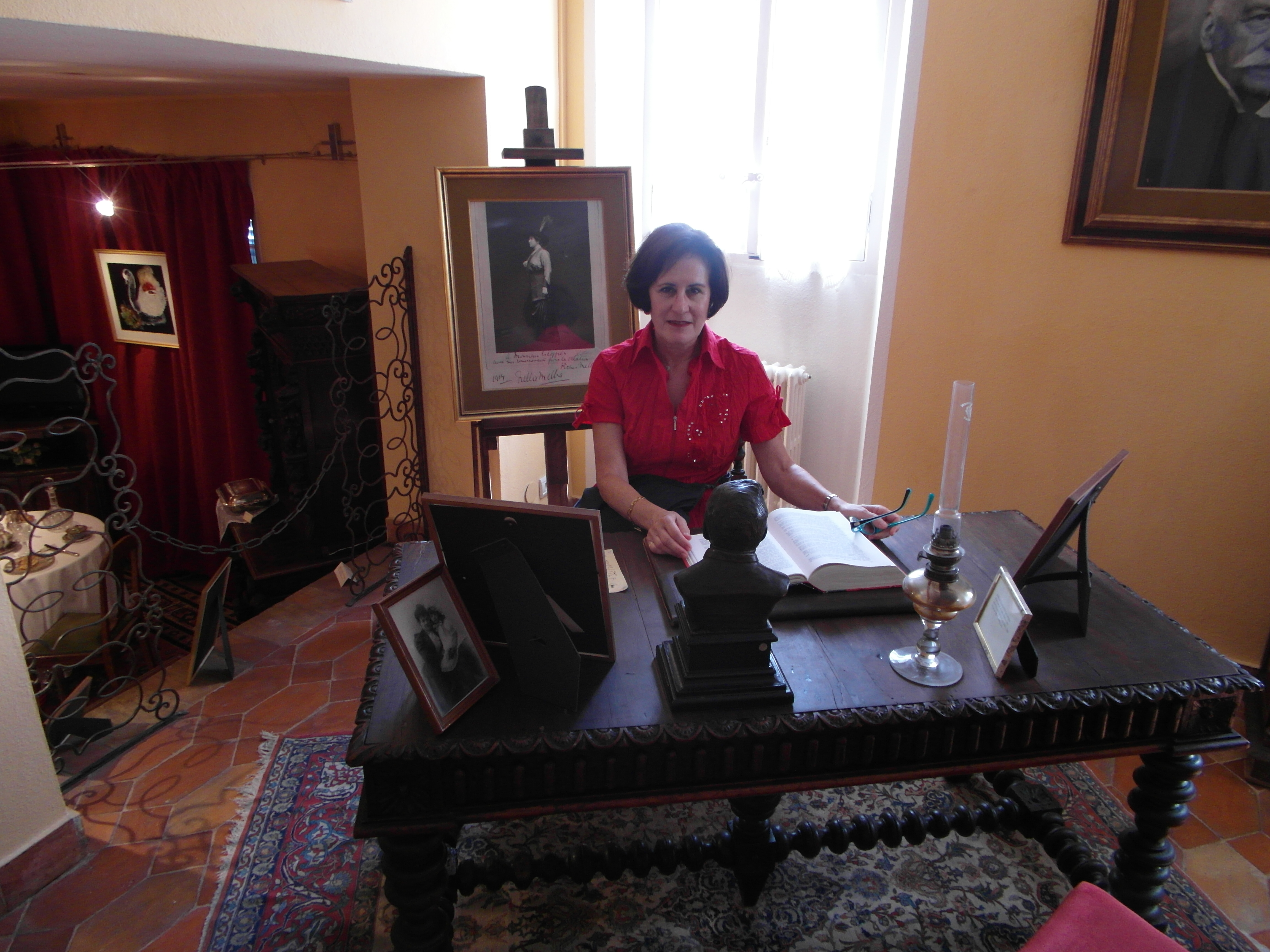
Seated at the desk of the King of Chefs and the Chef of Kings

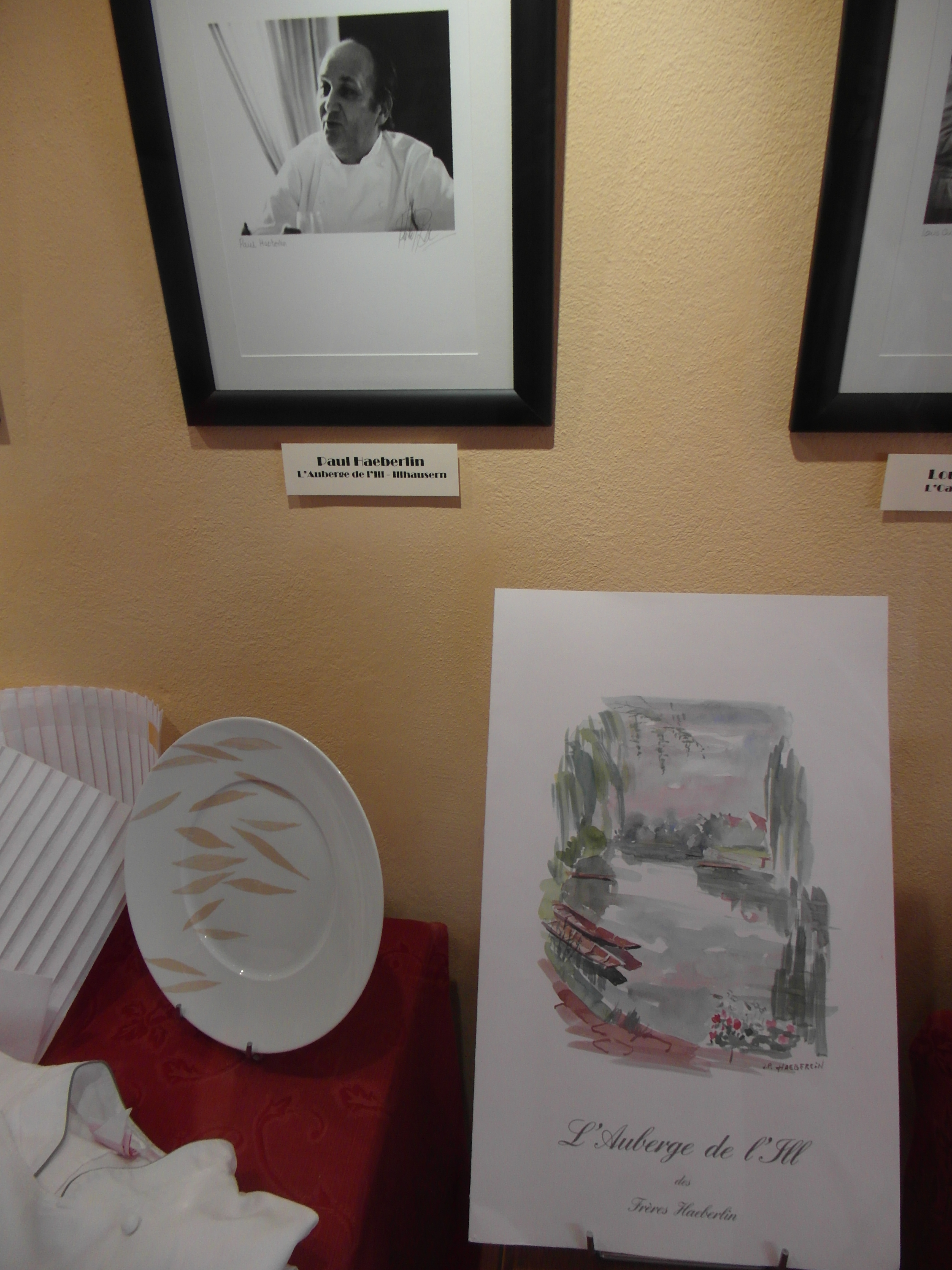
The museum collection includes many handwritten recipes and letters by Escoffier, photos of him at the Savoy where he invented Peche Melba, at the Ritz in Paris, and at the Carlton in London. It houses many of Escoffier’s cooking implements, including many designed by him, as well as Escoffier’s desk and chair, menus written by him or inspired by him, menus from great chefs he taught and inspired, a room full of chocolate statues created by great chefs trained by him, and many other heirlooms of the history of French cuisine, including how Escoffier elevated it into an art and a science. A pilgrimage there is just as satisfying for a true lover of French cuisine, if not more so, as a pilgrimage to the exhibit on Julia Child at the Smithsonian’s Museum of American History.

Eze ~ Gastronomy on the Top of a Cliff!

SAM_0758

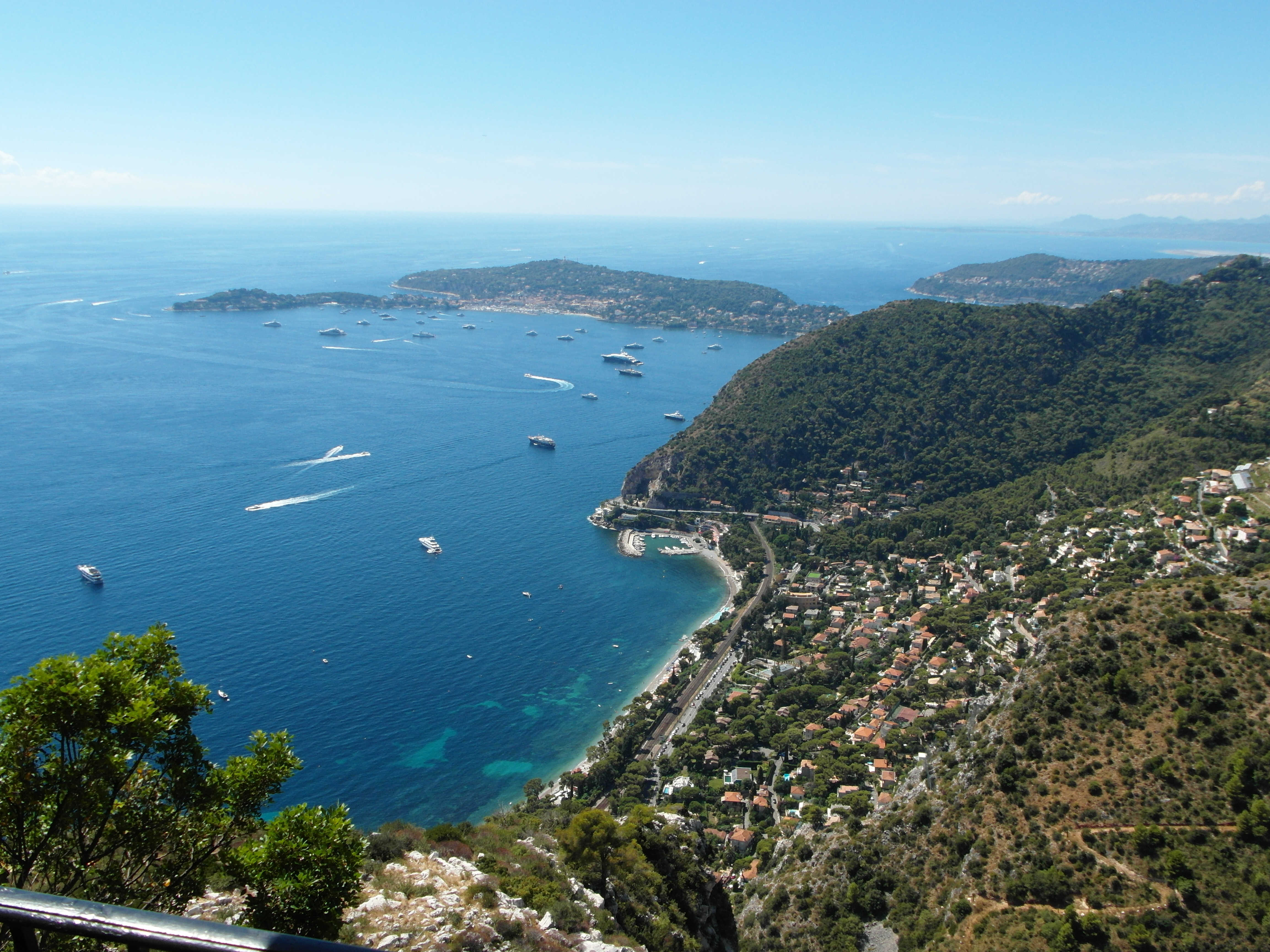
View of Beaulieu-sur-Mer, the bay of Villefranche-sur-Mer and Cap Ferrat

Eze, one of the most spectacular of France’s imposing “Villages Perchés” has a principal attraction other than its breath-taking 360 degree views … the Michelin- starred restaurant, Chateau Eza, named for the charming hotel in which it resides. Naturally, this restaurant’s reputation for excellent cuisine combined with the views was irresistible. So on our third full day we found ourselves on the bus … mesmerized by the views … as we winded our way up to the base of Eze. The rest of the climb up the steep, narrow streets to the top of this Medieval village was by foot, but so absorbed were we in enjoying the views that we hardly minded the steep climb.

So what is “gastronomy”? I like to think of it as the art and science of cuisine, preparing food with the best quality ingredients – regional produce is often the preference — using time-honored techniques, tasting as you go (a chef must have refined taste buds), and producing with significant expertise a nutritious work of art, as beautiful to look at as it is to taste and savor.

photo 3

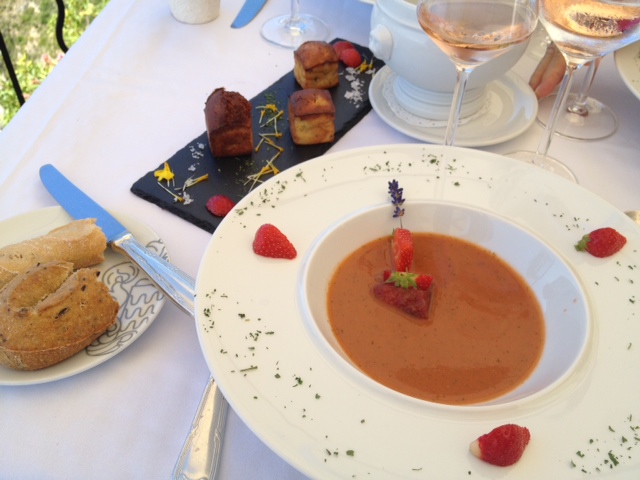
Watermelon & Strawberry Gazpacho with a touch of Coriander

Along with their à la carte menu, the Chateau Eza offers two different menus du jour. We selected the more extensive one which they very aptly call the “Menu du Prince”. Voilà the menu which we enjoyed with a very satisfying Côtes de Provence Rosé …

Amuse-Bouche of Salsify cooked in Truffled Veal Jus with Spinach
Watermelon & Strawberry Gazpacho with a touch of Coriander
accompanied by a lightly peppered Artichoke Muffin
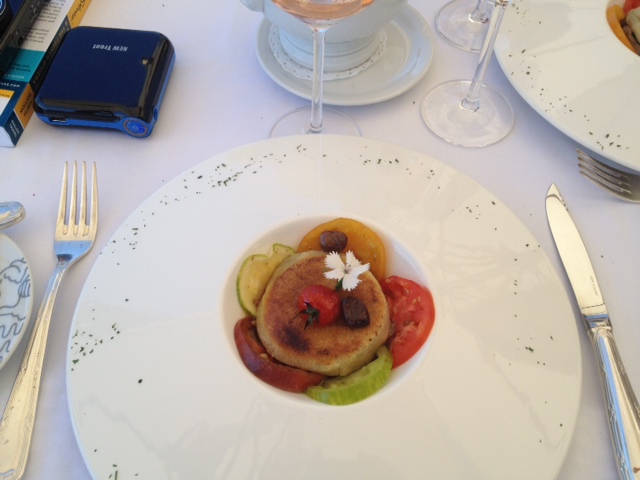
Small casserole of White Beans from Paimpol, local Heirloom Tomatoes & Herbs, flavored with Bacon Confit
Filet of local Veal under Crust with Nicoise Olives & Tomatoes
Mille-feuilles with crusty Pastry & Lemon Custard, Lavender Ice Cream
Garnish of Raspberries & Raspberry Coulis
Sweet Indulgences of the Chef

photo(1)

Filet of local Veal under Crust with Nicoise Olives & Tomatoes

A truly memorable meal which enchanted our taste buds, was highlighted with extraordinary views of the Mediterranean sea, Beaulieu-sur-Mer, Cap d’Antibes, Cap Ferrat and Nice … in a magical hilltop setting perched at the edge of the cliff.

Villefranche-sur-Mer ~ Bouillabaisse anyone ?

Why would you go to France … for the culture? the beauty? the outdoor activities? the entertainment? the shopping? the food? Yes, all of the above. As for us, while we strive to plan our touring around the cultural sights, somehow our taste buds take priority these days and they steer our course. So not too surprisingly, our first destination once we settled into our home base of Nice was a trip specifically planned to partake of the bouillabaisse at La Mere Germaine. This elegant restaurant, situated on the water’s edge in Villefranche-sur-Mer which is located just east of Nice, is reputed to be one of the top restaurants on the Cote d’Azur for bouillabaisse and it did not disappoint. The chef prepared special side salads (not on the menu) for us as entrées, which were followed by the main event … the bouillabaisse. The broth was divine, the Mediterranean fish fresh, tender and perfectly prepared, and the rouille, a garlicky red pepper sauce which you spread on garlic-rubbed croûtes or simply stir into your bouillabaisse broth, was the perfect complement. For dessert we shared an exquisite chocolate soufflé made to order by the restaurant’s in-house patissier. Accompanied by a well-chilled bottle of Provencal rosé, the meal was enhanced by top-notch service from our waiter, French music in the background, and a commanding seaside view over both the water full of impressive yachts and the steep hillside dotted with elegant homes.

Settlements in Villefranche date back to prehistoric times, but the village is particularly known for its medieval streets. So after lunch, we took a challenging walk up and down the city streets and stopped to look at Rue Obscure (Dark Street), a passage way under the harbor front houses that dates back to 1260. Did we walk off the multitude of calories that we ingested at lunch? Doubtful, but fueled by the bouillabaisse, we had a fascinating time trying.

Insalata di Nizza or Salade Nicoise?

renoir2_wide-1369cf772993e75ef515e18ae2419e71deab5a16-s6-c30

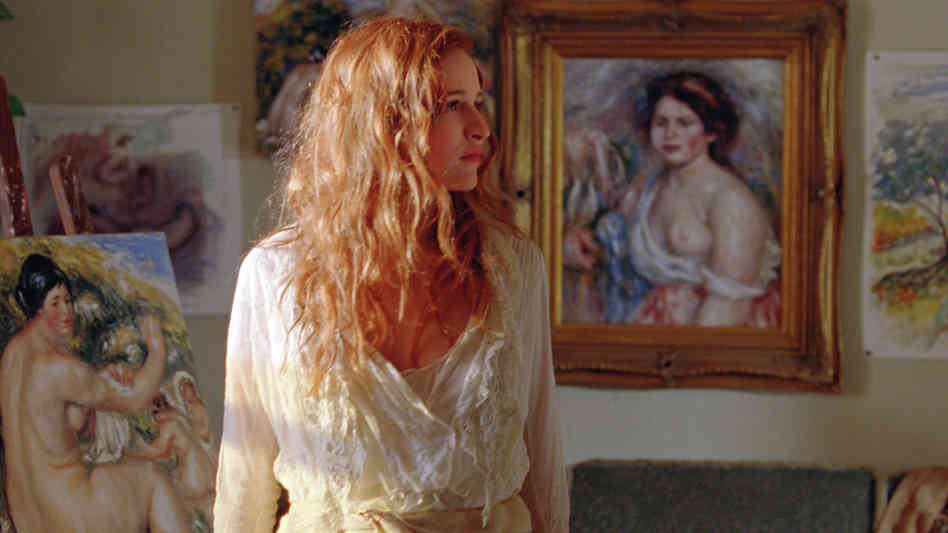
Christa Theret as Andree Heuschling in the movie Renoir

I should be ready soon to make a list of our touring priorities and determine what will need to be cut. Meanwhile, I keep finding tidbits of interesting information of relevance to our trip. Here are a few examples of the things I take note of:

1. Nancy a le torticollis (Nancy has a stiff neck): I have been looking forward to having a bouillabaisse at La Mere Germaine on the port of Villefranche sur Mer. In looking up the story of La Mere Germaine, I was and am intrigued by her connection with the officers and sailors of the US Sixth Fleet, who were regular visitors and who put up a plaque in her honor outside the restaurant. A book has been written about her as the “mother of the sixth fleet”! Why would the sixth fleet, which is based in Napoli, visit Villefranche sur Mer? Well, it turns out that the bay of Villefranche is a very deep water bay which can accommodate large ships such as the warships of the US Navy; this also explains why nowadays large cruise ships tend to throw anchor in the bay of Villefranche as one of their stops on the Mediterranean. But there is more.
Did you know that a couple of months after D-Day, on August 15th 1944, there was another Allied Forces landing, this time on the beaches of the French Riviera? I wonder, how did the beautiful topless bathers on the beaches of the Riviera react to the sight of an army of soldiers coming out of the water? It was August after all. I felt the need to find out more.

The operation had been named Operation Dragoon by Churchill, who was opposed to it, saying that he had been “dragooned”, forced into it. Churchill had wanted a landing further east in Italy in order to head straight north and get to Berlin before the Soviets did. However, a weak Eisenhower was unable to resist the fit thrown by General de Gaulle, who threatened to pull out the French Forces (made out largely of Pieds-Noirs from North Africa) if the landing did not occur in France so as to head north and liberate France first. I just can’t imagine how the idea of a small number of North African French forces could prove so threatening to Eisenhower, until I realize that the decision might have had more to do with the attraction of the beautiful topless beaches of the Riviera than to global military considerations. Naturally, General de Gaulle would not think of going anywhere else on a nice warm summer day; the mere thought of landing as a conqueror on a beach full of gorgeous women has got to be irresistible to generals and sailors alike. Think about it; the end of the war and the whole cold war period might have been totally different if Eisenhower had listened to Churchill and landed in say Serbia.

On August 14th 1944, the BBC broadcast the code signal “Nancy a le torticollis” (Nancy has a stiff neck) to tell the resistance forces of the impending invasion the next day. The invasion force, largely American forces but with some British and about 10% made up of French troops, took about two weeks to gain full control of the French Riviera. Nice, which as you may recall had been handed over to Italy by the Germans, fell on August 28th 1944. That is why we now say “salade nicoise” and not “insalata di nizza”!

2. Andree Heuschling: Did you have a chance to see the movie “Renoir“, which was released in the USA last March? It relates to the last few years of Pierre-Auguste Renoir‘s life at his farm “Les Collettes” in Cagnes sur Mer. The farm has since become the Musee Renoir and has recently reopened after a two-year renovation period. Central to the movie is the story of Andree Heuschling, usually called DeeDee, who became a model for Renoir in 1915 at the age of fifteen. Her beauty and charm motivated Renoir to keep painting, which he did until his death in 1919. DeeDee later married Renoir’s son, Jean Renoir, who apparently was quite indecisive but became a filmmaker at her urging. He starred DeeDee in fifteen movies, mostly silent movies, under the screenname Catherine Hessling. I look forward to visiting the Musee Renoir in a couple of weeks and admiring the (nude?) paintings of Andree Heuschling by Pierre Auguste Renoir. :)

3. Auto Bleue: Yesterday, I wrote my blog about French public transport on the French Riviera. Since then, I have discovered that it gets even better than I thought. Since 2011, they have a system of electric car sharing rental in operation, called Auto Bleue, with more than 50 stations in and around Nice. There is a station just a couple of hundred feet from our rental apartment. Similar to the bike rental services one sees in all large cities nowadays, one just reserves a car by internet or by phone and simply picks it up at one of the stations and returns it to the station when finished. The rates are quite reasonable and all inclusive. The cars are Peugeot 4-seater electric cars with a 100km range, so good enough for anywhere we want to go on the French Riviera (Cannes for example, which is our furthest point west, is only about 30 km west of Nice). I hope I get a chance to try this out, and if it works out, that could be our way to get to the Musee Escoffier and the Musee Renoir, or we could simply try it out on the Grande Corniche on the way to Monaco (after I check the brakes; I don’t want to have the same fate as Princess Grace).

4. SNCF by phone: did you know that the French railway company, SNCF, operates an English language phone service whereby you can get information as well as reserve and pay for your train ride by phone? It is available from 7am to 10pm every day.

5. Brigitte Bardot: Did you know that Brigitte Bardot, who lives in St-Tropez as you may already be aware of, has been taken to court and fined five times for writing that the Muslims are invading France and ruining the French way of life?

6. Le Festin des Baguettes (The Feast of the Baguettes): While checking on events happening during our stay on the Riviera, I came across the Festins des Baguettes in Peille, held on the first sunday of September. The article mentioned a Bal des Baguettes and women hitting their chosen men with baguettes. I was wondering if I had found the origin of the omnipresent French baguette bread, although I was puzzled by the idea of a beautiful woman hitting me with a baguette. It actually sounds like a lot of fun, doesn’t it? Well, in reality, we are talking here about a different type of baguette. Baguette in the French language can also mean a wand. Ever since the fourteenth century, when a young shepherd used a wand to find water for a very dry town, Peille, a town in the hills not far from Nice, has been celebrating the Festin des Baguettes (Feast of the Baguettes) every year on the first sunday in september. Oh well, strike that one out!
La Cuisine Nissarde: Best of Provence and Italy

cuisine-nissardeWhen one thinks of Nice, one immediately thinks of Salade Nicoise, that refreshing summer day salad which seems to always include tuna, anchovies, hard boiled eggs, olives, corn, boiled potatoes and green beans. As I prepare for our trip, I am discovering, much to my delight, that there is a lot more to the cuisine of Nice than salade nicoise. But before I get into the details of my findings, I do need to mention that the salade nicoise, as we know it, may not be the real salade nicoise after all.

Le Cercle de la Capelina d’Or is a committee of people from Nice set up to defend the honor of the real authentic salade nicoise. Approved ingredients include tomatoes, hard boiled eggs, salted anchovies, tuna, onions, basel and olives from Nice, with garlic, salt and olive oil. In season, beans, artichokes, hearts of celery and/or green pepper may be added. But it is blasphemy to include potatoes and green beans, and even more heretical to add corn to the mix. It was apparently the renowned chef Auguste Escoffier, the pope of French cooking, who committed the sin of adding potatoes and green beans to the recipe for salade nicoise. The committee is quick to point out that Escoffier, whom we all thought came from Nice, is actually not a local, since his neighborhood of Villeneuve-Loubet is separated from the center of Nice by a small river!

I was quite unaware that the region of Nice has its own cuisine, called cuisine nissarde. I was even more ignorant of the fact that the people of Nice had their own language (which explains why they say nissarde instead of nicoise), still spoken and written a bit around town. This all comes from the fact that Nice, up until 1860, was part of Italy not France. The whole French Riviera, starting past Antibes eastward was until then part of the Italian Riviera. During the seventeenth, eighteenth and nineteenth centuries, the ownership of Nice shifted back and forth between French and Italian lords, kings or emperors. In 1860, the Italians gave the region of Nice to France as a reward for France’s support of the second war of Italian independence against the Austrian empire; this was supported by a referendum held among the local population. Giuseppe Garibaldi, one of the founders of modern Italy, was opposed to the cession and claimed that the referendum had been rigged by the French. Italian nationalists ever since have laid claims to the region. And that is why, during the second world war, Nice was briefly given back to Italy by the Germans and was run by Italy during 1942 and 1943. I did not know that; no wonder the people of Nice would want their own language!

Not surprisingly, given that the ownership of Nice went back and forth between Provence and Italy, the impact of all this history is that the cuisine of the region is a blend of the cuisine of Provence and the cuisine of Italy. Since those two cuisines happen to be individually among my favorite foods in the world, I am in seventh heaven and eager to discover the many unique dishes of the region. Here are some of the most famous ones: Salade Nicoise, Ratatouille Nicoise, Daube Nicoise, Raviolis Nicoise, Gnocchi Nicoise, Farcis Nicoise, Ganses Nicoise, Sardines Farcies a la Nicoise, Pan Bagnat, Poche de Veau Farcie, Tian de Courgettes, Pissaladiere, Tarte de Blette, Beignets aux Pommes, Socca, Stockfish. So much to learn and to enjoy! And I can drown all that great food with the local wine, called Bellet wine, grown in the hills behind the city for centuries.

The cuisine seems to be based in large part on fresh vegetables, seafood and pasta. I can’t think of a better combination. I am overjoyed at the possibility of being able to buy freshly made pasta when I go out to get the morning baguette, croissants and pains aux chocolat. Actually I expect we will be eating our main meals out most if not all of the time. Fortunately, many restaurants in the region claim to respect the tradition of the cuisine nissarde and I have time to go through the list to pick my favorites. I was looking at some of the menus and they are indeed appetizing.

So I have a lot of work yet in store to prepare for the trip. Checking out the recipes of the cuisine nissarde dishes, checking out the restaurants and their menus, learning about the Bellet wine and its vineyards. Spaghetti aux fruits de mer, here I come!

Lunch at the Hotel Cap Eden Roc in Antibes

restaurant-eden-roc-terrasseI have asked for a lunch reservation at the Hotel du Cap Eden Roc in Antibes. Yes, the beautiful restaurant terrace overlooking the Mediterranean where a simple starter salad like a Salade Nicoise will cost you US$80. Visiting this hotel for its phenomenal position on the Cote d’Azur and its gastronomic excellence might be reasons enough for the well heeled, and they have indeed done so. But why would we go there for lunch?

Well, for one thing, staying there is nowadays quite costly, with the cheapest room going for about US$1,000 per night. But we do need to go there because of the historical significance of this hotel and its importance in the world of art and literature.

Started as a writer’s retreat in 1870, Villa Soleil was transformed into Hotel Cap Eden Roc by Antoine Sella at the turn of the twentieth century. Initially open only during the winter months, which was when the English and Russian aristocracies used to visit the French Riviera until the first world war, the hotel started to open some rooms for the summer when Gerald and Sara Murphy wanted to visit Cole Porter who was renting a villa nearby and convinced Antoine Sella to keep a small staff and a floor open. Gerald Murphy had been a schoolmate of Cole Porter at Yale and is even said to bear some responsibility for encouraging Cole Porter to write and sing songs.

By the time they descended on the Cote d’Azur, the Murphys had become close friends of Pablo Picasso in Paris. Gerald loved Picasso’s art, and Picasso loved Gerald’s wife, Sara, who is said to have become his muse. The Murphys invited Picasso down to Antibes and he agreed, coming with his young beautiful Russian wife of the time. The Murphys were also friends of F Scott and Zelda Fitzgerald, and the Fitzgeralds also came down to the Riviera. F Scott Fitzgerald, who apparently liked to test the sexuality of his friends, had fixed up Gerald with a young South American man, Eduardo Velasquez, who had just been ejected from England for having had an affair with a male member of the royal family.

F Scott Fitzgerald wrote The Great Gatsby in Antibes, and also a couple of years later, he wrote Tender is the Night, which was published in 1930. Gerald and Sara Murphy are the models for Dick and Nicole Diver in that book.

George Bernard Shaw also returned for many years at the Hotel Cap Eden Roc. The Duke and Duchess of Windsor were married at the hotel after he abdicated the throne in England.

After the war, Picasso rented or bought the Grimaldi castle nearby in Antibes and came to eat frequently at the hotel. The Chateau Grimaldi is now the Picasso Museum in Antibes, and that is why our plan is to visit the museum in the morning and then have lunch on the terrace at the Hotel Cap Eden Roc.

Marc Chagall was also a frequent customer of the hotel.

Since that time, the hotel has received the most important guests in the world, from Eisenhower to Churchill, from Kennedy to Madonna, etc…

That is why I have made a lunch reservation at the Hotel Cap Eden Roc for Wednesday September 4th at 1pm.

Helsinki, Finland ~ Fillet of Reindeer at Kappelli

IMG_0041

St. Petersburg, Russia ~ Lunch at Stolle and its famous pirogi pies

SAM_0436

St. Petersburg, Russia ~ Dinner at Palkin Restaurant … since 1785

Palkin

Follow

Get every new post delivered to your Inbox.

Join 23,546 other followers

%d bloggers like this: